Pets have been crawling, slithering, and hopping through classrooms across the United States for years. But now, schools and researchers are discovering what kids already know: These animals are more than a cute member of the classroom. They are important for learning, too.
Several recent studies have found that spending time with pets helps kids develop social skills and how to handle challenging emotions.
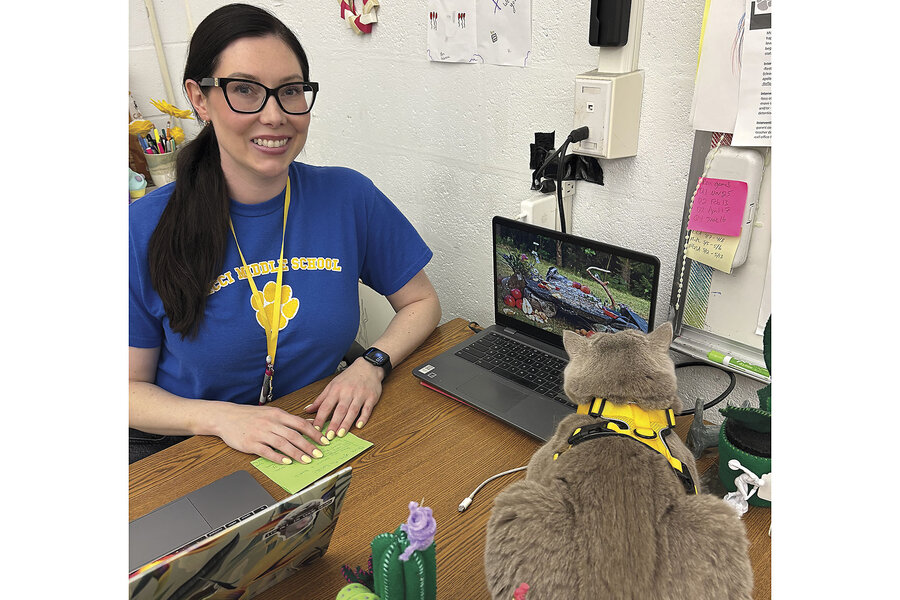
Kayleigh Smith, a middle school art teacher in North Providence, Rhode Island, brought her Scottish Straight cat, Pinecone, to class for the better part of the last school year. Pinecone has been able to achieve what many teachers find difficult to accomplish – getting a room full of middle schoolers to lower their voices.
Why We Wrote This
Spending time with pets can help youth refine their social skills and learn how to handle emotions, according to recent studies. Bringing in a class pet can benefit students – if the animal receives proper care.
“I feel like the class is overall just a lot calmer,” says Ms. Smith.
Pets also can help turn regular lesson plans into silly, educational moments. To make multiplication fun, for instance, Benjamin Shaw enlisted his classroom’s bearded dragon, Mushu.
“Mushu wants to eat five bugs, and there are three bowls, and each has five bugs. How many bugs in total?” Mr. Shaw asked his Dallas-Fort Worth third graders. Mushu has also been the center of habitat and animal anatomy lessons, showing off his scales.
“Our teachers and our families are looking for alternative, hands-on educational content and material where it’s not just to attach to another screen,” says Melinda Thomas, executive director of The Pet Care Trust, a group that helps support school animals.
The organization’s Pets in the Classroom program awarded more than 16,000 grants to teachers across the United States and Canada in the 2025-26 school year to help cover initial pet care expenses.
But as adorable and helpful as these scaly and furry friends are, it’s important to think about having a pet from the pet’s perspective, too.
While “you can easily say the kids would love it [pets], if you leave it at that, you’re really missing out on the bigger picture,” says Laura Ireland, the associate director of the Animal Law and Policy Institute at Vermont Law and Graduate School.
Caring properly for classroom pets requires teachers to ask themselves a lot of questions. Do they have the right habitat? Does the pet want to be held by 20 students in a day? Who is caring for the animal during school breaks or taking them to the vet?
Ms. Ireland also worries about where class pets originate. Some pet stores get animals from disreputable breeders, including enterprises called “mills” that prioritize churning out animals for profit and ignore animal well-being. If the pets come from a source that isn’t good for the animals, what lesson does that teach students?
“Thinking through all those issues … there is a way to do it correctly, but there’s so many ways for it go wrong,” Ms. Ireland says about classroom pets. She recommends to “try to look at things from the animal’s perspective … and then trying to put a voice to that.”
This often means that teachers take on a lot of the pet care responsibilities. So, next time you see a teacher cleaning out a hamster cage, remember to say thank you.
Morgan Keohane, an elementary school librarian and technology specialist in Boston, says her students love hanging out with her two guinea pigs – and that she’s happy to care for the animals during the summer.
“If you are an animal lover and are willing to take on [the responsibilities], students will reap some incredible benefits,” Ms. Keohane says.
Here are a few pets in classrooms around the United States:
Pinecone, cat
Teacher Kayleigh Smith started bringing her cat, Pinecone, into class regularly in January. She works at the Dr. Edward A. Ricci Middle School in North Providence, Rhode Island, and at first had brought Pinecone into school only once in a while as a treat for her class. But when she saw how the kitty calmed her students, she realized he should be a regular.
Fun fact: If a cat approaches you with its tail shaped like a question mark, it’s often a sign he’s feeling confident, curious, or just wants to play.

Photo Courtesy Of Sarah Williams
Rosie, guinea pig
Teacher Sarah Williams brought Rosie into her class at the Heritage Elementary School in Madison, Alabama, because she remembered her own 4th grade teacher having a guinea pig. That pet taught her how to care for animals, she says, and brought joy into school. She wanted to give her students the same experience.
Fun fact: Guinea pigs are very vocal. Rosie, for instance, squeaks when the fridge opens because she knows it means she’s about to get lettuce or carrots.

Courtesy Of Becky Williams
Hunny Bunny, rabbit
Hunny Bunny has been the star of teacher Becky Williams’ class at the Montessori School of Alexandria in Virginia for almost two years. Ms. Williams introduced the rabbit to her class of 3-to-6-year-olds when the animal was six months old. Her students keep each other accountable for not being too loud and “hurting Hunny Bunny’s ears.”
Fun fact: Because bunnies’ eyes are placed on either side of their heads, they have an almost 360 degree field of sight. This allows them to scan their surroundings for predators without turning their heads.

Courtesy of Morgan Keohane
Smokey and Bandit, guinea pigs
Morgan Keohane, a librarian and technology specialist at Lilla G. Frederick Elementary School in Boston, brought her first guinea pig into the classroom a decade ago to help as a reading buddy. She noticed that some students who were shy with other humans felt comfortable reading aloud to the animals. She adopted Smokey and Bandit in April 2024.
Fun fact: A guinea pig’s teeth never stop growing, so it needs to constantly chew on things to keep them healthy and filed down.