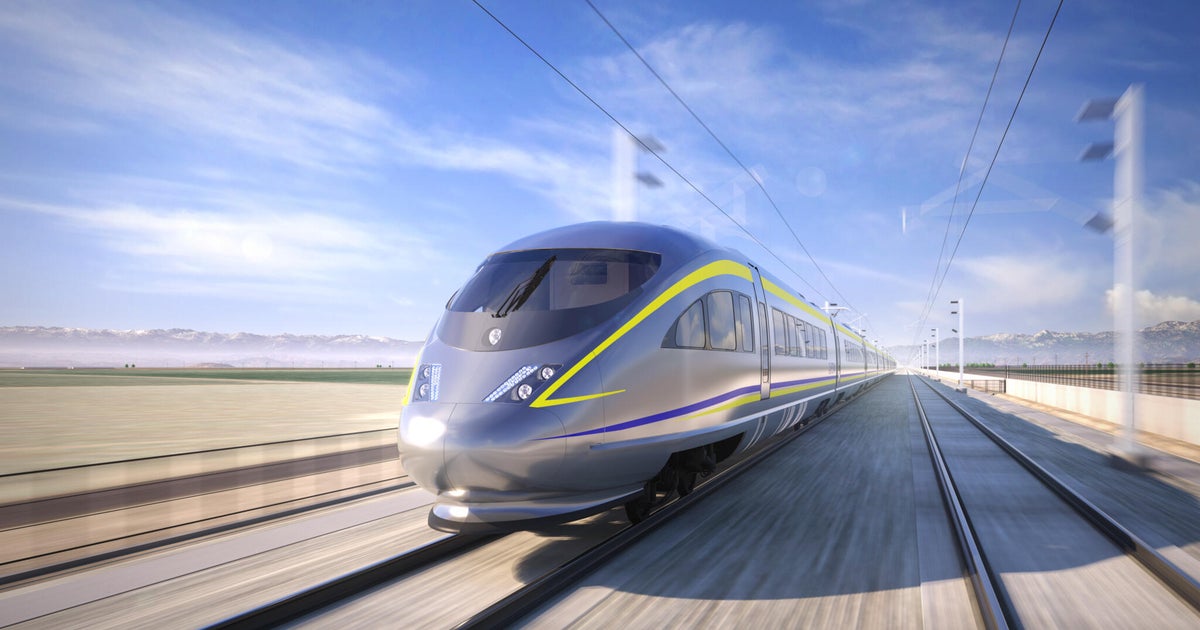
California’s high-speed rail project could run out of money as soon as December 2027, the project’s inspector general warned in a recent review — unless the state borrows billions to keep construction on schedule.
The High-Speed Rail Authority “will exhaust its current funding resources as soon as December 2027 if it does not secure financing,” Inspector General Ben Belnap’s office found, warning the authority faces a $9.5 billion funding gap over five years. The borrowing needed to fill it could add $3.6 billion to $6.6 billion in interest costs — money not included in the project’s official cost estimate.
The warning comes days after a CBS California Investigation revealed the authority repeatedly missed its deadlines to buy the trains at the center of a $4 billion federal funding fight — deadlines written into its federal grant agreement and promised to a federal judge — then quietly dropped its lawsuit against the Trump administration weeks after missing its own revised deadline.
Now, the authority is acknowledging the problem in writing.
Order cut in half, “Buy America” dropped
In an Aug. 6 notice of procurement revisions posted days after our investigation was published, the authority confirmed that “no Contract has been executed with any party” — and that the deal now on the table differs in key respects from the one presented to the federal government and the court.
The order was cut in half: from six trainsets to three, with options for 19 more that carry “no guarantee.” The revised terms require trains to be delivered and ready for testing “no later than February 2030.” And the authority is now considering a “lease-purchase financing structure” — meaning the state may not buy the trains outright at all.
The notice also removes the federal “Buy America” requirements for the initial trainsets — the domestic-preference rules, tied to federal funding, that generally require trains to be assembled in the United States from American-made components, including U.S.-produced steel and iron.
CBS California Investigates has asked the authority how and why it removed the requirement, whether the change means the trains will no longer be built in America, and whether any remaining federal funds apply to the purchase. The authority did not immediately respond.
The procurement webpage still lists the award date and contract execution as “to be determined.”
“Californians deserve an answer”
The leaders of both legislative transportation committees are now responding to the CBS California investigation — and none knew why the state hadn’t bought the trains.
“I am concerned,” Assembly Transportation Committee Chair Lori Wilson, a Democrat, told CBS California Investigates when presented with our findings.
“Absolutely, that’s a concern,” said her Senate counterpart, Transportation Committee Chair Dave Cortese, also a Democrat. Asked whether he was aware of why the state had not purchased the trains, Cortese said his committee would “continue to look into it.”
Sen. Tony Strickland, the committee’s Republican vice chair, went further: “We wasted billions of dollars,” he said, adding, “We need to push for more oversight.”
“You deserve an answer. Californians deserve an answer. The Legislature deserves an answer,” Wilson said. “If I can help get that answer, I will.”
The broken promise behind the $4 billion
As CBS California Investigates reported, federal grant documents signed during the Biden administration required the authority to execute a train contract by Dec. 31, 2024. It missed that deadline. When the Trump administration pulled $4 billion in funding, federal officials pointed directly to the missed milestone.
Gov. Gavin Newsom called the termination a “political stunt to punish California,” and the state sued. In sworn court filings, the authority assured a federal judge it would execute the train contract by Dec. 1, 2025, and keep the project on schedule. It missed that deadline too — canceling the board meeting where the contract was set for approval — and dropped the lawsuit two days before Christmas, with no press release.
Newsom, Attorney General Rob Bonta and the authority have never publicly explained why the deadlines were missed.
A watchdog’s warning — and a fight over transparency
Belnap’s review goes beyond the money. It found the authority’s 2026 business plan did not clearly disclose that the project’s schedule window has slipped from 2032–2033 to as late as September 2034, and concluded the authority “obscured basic facts about the project,” hindering lawmakers’ oversight.
In a written response included in the report, the authority disputed the findings, saying they reflect “differences in interpretation rather than gaps in information” — though the inspector general’s office, in comments appended to the report, stood by its findings.
Newsom did not respond to CBS California Investigates’ requests for comment on the train procurement. The award date for the trains remains, in the state’s own words, “to be determined.”