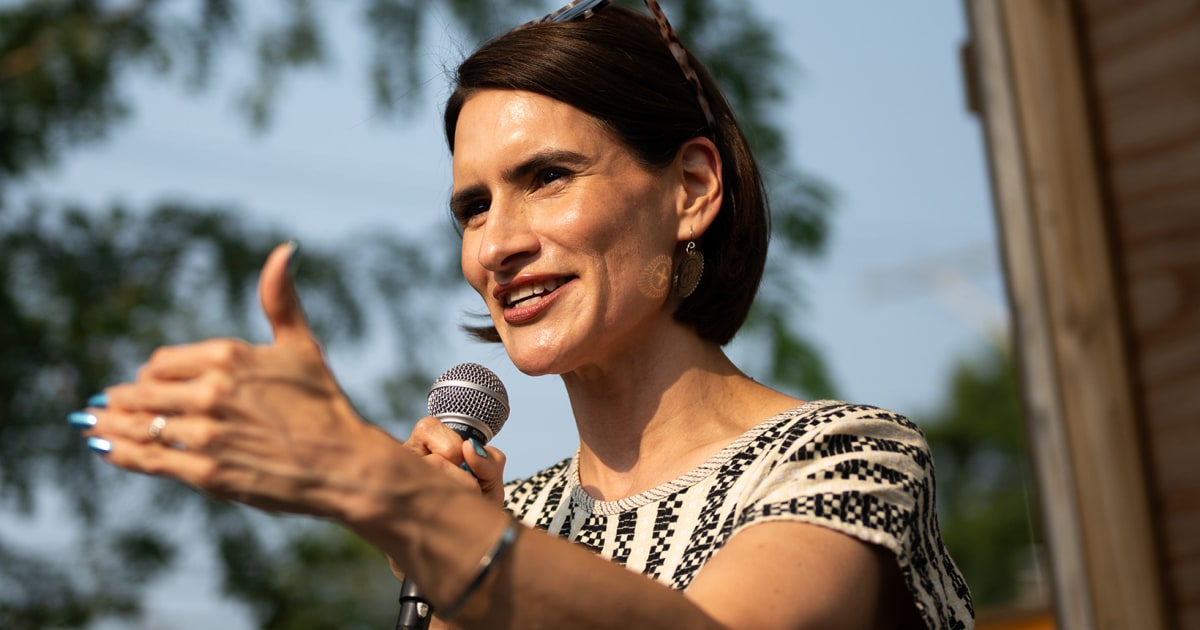
Lt. Gov. Peggy Flanagan has won the Democratic primary for the Senate in Minnesota, NBC News projects, notching another major victory for her party’s progressive wing.
Flanagan defeated moderate Rep. Angie Craig in the race to succeed retiring Sen. Tina Smith, who endorsed Flanagan along with Sens. Bernie Sanders, I-Vt., and Elizabeth Warren, D-Mass., and other progressive leaders. She would be the first Native American woman in the Senate if she is elected in November.
“This entire campaign has been about the many versus the money,” Flanagan told NBC News’ “Meet the Press Now” on the eve of the primary. Craig and her allies combined to spend nearly $20 million on the airwaves, while Flanagan and her allies spent $4.7 million, according to AdImpact.
“I’m running to make sure that people can afford the lives they want to live,” Flanagan said. “I want to get big money out of our politics, and I want to fight for things like ‘Medicare for All’ so that people aren’t just paying for health insurance but actually have access to health care.”
Flanagan criticized Craig, who is in her fourth term, for not standing up enough to President Donald Trump’s administration, which Craig disputed. Craig, who held a competitive House seat in the Twin Cities metro area, had argued that she was the best candidate to win in November.
Immigration became a major dividing line in the race after federal agents shot and killed two U.S. citizens, Renee Good and Alex Pretti, in Minneapolis this year amid the Trump administration’s immigration enforcement surge.
Craig faced criticism for having voted for the Laken Riley Act, an immigration detention measure that Trump signed into law shortly after he started his second term in January 2025. Craig said she later regretted that vote. Flanagan has called for abolishing U.S. Immigration and Customs Enforcement, saying in a recent Minnesota Public Radio debate that ICE “has to be ripped apart.” Flanagan said she does support immigration enforcement to ensure secure borders.
Flanagan, meanwhile, faced criticism from Craig over Minnesota’s handling of fraud in social services programs, with Craig suggesting that Republicans would be eager to use the issue against Flanagan in the fall. Flanagan accused Craig of parroting “Republican talking points.”
Asked during their debate whether she had a role in responding to the fraud scandal, Flanagan said, “The governor has taken the lead here, and the administration has been aggressive internally in working to stop fraud, prevent it from happening in the first place.”
Democratic Gov. Tim Walz, who decided not to run for re-election, stayed neutral in the Senate primary. But his wife, Gwen, backed Craig over Flanagan, the governor’s ticketmate.
After a divisive primary, Flanagan’s next task will be to unite the party as Democrats turn to November. She told “Meet the Press Now” that Democrats would come together to take on Trump.
“Congresswoman Craig and I will be unified in making sure that Democrats hold this seat no matter what happens. We can’t afford to give this Donald Trump one more seat in the United States Senate,” she said.
Craig said during the debate that she would support Flanagan if she won the primary.
“We have an existential crisis in our nation with Trump and Republicans, and so I would be right by the lieutenant governor’s side asking my supporters to support her,” Craig said. “The most important thing in this election is that we beat Republicans. That’s what matters.”
On the Republican side, former NFL sideline reporter Michele Tafoya won the Senate primary, NBC News projects. Although Trump did not endorse in the primary, Tafoya had support from National Republican Senatorial Campaign Chairman Tim Scott, R-S.C., as national Republicans viewed her as the only contender who could put the race in play.
Tafoya, a self-described “pro-choice” Republican, has faced some questions about her conservative credentials. She did not win the state GOP’s endorsement at the May convention, where delegates instead backed retired Navy SEAL Adam Schwarze.
She pitched herself as a political outsider, pledging in a campaign ad to “crack down on corruption, stop illegal immigrants from voting in our elections and to keep men out of women’s sports.”
Republicans are optimistic the race could be competitive in the fall, as they have made some gains in the state in the Trump era.
Trump lost Minnesota by 4 percentage points in 2024, winning 47% of the vote, which was the best performance by a GOP presidential candidate in two decades. But it has also been 20 years since Republicans last won a statewide election in Minnesota, when Tim Pawlenty was re-elected as governor in 2006.