
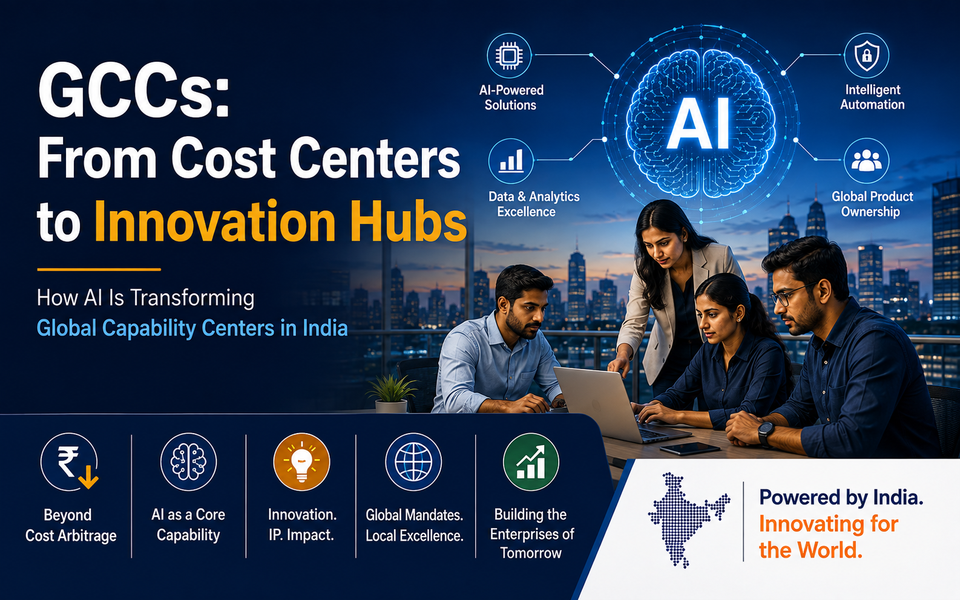
For over two decades, the story of Global Capability Centers (GCCs) in India followed a familiar script: set up an offshore unit, cut operational costs, and let it quietly handle back-office work while the “real” innovation happened at headquarters. That script has changed. In 2026, GCCs are no longer support functions sitting on the sidelines — they are becoming the innovation engines of the enterprises they serve, and AI is the biggest reason why.
India now hosts well over 1,800 GCCs employing close to two million professionals, with the ecosystem’s value rapidly approaching the $100 billion mark. What’s changed isn’t just the scale — it’s the mandate. GCCs that once measured success in cost savings are now measuring it in patents filed, products shipped, and AI systems built in-house.
From Cost Arbitrage to Capability Arbitrage
The old GCC model was built around a simple value proposition: the same work, done cheaper. That worked well when the tasks being offshored were repetitive — transaction processing, IT support tickets, routine testing. But repetitive work is exactly what AI automates fastest, and enterprises quickly realized that a GCC built purely around headcount and cost arbitrage had a shelf life.
What’s replaced it is a shift enterprises are now describing as “capability arbitrage” — instead of asking “how much cheaper can this be done in India,” the question has become “what critical capability can this center own end-to-end.” That’s a fundamentally different mandate. It means GCCs are being handed ownership of generative AI centers of excellence, global product engineering, cybersecurity threat detection, and advanced analytics — not as a side function, but as the primary reason the center exists.
What This Actually Looks Like on the Ground
A few real shifts illustrate the trend well. Cybersecurity firms have opened GCCs in Bengaluru specifically to build AI-driven threat detection products, not just to staff a support desk. Engineering-heavy multinationals have set up centers focused on software engineering and data analytics as core deliverables, with global product ownership sitting in India rather than at headquarters. Even traditionally non-tech sectors — real estate, retail, finance — are opening centers where the explicit goal is digital transformation and AI-led initiatives, not cost containment.
Industry estimates suggest over 70% of new GCCs being set up now are including a Generative AI lab as part of their initial design, not as something added later once the center matures. That’s a telling detail — it shows AI capability is being treated as foundational infrastructure for a modern GCC, on par with having a data center or a security team.
Why AI Specifically Is Driving This Shift
Three things make AI the catalyst rather than just another technology trend GCCs are riding:
It removes the labor-arbitrage ceiling. When a GCC’s value proposition is cost savings on manual work, AI automation directly threatens that value proposition — the work it used to justify existing can now be done by a model. GCCs that adapted fastest didn’t fight this; they repositioned themselves as the teams building and managing that automation, rather than the teams being automated.
It requires deep, sustained talent investment. Building and operating machine learning pipelines, MLOps infrastructure, and agentic AI systems isn’t something you bolt onto an existing offshore team overnight. It requires specialized talent at scale, which is exactly what India’s engineering talent pool offers. This has made India a natural home for AI-first GCC mandates rather than just cost-driven ones.
It creates ownable intellectual property. Cost centers don’t generate IP — they execute someone else’s IP. AI-native GCCs, by contrast, are increasingly filing patents, building proprietary models, and owning technology stacks that matter to the parent company’s competitive position. That’s a structurally different relationship between headquarters and the India center.
The City-Level Story
This shift isn’t uniform across India — different cities are specializing in different parts of the AI value chain. Bengaluru continues to lead in advanced AI research, product ownership, and cybersecurity. Hyderabad has emerged as a strong contender for enterprise platforms, cloud transformation, and large-scale digital programs, in some recent years outpacing Bengaluru in new center launches. Pune and Chennai are carving out their own niches, and even tier-two cities are beginning to attract centers as companies look for lower operational costs without sacrificing access to AI talent.
What Enterprises Should Take Away From This
For global companies still treating their India center as a cost lever, the risk is falling behind competitors who’ve already made the shift. The GCCs winning today are the ones being handed genuine ownership — of a product line, an AI initiative, a security mandate — with the authority and budget to actually build, not just execute instructions from elsewhere.
For India’s GCC ecosystem, the implication is equally significant. As centers take on more strategic mandates, the demand shifts from generic technical staffing to specialized AI, MLOps, and applied research talent. This is reshaping hiring patterns, compensation structures, and even where in India companies choose to set up, as access to genuinely deep AI talent becomes a bigger factor than square footage or wage differentials alone.
Closing Thought
The GCC story in India was never really about cost. Cost was simply the entry point that got enterprises in the door. What’s happened over the past few years — and what’s accelerating sharply in 2026 — is that AI has forced a re-evaluation of what these centers are actually for. The centers that treated AI as a threat to their existing model are being left behind. The ones that treated it as their next mandate are becoming the innovation hubs their parent companies increasingly depend on.
That’s not a trend confined to a few flagship centers in Bengaluru or Hyderabad — it’s becoming the baseline expectation for what a serious GCC in India looks like in 2026 and beyond.












Leave a Reply