
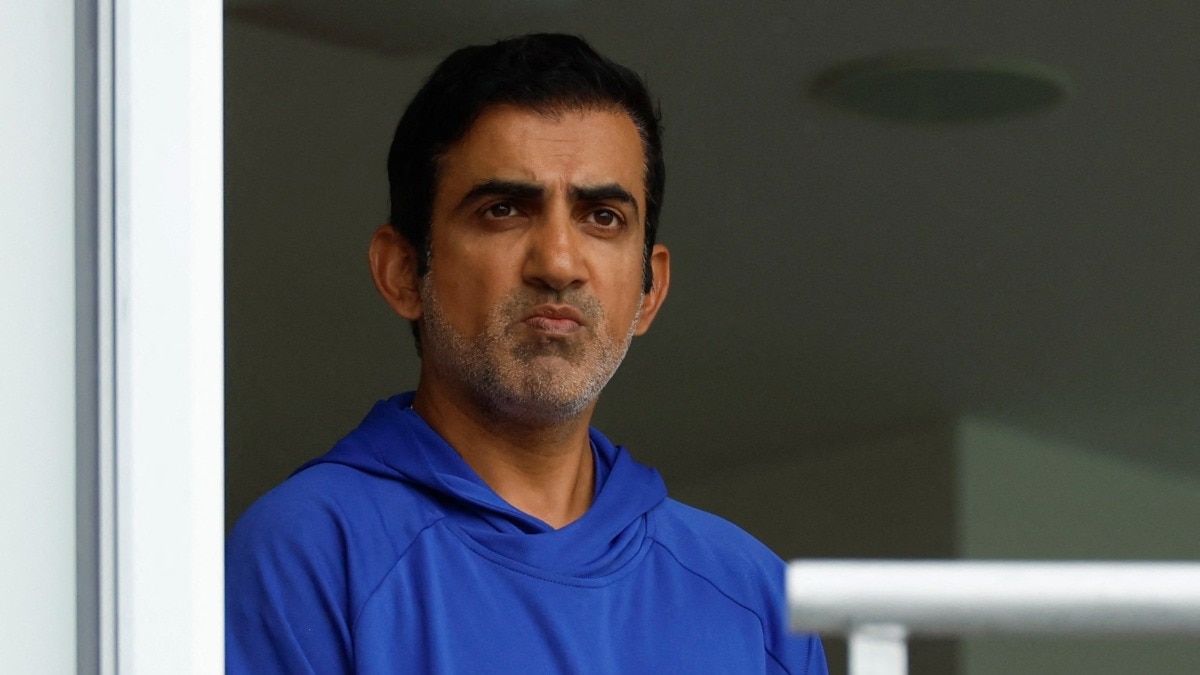
India head coach Gautam Gambhir has rejected the suggestion that India are struggling in Test cricket, insisting their recent setbacks should be viewed as part of a transition rather than evidence of a deeper decline.
India head into the second Test against Sri Lanka in Colombo with a 1-0 lead after their 165-run victory in Galle. But with the second Test also set to decide the series, the focus remains on a team still attempting to establish a new identity following the departures of several of its biggest names.
Since Gambhir took over as head coach, Rohit Sharma, Virat Kohli and Ravichandran Ashwin have all retired from Test cricket. Their exits have forced India to make significant changes, while the team has also endured series defeats against New Zealand and South Africa at home and a difficult tour of Australia.
Gambhir, however, believes those results should not be taken as evidence that India have lost their way.
“Rankings do not matter. We are not struggling. Since the England tour, we have played reasonable Test cricket,” Gambhir said ahead of the Colombo Test.
For the head coach, the ultimate measure of India’s progress is not their ranking or the noise surrounding individual results. It is whether the team can eventually win trophies.
“My job is to win trophies. That’s what all I care for and believe in,” he said.
That places greater importance on the emerging players now being asked to carry India’s Test cricket forward.
A NEW CORE EMERGES
Shubman Gill has taken over as captain while also settling into the No.4 position, giving India a new leader around whom the batting order can be built. Devdutt Padikkal has also shown promise at No.3 while the bowling department has produced perhaps the most encouraging development in the Sri Lanka series.
Manav Suthar claimed 10 wickets in Galle, making an immediate impact in just his second Test. The left-arm spinner has now shown enough promise to suggest he could become an important part of India’s long-term plans.
His emergence also adds to the competition among India’s spin options, with Ravindra Jadeja and Kuldeep Yadav already established and Madhya Pradesh all-rounder Saransh Jain potentially pushing for an opportunity in Colombo.
Gambhir said India’s selection will ultimately be dictated by the bowling combination that gives them the best chance of taking 20 wickets.
“We will try to field the best bowling attack that can get us 20 wickets. Kuldeep is a good bowler and sometimes it’s up to the captain as well,” he said.
The comments also underline Gambhir’s belief that players should not be discarded after one or two poor performances.
“There will be ups and downs in cricket, and we need to back our players and give them longer rope, and it’s not based on one or two matches,” he said.
That approach could prove particularly important during India’s transition. Replacing the experience accumulated by Rohit, Kohli and Ashwin cannot happen overnight, and the next generation will inevitably experience setbacks while adapting to Test cricket.
For Gambhir, those setbacks are part of the process.
WHY GAMBHIR WANTS THREE TESTS
Gambhir also made a broader argument for three-Test series, even though India’s current assignment against Sri Lanka is a two-match contest.
India have already taken a 1-0 lead, meaning the second Test in Colombo will decide the series. Gambhir believes a three-Test series provides a better opportunity for teams to respond after losing the opening match.
“Three-Test series is ideal. Short turnaround is fine, we know how to manage our bodies and recover. We give optional practices and rest bowlers. I feel a three Test series is ideal,” he said.
He also explained why a three-match contest gives a team greater room to recover from a poor start.
“Ideally I would want a 3 match Test series. Sometimes, if you lose the first Test, the other team cannot make a comeback and the maximum they can try for a draw…”
India’s immediate concern, however, is Colombo. Gambhir was satisfied with the nature of the Galle surface and hopes the second Test provides another genuine examination for both sides.
“Galle was a good Test cricket pitch and we enjoyed playing there and hopefully the pitch remains same here. It was not a perfect Test match but that’s how Test matches are played,” he said.
India’s Test transition remains unfinished, but there are already signs of a new core beginning to emerge. Gill is growing into his leadership role, Padikkal is showing promise at No.3 and Suthar has provided an exciting new spin option.
For Gambhir, the challenge is to give that group enough time to develop while maintaining India’s expectation of winning. The Colombo Test is therefore another opportunity to show that the changes of the past year are not a sign of decline, but the foundation of India’s next Test side.
– Ends





Leave a Reply