
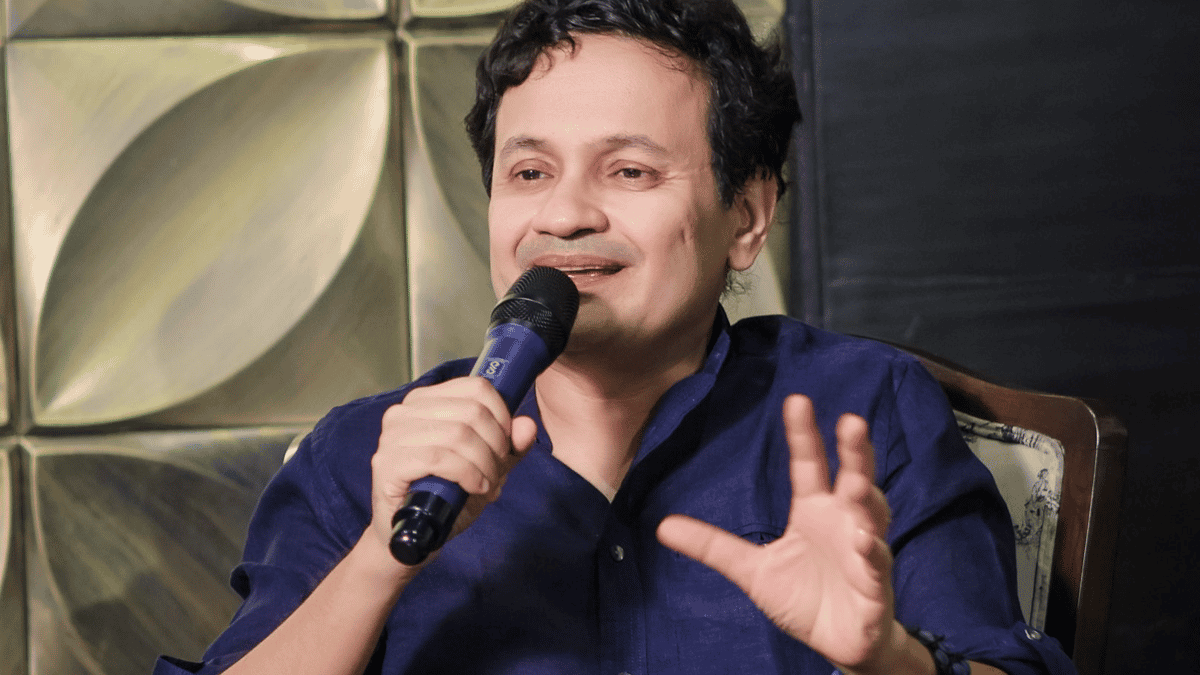
With the alacrity and honesty of a man in a confession box spilling the whole truth to his parish priest, Saikat Majumdar, author of Open Intelligence: Education between Art and Artificial, lays all his cards on the table. What I appreciated most about his thoughtful study of a new and complex subject was his clarity about the core issue. “Unless we put back ethical and social values at the heart of education, human beings will carry on their mercenary business as usual, and our supremely gifted children will grow with the assumption that personal survival and profit motives are the defining values of existence at the cost of everything else,” he shares.
As someone who has long championed interdisciplinary liberal arts education, AI is both a tempting subject and an unavoidable one. Identity and one’s sense of self are essential concerns of Majumdar as a novelist, as in the shape of characters; and these are fundamental realities that AI have started to alter. “AI chatbots behave like human characters. It appealed to the novelist in me as much as it spoke to the educationist,” said Majumdar.
The chapters in this book, intriguingly titled: Art in the Artifice, The Great Roulette Wheel, The Tense Future of Intelligence, The Apple Orchard of Knowledge, and Creating Your Own Story, neatly guide the newcomer and those eager to learn the basic nuances about how Open Intelligence works. Written with the fluidity and natural panache that readers encountered in his felicitous works of fiction, Majumdar arrests their attention here, too, with the persuasion of a raconteur. The initial fear of becoming bored with technical details and data dissipates as the author draws them into the debates around the topic.
“Whatever values human beings deploy in using AI, AI will imbibe them. They learn from human usage. Eventually, when they become more powerful than human beings, humanity will be at the mercy of the kind of ethics AI possesses. And that is where its current human employers can make a difference — through the right education in values,” he remarks.
With five novels and four non-fiction books under his belt, he had said something quite fascinating to me two years ago, in June 2024. “Parents divorced when I was 12. Many conflicts, including my mother’s life as an actress… A lonely and disturbed childhood partly immersed in the strange world of a boarding school. Holidays were uncomfortable with step-parents on both sides. School felt debilitating; I totally failed to connect to the competitive tech-medicine culture of ambitious students. I was redeemed by the discovery of literature,” he had shared. Majumdar also pointed out: “Bringing up two children has convinced me of one thing: children learn a lot less from what we tell them than what we really do and how we actually lead our own lives.”

I asked if he would say his lived experience as a father, growing up with teenage children of his own, spurred him on to investigate the blueprint of this book — the state of Artificial Intelligence and how it is shaping the lives of young children and is continuing to permeate all disciplines. “The process of human growth and education has fascinated me for many years. This has shaped my non-fiction as well as coming-of-age fiction, the genre of the Bildungsroman, or the novel of education. But it is also true that becoming a parent for the first time lit a spark inside me and took me back to my own messy childhood, and this remembrance inspired much of my fiction. However, I was already an academic before I became a parent, and for a few years I saw parenthood and the life of an educator run on parallel but unrelated tracks. But as soon as my first child started talking, she started entering my writings on education. You just cannot miss out on the development of thos e you live with while you think and write about human growth. The connection deepened in the pandemic years, when we were all cooped up at home and every single moment of our lives was intensely visible to each other. And then, of course, their generation is digital natives. Now one is a teenager, a young Gen Z, and the other a pre-teen, a Gen-Alpha, whose interaction with ChatGPT in the lingo of their generation became one of the epigraphs to this book. They have strong feelings about AI, including strong reservations, such as about its negative impact on the environment. All of that has entered this book. But fundamentally, I was drawn to this theme because it is about human consciousness, creativity, and that elusive sense of self — questions essential to both a writer and a parent.”
People who know Majumdar’s work through his fiction might actually wonder how and why there is a shift from fiction to a book about Artificial Intelligence. Although I see a close relationship between the author’s understanding of the world as an empath in the truly Jungian way in his deeply moving novels and the ethics of employing a technical, sterile scientific method of AI, as an aid to telling a story, how does he explain the intersection of the art and science of AI and storytelling, of the human condition and science, of softness and technical power.
“This isn’t really a book about AI. This is a book about education, human imagination, creativity, and labour, continuing with the themes of my previous book College, Open Intelligence (2018), a bestselling book which outlines the essence of an education that will help us preserve the human and the humane confronted by the artificial. But none of these can be imagined today without AI, which is where it comes in and takes on a certain philosophical and artistic dimension along with the obvious technological ones. Unfortunately, our own education models, prioritising skill, professionalisation and scholarly excellence, have more often than not tended to lose track.”
Majumdar has brought up the core issue about welcoming AI into our systems of education, healthcare, and any kind of knowledge dispensation. But doesn’t a shadow fall between the idea and the implementation? How do we ensure values and ethical and moral standards are adhered to? “The centrality of ethical values (and possibly of a progressive political vision, though that is a more debatable issue) has always been a key concern of education. But ironically, it is also a concern that is sidetracked easily, both by demands of disciplinary depth as well as by those of professional success, with which much education has come to be synonymous, particularly here in India. You need to know a field well, and you need to make money. Ethics is easily forgotten under the shadow of these needs, though they could have also reshaped and revitalised both goals.”
“As I try to explain in the book, the dream of a more ethical and just society is now essential to the survival of all humanity — including those who have benefited from structures of inequity and discrimination so far. If we finally imprint upon AI that exploitation and inequity are desirable values, it won’t be long before this super-powerful stakeholder discriminates against humankind and starts to harm us, perhaps on the way to eliminating us altogether,” he shares.
How would Majumdar argue the case for AI in view of the concern that students are already using ChatGPT and other AI to help them write papers and exams where they will be graded against students who may be using these tools? Many instructors are troubled by an uneven playing field. “Actually, in some ways, AI tools such as the Large Language Models have levelled the playing field. There are many who have ideas and experiences that are valuable, but in the absence of a certain kind of language and self-packaging, they could never participate. Now they can, to an extent, though language and articulation are also in some crucial ways inseparable from ideas. But curriculum and teaching also need to respond to technology.
Pedagogy has to catch up with technology, not remain in denial with it. We have a good precedent in the permission to use calculators in exams in the 1970s, which was accompanied by raising the difficulty of the math curriculum, so that the brain space f reed up by the use of calculators is productively applied to more advanced problems. We need to come up with pedagogy that incorporates AI use to enhance learning, as students are going to use it anyway. We might as well teach them how to use it ethically and get the most out of it,” shares Majumdar before signing off.
Julie Banerjee Mehta is the author of Dance of Life, and co-author of the bestselling
biography Strongman: The Extraordinary Life of Hun Sen. She has a PhD in English and South Asian Studies from the University of Toronto, where she taught World Literature and Postcolonial Literature for many years. She currently lives in Calcutta where she curates and anchors the Rising Asia Literary Circle and is the t2 Literary Columnist








Leave a Reply