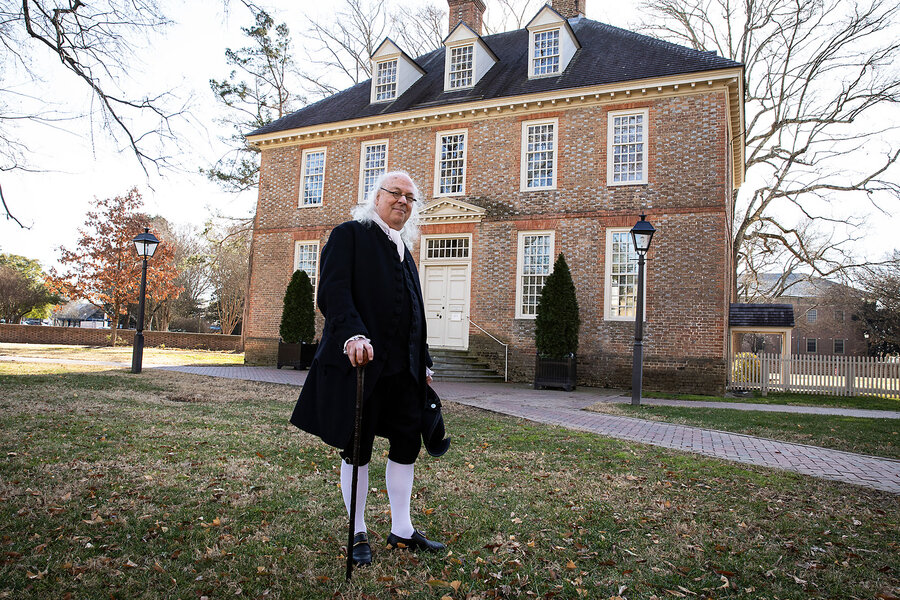
It’s a sunny wintery morning in January, and a man who bears a strong resemblance to Benjamin Franklin is walking the brick-lane sidewalks of Colonial Williamsburg.
In a few months, the streets here will be teeming with tourists eager to meet with historical reenactors like this man, B.J. Pryor, and to learn more about the founding days of the American republic, as the United States celebrates the 250th year of its independence.
Some tourists may be curious about what America’s Founding Fathers – or the closest approximation they can find – would have thought about American democracy today, even though interpreters of historical characters meticulously stay true to their time period. But understanding the aspirations – the “original intent” – of the Founding Fathers might not be as simple as it seems.
Why We Wrote This
As America celebrates George Washington’s birthday, the results of the Revolutionary War period can feel inevitable when viewed from a 250-year distance. But historical reenactors aim to portray the complexity of the Founding Fathers and their times, encouraging deeper thought about the connections between then and now.
“Everyone wants to claim the Founding Fathers and use them for their purposes,” says Mr. Pryor, who has portrayed Franklin for two decades. “As Franklin, I like to tell people, ‘I’m glad we have approved this new constitution. I think it is the best we could possibly have obtained under the circumstances. And the most important thing about it is we can change it.’”
Even Thomas Jefferson, Pryor notes, admitted that institutions must adapt to keep pace with the times.
Christopher Brown, a historian on the Revolutionary War at Columbia University and consultant for the Ken Burns documentary series, “The American Revolution,” says the men who put their signatures on the Declaration in 1776 agreed on the need to be free of monarchical rule, and little else.
“I think they would be amused by the notion of original intent of the Founding Fathers, not least because the document that they created, the Constitution, was full of compromises,” Professor Brown adds. “There were so many intents in the room at the moment that document was written, it would be ridiculous to think there could be one legitimate intent.”
As divided as America feels today, there is a glimmer of hope in what Pryor and other historical reenactors encounter: the shared curiosity in learning more about the roots of America’s experiment in democracy.
To capture the essence of those times, Americans need to shake off their tendency to treat the Revolutionary War period as sacred, says Ted Maris-Wolf, a historian and associate director of the Charles Center at the College of William & Mary.
Americans today might recognize hot-button issues that confronted the nation-builders of 1776: What does it mean that all men are created equal? What are the limits of individual freedom, or of the federal government?
But people also struggle to connect the dots between the challenges of America’s revolutionary generation and today. Mr. Maris-Wolf argues that historical reenactors can provide a citizens guide to understanding America’s foundations in order to map out its future.
“With these reenactors, there seems to be at least an attempt to make those political figures real humans,” says Mr. Maris-Wolf, who was once the director of Colonial Williamsburg. “You can show the vulnerabilities, the failures, in addition to the achievements, the founding of the country.”

Melanie Stetson Freeman/Staff
Ben of Williamsburg
Clad in the black woolen broadcloth jacket and breeches of an 18th-century gentleman, B.J. Pryor has been portraying Ben Franklin for decades, passing along insights from his personal research to visitors, schoolchildren, and tour groups.
When he is dressed as Franklin, Mr. Pryor keeps his 21st century opinions to himself. But if he is doing his job right, he can give his audience the tools to learn from Franklin’s documented beliefs and actions to help people understand the principles on which the United States was founded.
“Whenever I hear a sentence that begins, ‘the Founding Fathers thought,’ I think, OK, that sentence is bogus, because there is nothing that the Founding Fathers all thought the same about, or hardly anything,” Mr. Pryor says. “They disagreed, they fought, they bickered, they hated one another.”
Today, people might recognize the same thing amid political hyperpartisanship. Indeed, tensions back then sparked armed conflict between Colonies. Connecticut and Pennsylvania fought not one but three wars over disputed territory along the Susquehanna River. Even when they were united against the British, some of the Colonies were reluctant to give up sovereignty to a national government.

Melanie Stetson Freeman/Staff

Melanie Stetson Freeman/Staff
Any document signed in these conditions was bound to be a work in progress.
“They did not think that they were drawing up a document that would last for 200 years,” Mr. Pryor says, back at his modern town house, showing off his collection of books and magazines from the Colonial period. “You know, they assumed that this was a good system and it would work, but times would change, and no doubt, something different would be needed down the road.”
In short, the Founding Fathers wrote a remarkable document that made independence appear not only possible, but also inevitable. Along with a Constitution written a decade later, they built a foundation for a system of self-government that would continually need repairs and improvement.
Today, some constitutional scholars say that document is under threat from a Trump administration that interprets it as giving broad powers to the head of the executive branch – a stance the U.S. Supreme Court has largely upheld. Mr. Pryor, drawing on his knowledge of the Founding Fathers, says they anticipated there would be conflict.
“The purpose of government cannot be to bring perfect harmony among all people,” Mr. Pryor says. “What you do hope a government can do is keep us from slitting one another’s throats. Enable us to share a polity without killing one another or inflicting gross harm on one another. If we can accomplish that, we have done something great.”

Melanie Stetson Freeman/Staff
George of Appomattox
Dan Shippey’s journey to portray George Washington began shortly after two jetliners struck the World Trade Center in 2001.
Like many Americans, Mr. Shippey was shaken to his core by the event. But he noticed something more: Americans were questioning what it meant to be an American.
“We all come from diverse backgrounds, very diverse thoughts,” says Mr. Shippey. “If you take all the things we don’t have in common, the one thing we have is the foundational ideas that go back to the Revolution.”
Ideas and values such as freedom, equality, and liberty, are not static, and can be in conflict with each other, says Mr. Maris-Wolf at William & Mary. Education specialists at Colonial Williamsburg designed curricula to help students and the general public understand the tensions between values such as unity vs. diversity, law vs. ethics, private wealth vs. common wealth, and freedom vs. equality, which fueled the Founding Fathers’ debate on what it means to be American.

Melanie Stetson Freeman/Staff

Melanie Stetson Freeman/Staff
“There was no resolution at the time in the debate over these values, and there continues to be no resolution today,” Mr. Maris-Wolf says. People want to know what historical figures would say about today’s issues, but it’s not the same America now as then.
For Mr. Shippey, the best way to teach about the American revolutionary period was to make dusty historical figures come to life. A friend suggested that he portray George Washington.
“He said, ‘Well, you’re tall, and you’ve got the nose for the job,’” Shippey recalls.
He portrayed Washington at Mount Vernon for four years, and continues in other venues. With the 250th anniversary of independence, Mr. Shippey sees an opportunity to capitalize on American curiosity for the past.
“We are getting this moment to remind people of the importance of the founding ideals of America,” Mr. Shippey says. “These are the ideals that set the foundation of who we are and where we want to be.”

Courtesy of Barry Stevens
Ben of Alexandria
For the record, Barry Stevens never asked to become Ben Franklin. A retired theater teacher in Alexandria, Virginia, he started attending historical reenactments at the suggestion of his son back in 1999. He appreciated the theatrical element of men and women who portrayed Revolutionary War soldiers, artisans, and camp followers, and he found himself drawn in.
Initially, he attended Revolutionary War reenactments, made period-appropriate clothes, and grew his hair out in a ponytail. Then, sometime around 2005, people started calling him “Ben.”
“People would come up to me and they’d say, ‘Hi Ben, how are things in Philadelphia?’” Mr. Stevens says. “No sign, no name tag, nothing that I did to try and elicit that kind of a response. And after a while, I got to thinking, well maybe there is something in this.”
Mr. Stevens threw himself into the role, and recently portrayed Franklin in the 2025 docudrama “The American Miracle,” alongside Mr. Shippey as Washington.
Like most historical interpreters, Mr. Stevens enjoys interacting with Americans who have the curiosity to learn about their past. But he stays in character and avoids putting 21st-century opinions into 18th-century Ben’s mouth. His Franklin has opinions about the Boston Tea Party, for instance. For the record, Franklin, as America’s representative in London, viewed the patriots’ destruction of British tea as a dangerous provocation.
But Mr. Stevens says he avoids getting dragged into more modern debates. “I can’t say, ‘Oh, this White House is something else,’ because I have to limit my discussion to what I knew existed up until Franklin’s death.”
But, Mr. Stevens says, he can reflect the fact that Franklin’s views about trade relations, slavery, and the tension between Western expansion and treaties with Native American tribes each changed dramatically over time until his death in 1790.
“I feel an obligation to present the truth of it all,” Mr. Stevens says, after a recent presentation to a gathering at a senior center in Alexandria. “You don’t necessarily have to take a line and say, well, Franklin would have been against this or not. But it certainly can stir your thought and say, that issue sounds familiar, and we’re still dealing with it, or it’s come back.”

Melanie Stetson Freeman/Staff
Tavern-keeper in Portsmouth
In Portsmouth, New Hampshire, you can walk through a neighborhood once called Puddle Dock, now managed by the Strawbery Banke museum. The streets still feel part of the 18th century, full of role players dressed for revolutionary times.
Nancy Dickinson, an Air Force veteran and former elementary school teacher, portrays Katherine Stavers, an 18th-century tavern-keeper at Strawbery Banke. Stavers built the tavern, Portsmouth’s largest, in 1766 with her own money, Ms. Dickinson says, and she and her husband ran it.
The questions visitors ask can be quite sophisticated. Some people want to know more about the rights of women in
18th-century America; others ask about the differences between rich and poor people in America, or about the legacy of slavery and race.
All three of these questions reverberate today, reflected in court fights over abortion, growing tensions over income inequality and issues of affordability, and the current administration’s campaign against diversity, equity, and inclusion in higher education and in the workplace.
“We are modern people, and some people have difficult questions to ask,” Ms. Dickinson says. She has occasionally come out of character if people become emotional about a particular topic.
“I talk with them, and they feel more comfortable,” Ms. Dickinson says. When she talks about slavery, “This is something that people should know about. We can acknowledge that it is awful. We can’t say it never happened.”
Ultimately, people who come to historical sites like Strawbery Banke are curious learners, who also carry with them a lifetime of biases and experiences that shape how they view the world.
The key is to build on that curiosity, Ms. Dickinson says, and to show that “some of the challenges back then have not been resolved. As we get into 2026, the question is, How are we going to be talking about this period? Will it just be marching bands and speeches?”