Just a few weeks ago, Yesica Ramírez was planning to attend a rally in Orlando to commemorate the legacy of Cesar Chavez.
That celebration is canceled. And Ms. Ramírez – as well as other fellow farmworkers and fighters for causes Mr. Chavez embodied – is struggling to make sense of the man he was, regardless of the legacy he left.
His legacy, too, has in many ways been a part of her own identity for decades. “I think it was a very hard blow for the entire farming community,” says Ms. Ramírez, a general coordinator with the Farmworker Association of Florida. “He was a role model, a moral exemplar for us as farmworkers, as well as this organization,” she says, speaking in Spanish.
Why We Wrote This
Cesar Chavez, an icon in the labor rights movement who was revered by millions of Latinos and others, now is accused of sexual abuse of girls and women. The allegations, coming decades after his death, profoundly complicate his legacy.
The allegations against Mr. Chavez – that he groomed and sexually assaulted girls as young as 12 years old, and that he raped the movement’s co-founder – are the latest revelations of American betrayals. Politicians. The Catholic Church. Coaches and team doctors in college athletics.
What makes the Chavez case distinct for those who revered him – and in some ways more disorienting – is the particular tenderness with which his name was held. He was not merely famous. He was, for millions of Latino families, a kind of secular saint. That icon is now gone.
Ms. Ramírez began volunteering for the association about 20 years ago, she says, when she was enduring the effects of pesticides used on farms where she had worked. In 2014, organizers invited her to become the first woman to hold her current position. Her predecessor, in fact, worked closely with Mr. Chavez for years, she says, which makes the iconic figure’s presence that much more acute.
“And to think that the person who fought for the rights of the farmers – he himself violated them,” says Ms. Ramírez. “We’re still kind of processing the blow, you know?”
“This touches our history”
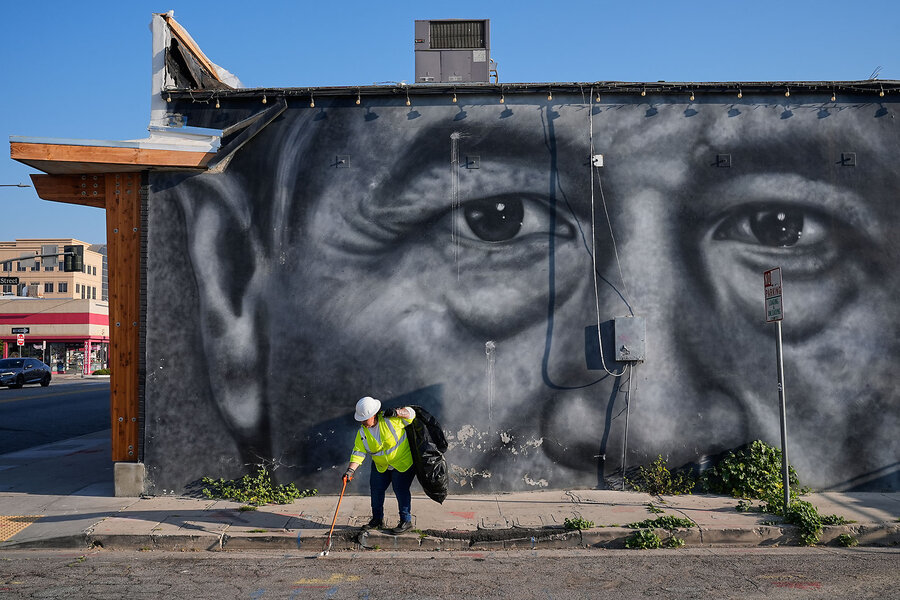
That sense of emotional dissonance continues on what has long been a national week of celebration for farmworkers, culminating on March 31, Mr. Chavez’s birthday. This year, however, communities across the country are scrambling to remove that name from hundreds of street signs, schools, parks, and other posted commemorations.
Political leaders have been both stunned and mournful. “For many of us, this is not just news,” said Denver City Council President Amanda Sandoval at a news conference after the revelations. “This touches our history, our identity and the stories we were raised on,” she said as city officials planned to change street signs and remove a bust of Chavez from a city park.
“We made the very difficult decision to remove the sign and the bust that I drove by my entire life,” Ms. Sandoval said, in tears. “Removal is not the end of the conversation. It’s actually just the beginning.”
Still, the accomplishments of Mr. Chavez and the United Farm Workers he co-founded with Dolores Huerta remain, as many advocates try to emphasize. He helped lead the Delano grape strike of 1965, went on numerous multiweek hunger strikes, led the 340-mile march from Delano, California, to Sacramento – acts that forced a nation to reckon with the people picking its food.
The California Agricultural Labor Relations Act of 1975, won through relentless United Farm Workers pressure, was the first law in U.S. history to grant farmworkers the right to organize and bargain collectively. His union won rest breaks, clean water, and pesticide protections in the fields. The phrase, “Sí, se puede“ – roughly, “Yes, we can” – was born in his movement.

“Our community must look at itself honestly, not to destroy what was built, but to build something that can finally hold the weight of everybody in it, something that doesn’t require women to choose between their bodies and their belonging,” said New Mexico state Rep. Marianna Anaya at an outdoor rally in Albuquerque. “That’s the culture change that we are calling for today – not a new street sign, a new culture.”
In March, The New York Times reported the allegations against Mr. Chavez after speaking with more than a dozen women who experienced abuse, and more than 60 other people who corroborated their accounts.
In a statement after the story broke, the Chavez family said they “wish peace and healing to the survivors and commend their courage to come forward. … We carry our own memories of the person we knew. Someone whose life included work and contributions that matter deeply to many people.”
Still, even before accounts of his abuse, the historical record on Mr. Chavez was more complicated than the iconography suggested.
Historians and writers, such as Frank Bardacke, had long documented his authoritarian tendencies in his later years. In his award-winning book, “Trampling Out the Vintage: Cesar Chavez and the Two Souls of the United Farm Workers,” Mr. Baracke reported paranoid purges of staff, a drift toward personality cult, and a leadership style that brooked no dissent.
The union’s membership and influence declined sharply through the 1980s, as the movement Mr. Chavez built contracted. The union, many argued, had become more about the man than the workers.

A different coalition achieves labor gains
Nely Rodríguez knows the costs of silence – and of having to endure the privileges often taken by men with power.
But as a farmworker and activist with the Coalition of Immokalee Workers, she has in many ways experienced a very different model of institutional leadership and a very different organizing strategy for protecting workers.
She arrived in Florida 20 years ago after working in the fields of Michigan, where she picked asparagus, squash, and pumpkins. In many ways, conditions were better on those northern farms, Ms. Rodríguez says, but she had family in Florida and, well, the cold.
But when she arrived in the early 2000s, she entered one of the most brutal agricultural labor markets in the United States. For the vast majority of workers, conditions were grinding and largely invisible: poverty wages, rampant wage theft, no toilets in the fields, no shade, no clean water. There were even criminal rings that profited from forced labor. One U.S. attorney who prosecuted members of these rings called these fields “ground zero for modern-day slavery.”
Women were especially vulnerable. Sexual harassment and assault by supervisors was routine, largely unreported, experts say, and widely accepted as the price of the work. “It was like our daily bread,” Ms. Rodríguez says in Spanish. When someone needed to go to the bathroom, for example, a supervisor would drive them to a facility too far away to walk.
“That’s the experience I can tell you about personally, that bosses take advantage of you, make comments like, ‘If you go out with me, I’ll put you to work on something else,’” she says, describing harassment rather than abuse. One boss had a gun in his truck. “But you’re already there in a situation. You need to work. You have to support your family. In my case, I had children.”

Mike Maloney/San Francisco Chronicle/AP/File
Then, during the offseason, Ms. Rodríguez started attending Wednesday night meetings at the Immokalee coalition. She realized she was not the only one being harassed.
In many ways, the coalition was built to change a culture of privilege: no singular leader, no hierarchy of moral authority, no person whose reputation placed them beyond accountability. Instead, workers educated workers. Women organized women. And power was explicitly collective and deliberately decentralized.
“And that’s what impressed me and what inspired us to continue,” Ms. Rodríguez says. “Precisely because it’s an organization run by farmworkers and formed by farmworkers. Precisely because of the bad conditions the workers faced – and more than anything, the problem of harassment against women.”
Working with federal prosecutors, the coalition helped liberate more than 1,200 workers from forced labor operations across the Southeast, organizers say. It then helped pioneer the landmark Trafficking Victims Protection Act of 2000.
In 2011, the group launched the Fair Food Program – a legally binding partnership between farmworkers, growers, and major corporate buyers that has fundamentally transformed conditions in the fields.
Organized workers went directly to corporations rather than lawmakers, getting them to sign legally enforceable agreements. These include a penny-per-pound wage premium passed directly to workers’ paychecks, mandatory worker education sessions that organizers conduct on farms and on the clock, and immediate exclusion of growers who violate workplace rules – rules workers themselves have written.
Fourteen major corporations have signed on to the Immokalee program, including Walmart, McDonald’s, Subway, Burger King, Whole Foods, and Trader Joe’s. The Harvard Business Review has called it one of the 15 most important social-impact stories of the past century.
In many ways, Mr. Chavez’s influence never penetrated these areas in Florida’s deep south, and the Immokalee coalition evolved with different aims and a different understanding of leadership models. Ms. Rodríguez acknowledges his historical place without sentimentality. He was a leader who fought for wages and justice, she says. But he was never central to what the coalition in Immokalee was building.
“We have created a movement led by workers, and that was the dream we had: that this human rights movement would last, that it would be something that would remain,” Ms. Rodríguez says.
Ms. Ramírez, with the Farmworker Association of Florida, might be a bit shaken by the revelations of Mr. Chavez’s actions, but she sees a future in which more women will lead the movement.
“In our culture, we are taught to keep quiet when going through these situations,” she says. “But the empowerment and movement of women, especially farmworkers, brings a lot to our society and our communities. Because when women are leaders, they are the voices, too.”