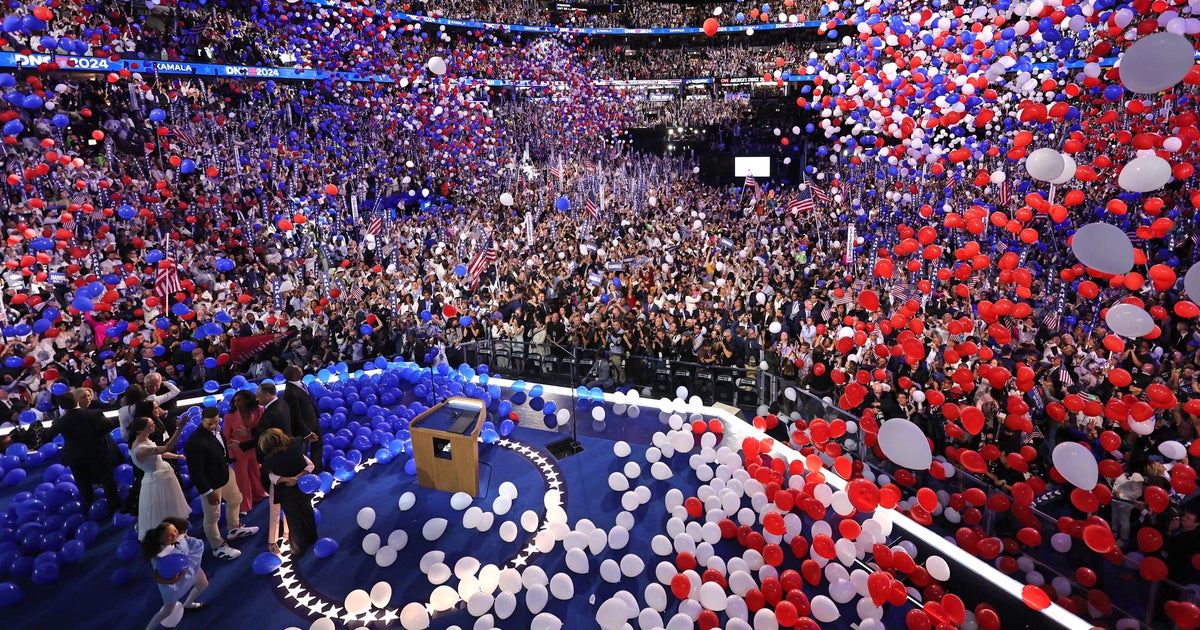
The Democratic National Committee is focusing on five cities to potentially host the party’s next presidential nominating convention in 2028, while officials have also decided against holding a similarly styled event ahead of this fall’s midterm elections.
The decision comes as Republicans have moved towards holding a midterm convention later this year in a twist from tradition that has been championed by the leader of the right, President Trump.
CBS News has learned the DNC will announce Monday afternoon that its next convention will be held from Aug. 7 to Aug. 10 in 2028, with Atlanta, Boston, Chicago, Denver and Philadelphia in the running for the coveted role of host city.
Even as Democrats look ahead to the next presidential election where they are aiming to retake the White House from Republicans, the party’s decision to avoid dedicating attention and resources to a potentially costly midterm convention is being viewed internally as one that could give candidates on the left an advantage over the GOP this fall. The DNC had initially signaled last year that it would consider holding a midterm convention in 2026.
“Republicans were baited into wasting time and money on a midterm convention that will sink their swing-seat candidates by tying them directly to Trump’s wildly unpopular policies,” DNC executive director Roger Lau said in a statement about the decision. “Meanwhile the DNC has put resources where they’re needed most and doubled down on the playbook that helped our candidates flip seats up and down the ballot in 2025.”
In recent months, Mr. Trump has publicly embraced holding a midterm-focused event that could bring the GOP national attention as it tries to hold on to a narrow majority in the House and faces the long-shot risk of losing the Senate this fall.
Last September, Mr. Trump wrote in a social media post, “The Republicans are going to do a Midterm Convention in order to show the great things we have done since the Presidential Election of 2024”
“It will be quite the Event, and very exciting!” Mr. Trump added.
And after a January 2026 GOP meeting helped push the midterm convention idea forward, RNC chairman Joe Gruters said in an appearance on Fox News, “we need to do things a little bit differently if we’re going to defy history.”
Party conventions in presidential years are a major fixture of focusing national attention on leading party candidates as they try to win over voters. For both major parties, the widely broadcast conventions are enormous undertakings that highlight not only their current standard bearers, but also provide a stage for up-and-coming or little-known leaders to introduce themselves to a large audience.
The impact of a midterm convention in this day and age of politics is an open question.
The stakes for the two major parties in the midterms are high. If Democrats retake control of the House, they could curtail or block much of Mr. Trump’s agenda during the final two years of his presidency.
Republicans came away from the 2024 presidential election with unified control of Washington and a lengthy window to lean in on their power to enact change that could impact voters’ decisions at the ballot box.
The party of the incumbent president often suffers losses in a midterm cycle, but there are already clear variables this year that differ from the dynamics the GOP faced in 2018, when the party lost control of the House during Mr. Trump’s first midterm election in his first administration.
Democrats took back control of the House in the 2018 midterms by netting around 40 seats, compared to their performance two years before. Since then, margins between Republicans and Democrats have narrowed in the House, and the map of competitive House seats in 2026 could be thin, depending on the political environment this fall.
Republican candidates also appear more willing to align themselves to Mr. Trump than in 2018, when some GOP incumbents tried to distance themselves from the man in the White House.
Federal campaign finance records also show that the Republican National Committee has a significant financial advantage over the DNC. Party finances through the end of January show that the RNC had close to $102 million in the bank while the DNC carried around $15 million in cash on hand and over $17 million in debt.
Yet Democrats’ election performance in 2025, where they easily won races for governor in New Jersey and Virginia, has helped give the left energy and some hope that they may be on track for wide-ranging wins in November.
The party’s choices between now and 2028 are being closely watched as they look to overcome the setbacks that troubled the party during the Biden era and led to election losses in 2024.
Democrats’ potential 2028 convention cities also provide an interesting signal of the argument it may be trying to make with voters in a few years. Chicago hosted the DNC’s 2024 convention, while Boston, Denver and Philadelphia — in the coveted battleground of Pennsylvania — have held the same role for the party during recent presidential cycles over the last 22 years.
Atlanta would send a different message, given Georgia’s rising prominence as a closely contested state between Republicans and Democrats. It’s also become an even more notable flashpoint in American politics after the FBI executed a search warrant in late January at an elections office in Georgia’s Fulton County.
The search stemmed from alleged “deficiencies or defects” involving the 2020 presidential election, despite the state’s chief GOP election official long defending the integrity of his state’s vote and the fairness of the outcome and there being no evidence of decisive voter fraud.
It is unclear when the DNC will decide which city will get to hold the 2028 convention.
“The DNC is proud to be moving forward with our 2028 Democratic National Convention plans, another critical step toward retaking the White House and finally putting an end to Republicans’ betrayal of working families,” party chairman Ken Martin said in a statement.