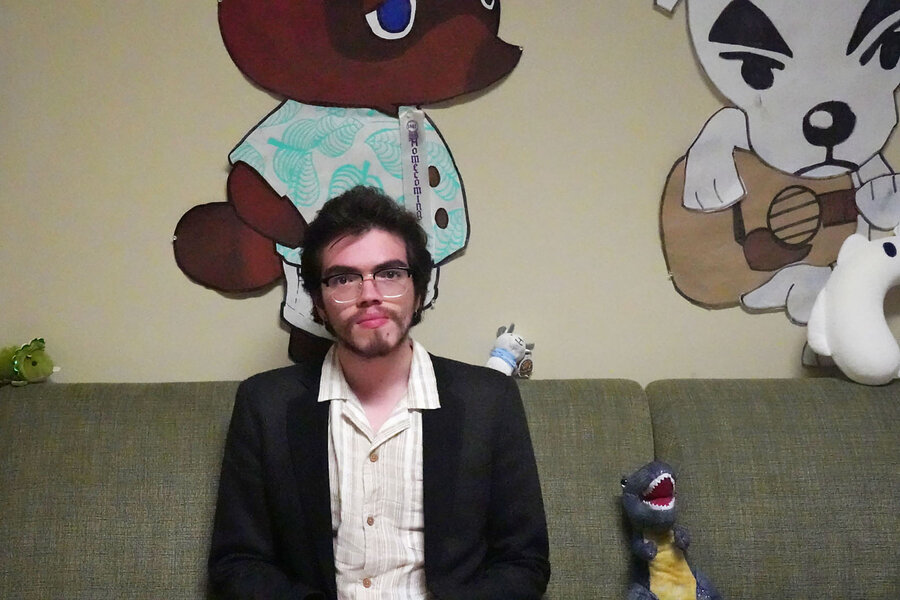
Students at the University of Texas at Dallas looking for print editions of The Retrograde might find themselves going on a scavenger hunt.
The administration granted the newly established independent student newspaper four newsstands on campus. By contrast, The Mercury, the university-supported newspaper, was allowed 36 locations.
“It’s censorship through access,” says Gregorio Olivares Gutierrez, a junior at the university who started the alternative newspaper last year after school leaders fired him from The Mercury over coverage of pro-Palestinian protests. He argues The Retrograde’s newsstands are placed in low-traffic buildings.
Why We Wrote This
At least six states are considering legislative proposals that protect the First Amendment rights of student journalists. Over the past year, tension between administrators and student newspapers has emerged at several universities.
Mr. Olivares Gutierrez sought support from the Foundation for Individual Rights and Expression, a free speech advocacy group, after the administration didn’t answer his requests to increase distribution sites. FIRE urged the university to “work towards fulfilling its First Amendment obligations and public commitments to student journalists, not undermining them,” in a Jan. 20 letter offering help with university policy revisions.
The controversy in Dallas is one example of mounting challenges student journalists face nationwide, from censorship to administrative stonewalling to the elimination of print editions. Last October, Indiana University administrators halted print editions of the Indiana Daily Student and fired the staff adviser in a dispute over news coverage in the paper.
Rather than take their notebooks and go home, many student journalists are taking action – enlisting free speech groups, filing lawsuits, or pushing for state-level legislation to protect their First Amendment rights. Many university administrators, meanwhile, are contending with the Trump administration’s use of lawsuits and withholding of research funding over what the White House calls a lack of ideological viewpoints on campuses.
“The last couple of years have been unlike any other. You have a commander in chief saying the press is the enemy of the people. If you really want to take out the media, you strangle them at the source, and that source is student journalism,” says Mike Hiestand, senior legal counsel at the Student Press Law Center.
Legal safeguards for student journalists
In some cases, student journalists have earned plaudits for their recent news coverage. The Harvard Crimson, for instance, broke news on Harvard University’s latest investigations of the school’s ties to Jeffrey Epstein.
More than one-third of counties nationwide lack any full-time local journalists, according to a July 2025 Nieman Journalism Lab report. Many places now depend on student reporters to cover city halls, school boards, and state governments. Student journalists account for 9% of state capitol reporters, according to a 2022 Pew Research Center report.
At the same time, many student newspapers depend on their school for funding. A February 2024 study by researchers at the University of Florida found that at least 56% of student newspapers receive some sort of funding from their college or university.
Public and private universities are pressuring student journalists out of a desire to keep donors happy and avoid antagonizing the Trump administration, says Jenna Leventoff, senior policy counsel for the American Civil Liberties Union.
“Universities … are asking themselves, ‘Do I want my funding to stay intact? Or do I want to support the paper?’” Ms. Leventoff adds.
Those tension points are why stronger legal protections for student journalism are necessary, free speech advocates say. And one of the best ways to do that, they suggest, is through state laws designed to protect freedom of the press for students.
Since the late 1980s, 18 states have enacted legislation known as “New Voices” laws that support student press rights, according to the Student Press Law Center.
This year, New Voices legislative efforts include proposals in Kentucky, Michigan, Missouri, New York, Pennsylvania, and Utah.
The New Voices movement emerged in response to the decision in the 1988 Supreme Court case Hazelwood v. Kuhlmeier, which permitted school officials to block the publication of certain articles in the school newspaper. Some First Amendment lawyers argue that the decision undermined the landmark free speech case Tinker v. Des Moines. That 1969 decision found that students and teachers do not “shed their constitutional rights to freedom of speech or expression at the schoolhouse gate.”
“What New Voices does is restore us to the Tinker standard, which permits censorship of student-run media only in narrowly defined, legally justified circumstances,” says Mr. Hiestand from the Student Press Law Center.
Laws on the books vary by state. Some, like Virginia’s, apply only to college students. Most provide protections for editorial independence, including safeguards for faculty advisers so they are shielded from retaliation if they refuse to censor student work.
Clashes on campuses
Mr. Olivares Gutierrez, who hopes to see New Voices legislation passed in Texas, remains energized as he awaits a response from the University of Texas at Dallas over the newsstand placement. (The Retrograde also publishes online.)
Before launching The Retrograde, the political science and philosophy major served as editor-in-chief of the university-backed paper, The Mercury. By Mr. Olivares Gutierrez’s account, university administrators fired him in September 2024 over the paper’s coverage of campus protests of Israel’s war in Gaza and allegations that he violated bylaws for student publications.
While Mr. Olivares Gutierrez was editor, The Mercury’s reporting raised questions over whether the university was right to bring in state troopers to dismantle a pro-Palestinian encampment on campus and arrest 21 people.
The paper also published an interview with an art history professor who was arrested. Afterward, a university administrator told Mr. Olivares Gutierrez in a meeting that he and the paper’s student managing editor had engaged in “journalism malpractice,” he said.
A staff strike ensued.
The following semester, Mr. Olivares Gutierrez and his colleagues founded The Retrograde, a fully independent newspaper. When it launched in January 2025, all 36 student members of The Mercury joined.
The University of Texas at Dallas declined to comment on The Retrograde’s effort to increase distribution sites. A spokesperson said in a written statement that The Mercury “has resumed publication with student journalists. The University of Texas at Dallas is committed to providing those students with a professional journalism experience in a manner that complies with applicable state and federal law.”
“It’s a crazy situation to be in, but it’s paramount we do this,” says Mr. Olivares Gutierrez. “We constantly talk about this as being a bigger issue than us. Journalists are under existential threat on campus and in the country.”
Echoes of the spat in Texas emerged in Indiana last fall. Administrators at Indiana University announced in October that print editions of the Indiana Daily Student would be discontinued for the rest of the academic year.
Leaders at the university’s media school had released a business plan that called for decreasing print production and limiting some editions to special thematic coverage without news. Jim Rodenbush, a staff member and the paper’s director of student media, refused to cut news content planned for the special Homecoming edition.
Print editions of the student newspaper resumed last November after a tidal wave of backlash from students, alumni, and journalists. Mr. Rodenbush, however, remains out of a job.
“It became increasingly harder to do my job,” says Mr. Rodenbush, describing pressure to shy away from controversial topics and make “as little noise as possible for the people on the outside.”
Mr. Rodenbush was let go because his “lack of leadership and ability to work in alignment with the University’s direction for the Student Media Plan is unacceptable,” according to a letter from the dean of The Media School obtained by the IndyStar.
A test case in California
A recent test of California’s New Voices law resulted in the reinstatement of Eric Gustafson as media adviser for Lowell High School in San Francisco.

A state court in January found that the school violated the law when administrators reassigned Mr. Gustafson because of controversial stories. Those included articles about student drug use and reports of sexual harassment by teachers.
“It was so clear that what was happening was censorship, even if that wasn’t the intent,” says Mr. Gustafson, who notes that the principal started reviewing student stories. “Here we are in liberal San Francisco, and this was old-school intimidation.”
The ruling is the first known test of California’s adviser-protection provision since its 2009 enactment.
In New York, Democratic State Sen. Brian Kavanagh has introduced New Voices legislation multiple times. It’s stalled out on every try. Mr. Kavanaugh reintroduced it again this legislative session. If passed, it would protect student expression in high schools except in certain cases, such as defamation. He attributes the bill’s failure largely to political pressure from school administrators.
“In my experience, most of those opposing an independent student newspaper generally value journalism in society, but they are under a lot of pressure from various stakeholders in their community, from parents to teachers,” he says.