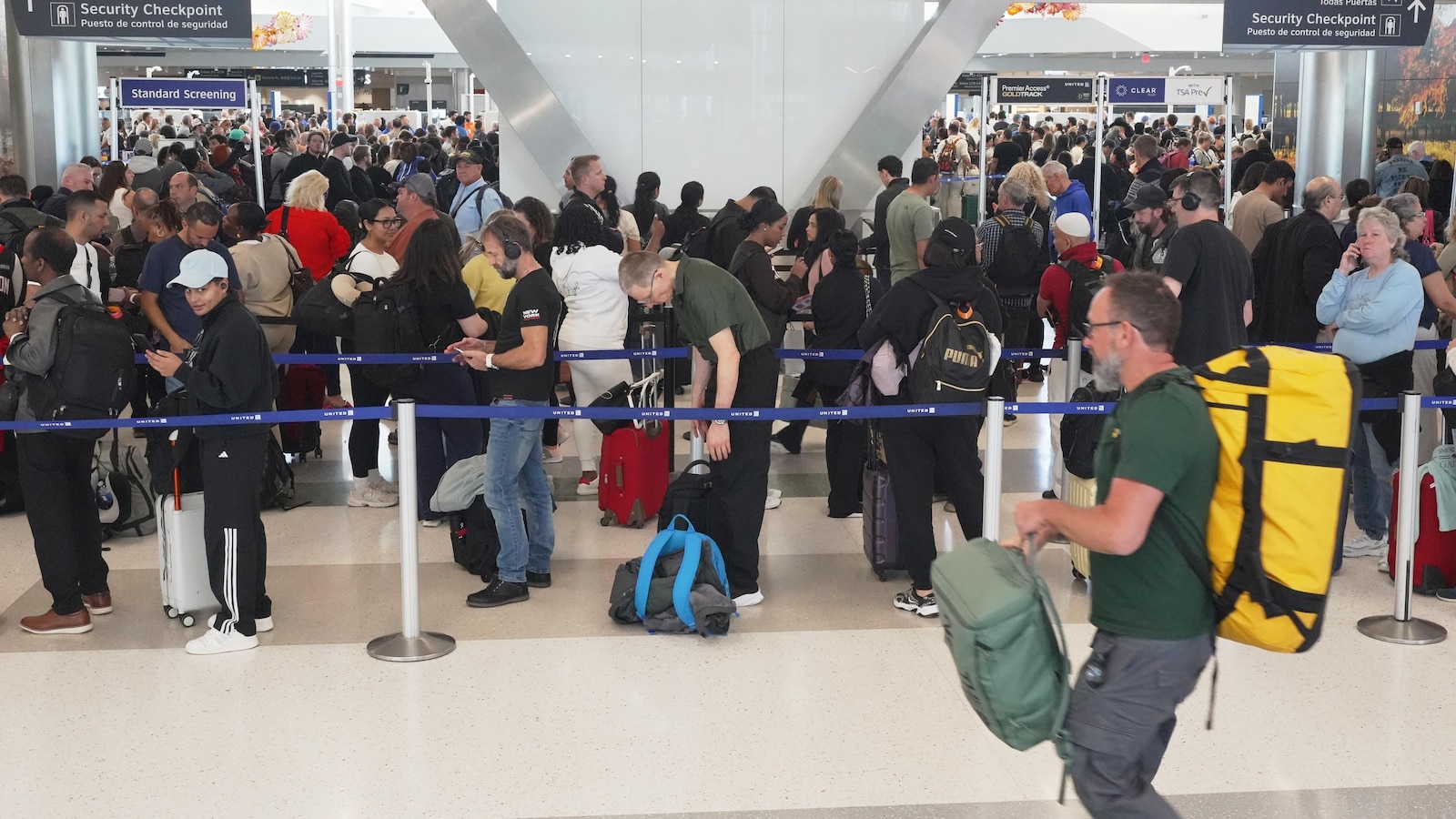
Scenes of airport security lines spilling out of terminals may be adding a new layer of stress for travelers as the busy spring break season unfolds.
Some airports have seen wait times stretch well past an hour. In recent days, passengers reported waiting up to two hours in line at Atlanta’s Hartsfield-Jackson International Airport, while people were advised to get to the airports in New Orleans and Austin, Texas, as much as three hours before their flights.
Many other airports reported wait times in line with normal conditions, making it difficult for travelers — especially those with upcoming trips or those accustomed to arriving at the last minute — to know what to expect.
The uneven delays are being driven by a mix of factors, including a partial government shutdown that has strained Transportation Security Administration staffing, along with heavy spring break crowds. The result is a patchwork of conditions that can shift quickly, even within the same airport.
That unpredictability makes checking TSA wait times before a scheduled departure a key step for airline customers right now.
TSA is not actively managing its sites during the shutdown, meaning the wait times listed on the MyTSA mobile app may not be accurate. Experts say the estimated wait times listed on third-party websites tracking TSA lines may also be outdated during the shutdown if they rely on publicly available data.
“Luckily, major airports tend to list those checkpoint times, terminal by terminal. I can’t think of a major one that doesn’t,” said Eric Rosen, director of travel content for The Points Guy, a travel and finance advice website.
The most reliable way to monitor wait times right now is by checking an airport’s websites and social media accounts, Rosen said, including the social platform X, where many airports have been sharing timely updates and guidance.
Still, travelers should keep in mind that airport conditions can change quickly, meaning any information might not reflect what is happening at a specific time.
Experts say it’s best to check airport conditions early and often. Waiting until a few hours before a flight can leave little to no margin for delays — for example, if the drive to the airport takes 45 minutes for a flight leaving in three hours.
The shutdown, which began Feb. 14, affects only the Department of Homeland Security, which includes TSA. It is the third funding lapse in a year that has left roughly 50,000 TSA agents working without pay and waiting for money from missed paychecks.
Employee absences are rising as the shutdown drags on because unpaid TSA workers face growing financial strain, making it harder to afford basics, like gas or childcare, while continuing to report for work, according to the American Federation of Government Employees, the union that represents most airport security screeners. Homeland Security has said at least 366 TSA agents have quit during the shutdown.
“It’s so hard to predict where these bottlenecks are going to pop up,” Rosen said. “One airport might have 30% of its TSA agents calling out in a certain day and 10% the next day. There’s just no way to know that in advance.”
Democrats in Congress have said Homeland Security won’t get funded until new restrictions are placed on federal immigration operations following the fatal shootings of Alex Pretti and Renee Good in Minneapolis earlier this year.
Tyler Hosford, a security director at global risk management firm International SOS, said travelers should take a proactive approach rather than relying solely on monitoring TSA wait times.
When booking travel, flying earlier in the day can be helpful, he said, because passengers would have more time to adjust their plans if something goes wrong — whether that means rebooking another flight, departing from a different airport or arranging a rental car.
“I always say you should have a Plan B under the best of circumstances,” Hosford said. “But I think we’re to a point where you need to start having Plan C, D and maybe even E.”
If travelers arrive at an airport with long lines, it doesn’t have to be a hopeless situation, Hosford said.
Passengers can ask staff at security checkpoints for an estimated wait time and whether any assistance is available to move through the line more quickly.
“Always talk to people. It can never hurt to ask,” Hosford said. “The worst they can say is, ’No, we can’t help you.'”
If that happens, he said, contact the airline — by phone, on their mobile app or on social media — to ask about options for rebooking.
“Never stay stagnant. You want to be moving forward trying to find your options,” he said. “It can feel exhausting, but the alternate is you potentially get stuck and miss your flight.”