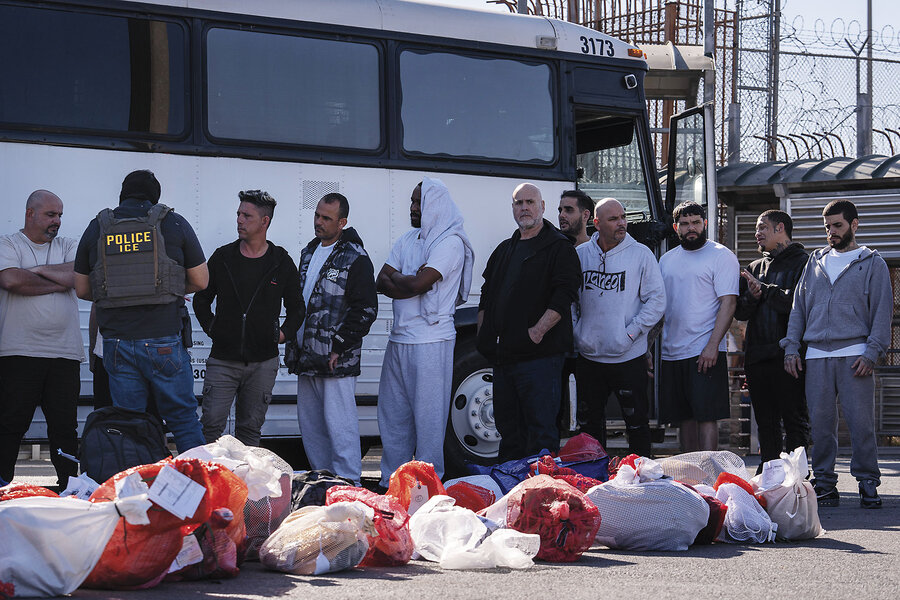
With some 68,000 immigrants in detention – as of February – and a goal of making space for up to 92,600 by this fall, Immigration and Customs Enforcement has roiled communities as it snaps up warehouses to hold those it hopes to deport.
After record-high illegal border crossings under the Biden administration, President Donald Trump ordered a whole-of-government crackdown on illegal immigration. His administration has also moved to end deportation protections for many immigrants lawfully here. Congress last year gave ICE a $45 billion check to expand detention and help fulfill Mr. Trump’s mass deportation goals, as arrests began to surge in the interior.
ICE says detention isn’t punitive, but ensures immigrants show up on their court dates and are already in hand when a judge orders deportation. Meanwhile, the Trump administration is broadly interpreting the reasons for mandatory detention and urging immigration judges to deny immigrants bond.
Why We Wrote This
The Department of Homeland Security has been buying up warehouses around the United States so that it can house more immigrants that it hopes to deport. Some communities oppose the new detention sites, while some local officials see economic opportunities.
As ICE buys warehouses that the agency says would hold 1,000 to 10,000 beds each, some communities are pushing back. Towns where new ICE sites could crop up are grappling with infrastructure and humanitarian concerns.
Newly confirmed Homeland Security Secretary Markwayne Mullin is reviewing where things stood under his predecessor, so, last week, DHS said it had paused new warehouse purchases. Mr. Mullin said during his confirmation hearing that he wanted to work with communities where detention centers were proposed.
Critics say the government uses harsh detention conditions to coerce “self-deportation,” and they raise concerns about access to medical care and legal counsel. DHS has denied such claims. Meanwhile, 14 people have died in ICE custody so far this year, reports analyst Austin Kocher, a professor at Syracuse University. (ICE did not respond to several questions sent by the Monitor.)
Why is ICE expanding its detention efforts?
The agency says it wants to “streamline” the deportation process and hold more people in fewer detention centers.
ICE sees detention as a way to guarantee deportations of those ordered to leave, as it’s easier to deport people from custody than to search for them. Despite the administration’s claims that it targets “the worst of the worst,” most ICE detainees have not been convicted of crimes. That said, civil immigration violations are enough to deport someone without a criminal history.
ICE has reportedly bought at least 11 warehouses around the country. Separately, ICE has also canceled 13 planned warehouse purchases, nearly all following local opposition, according to Project Salt Box, a website tracking the purchases through public records. The agency has said its goal is buying 24 “non-traditional facilities.”
How have communities responded to new proposed detention sites?
Reactions have been mixed. After local backlash, warehouse purchases have slowed significantly in recent weeks, says Michael Wriston, a former intelligence analyst and head of Project Salt Box.
From New Hampshire to Mississippi, elected officials and residents have voiced alarm over the facilities’ potential impacts on local resources and their suitability for human habitation. They say the federal government hasn’t consulted with them. Still, states and localities generally have little power to stop the federal government from buying up properties.
In Social Circle, Georgia, a city of 5,000, ICE purchased a warehouse where it plans to hold at least 7,500 detainees with 2,000 staff members. Once operational, the site will exceed the city’s entire sewage capacity and overwhelm local emergency resources, says City Manager Eric Taylor.
“I’m extremely worried,” says Mr. Taylor, adding that he locked a water meter at the facility in February to prevent water from being turned on. “[DHS officials] don’t seem to have any plans for how they’re going to address [the facility’s impact].”
Mr. Taylor says the only time he heard from Homeland Security regarding the warehouse was in mid-February, weeks after the $129 million purchase was made. During the meeting, he says, a federal official presented a sewage analysis that erroneously included an out-of-county treatment plant under Social Circle’s sewage system. Mr. Taylor says he has since reached out to DHS multiple times but hasn’t heard back.
In Bradford County, Florida, prisons are already a major source of employment, so county officials see a new ICE facility as a potential economic boost. County commissioners voted in January to refine a proposal to turn a vacant, county-owned warehouse into a facility holding at least 1,000 detainees for ICE. The facility would be run by Sabot Consulting, which the county sheriff says reached out to him with the proposal. The company did not respond to a request for comment.
Bradford County Sheriff Gordon Smith says he “totally supports” the idea. In his county of roughly 30,000, the project would create hundreds of “living-wage jobs,” he says, and bring infrastructure upgrades to the warehouse that the county can’t afford itself.
“If we don’t do something to bring more economic development to our community, we’re going to be in a real crisis,” the sheriff says.
How long can ICE detain immigrants in these centers?
“The courts have said that you cannot detain people forever,” says Kathleen Bush-Joseph, who until this month worked as a lawyer at the Migration Policy Institute. However, “sometimes people can languish in detention for long periods of time.”
In 2001, the Supreme Court ruled that ICE can’t indefinitely detain people who have final deportation orders. That case said they shouldn’t be held for more than six months if it appeared unlikely they would be deported. By contrast, courts haven’t set detention limits for people still awaiting outcomes in their immigration cases.
How long people are in detention can depend on a variety of factors. For those with cases still in immigration court, choosing to fight on and appeal can extend their stay.
Detention is “the cornerstone of the deportation process,” says Scott Mechkowski, a former deputy field office director at ICE, but it costs money. “Every day that you’re in custody, you’re costing taxpayers X amount of money.”
As much as immigrants want to get out of ICE detention, it’s not easy. They are not entitled to lawyers at the government’s expense. Still, immigrant detainees have been filing challenges to their detention in high numbers – on average, more than 200 a day, ProPublica reported in February.
Other logistical and even diplomatic barriers can block deportation and prolong detention. For example, some countries don’t cooperate in accepting their citizens.
Another wrinkle: Courts have both stymied and sped up federal attempts to bypass deportation roadblocks, with mixed rulings on plans such as third-country deportations.
What about children? How long can ICE detain them?
Whether a child is with a guardian matters. Under U.S. law, DHS generally can’t detain unaccompanied minors past 72 hours. By then, those children must be transferred to the Department of Health and Human Services. That agency housed on average 2,348 unaccompanied children in February.
Families, on the other hand, can be held in custody longer. Courts have interpreted a decades-old settlement agreement in a way that generally requires ICE to hold family groups including minors no longer than 20 days.
At the Dilley detention center in Texas, families with children have endured lockdowns, virus outbreaks, and worms in food, according to complaints. It is not clear yet whether any of the new facilities will hold families.
Over 900 children have been held beyond 20 days as of January, reports NBC News, citing data from court-appointed monitors.
The Trump administration, it seems, “is not taking those rules very seriously,” says Scott Shuchart, a former assistant director for regulatory affairs and policy at ICE. “It does seem like they’re detaining people, family groups, longer term.”