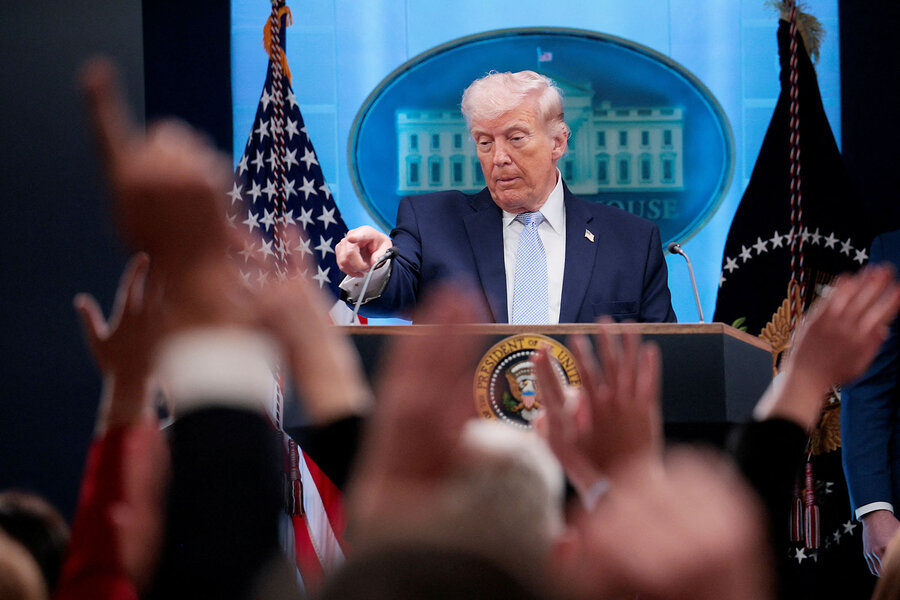
As the White House’s deadline for Iran to reopen the Strait of Hormuz looms amid reports that Tehran has rejected the latest ceasefire proposal, President Donald Trump intensified his rhetoric on Monday, warning that the “entire country can be taken out in one night – and that night might be tomorrow night.”
Mr. Trump alternately threatened to bomb Iran back to the “stone ages” and touted “significant” and imminent prospects for peace during a midday news conference. A reporter asked the president whether he is winding down the U.S. war or ramping it up.
“I can’t tell you,” he said.
Why We Wrote This
Despite President Donald Trump’s latest threats, diplomacy continues for an Iran ceasefire. He set an April 7 deadline to reopen the Strait of Hormuz shipping lanes, but he has moved deadlines before.
Was he concerned that carrying out threats to bomb Iran’s civilian infrastructure could constitute a war crime, as some experts in international humanitarian law have suggested? “No, not at all,” the president replied, adding, “I hope we don’t have to do it.”
On the podium, Mr. Trump had gathered Cabinet officials to share details of the rescue of a U.S. airman this past weekend involving “hundreds” of troops, including special operations forces.
“It was an incredibly brave and courageous mission,” said Air Force Gen. Dan Caine, the chairman of the Joint Chiefs of Staff. “Having the guts to try means so much to so many.”
This culmination of the promise of U.S. military forces — to leave no one behind — did not appear to temper the president’s resentment of the Iranian regime, however, or of the journalists who broke the news last week of the downed U.S. fighter jet and missing service member that set off an Iranian search.
“The person who did the story will go to jail” if they do not reveal their sources, President Trump said.
Hours after the airman was rescued on Easter Sunday, flying across the Iranian border into safe territory just after midnight, Mr. Trump issued an expletive-laden social media post threatening to blow up Iran’s bridges and power plants unless it reopened the Strait of Hormuz.
Threats and maneuvering
It was on March 26 that Mr. Trump set a 10-day deadline for Iran to reopen the Strait, where traffic has been largely halted since the U.S. and Israel attacked Iran five weeks ago.
Over the weekend, he extended that deadline by three days to April 7 at 8 p.m. Eastern. Mr. Trump said on Monday that he did this because Iran had asked for an extension.
“I can’t talk about the ceasefire, but I can tell you that we have an active, willing participant on the other side,’’ he said.
Egyptian, Pakistani, and Turkish envoys are said to have submitted a proposal for a 45-day ceasefire and a reopening of the Strait. “It’s not good enough, but it’s a very significant step,” Mr. Trump told reporters on the sidelines of the White House Easter Egg Roll on Monday.
The regime, for its part, has remained defiant and perhaps emboldened by help it is reportedly receiving from China in the form of satellite images of U.S. military assets in the Middle East, enhanced by artificial intelligence, that could be helping Tehran target U.S. forces, some analysts say.
Iranian leaders said they will reopen the critical waterway only after the U.S. pays reparations for war-related damages and energy losses throughout the country. The plan would put in place a new protocol requiring certain ships to pay a fee – in some cases up to $2 million, according to reports – for transiting the Strait.
“What about us charging tolls?” Mr. Trump said on Monday. “Why shouldn’t we? We’re the winner.”
A taunt, a threat, and a secret
During his turn at the lectern on Monday, Defense Secretary Pete Hegseth took the rescue of the downed F-15E weapons officer as an opportunity to taunt Iran.
The airman was “under the constant threat of Iranian forces closing in,” Mr. Hegseth said. “Ultimately, it was an impotent Iranian threat,” he added. “Iran is embarrassed and humiliated — and they should be.”
The weekend mission to extract the downed airman was high-risk and involved 155 aircraft. At least three of those aircraft were hit by what the president on Monday called “very, very heavy” Iranian fire.
Injured after ejecting from his fighter jet after it was struck, the downed flyer reportedly climbed 7,000 feet and nestled in a rock crevice as he awaited extraction from deep behind enemy lines.
Another U.S. military pilot whose aircraft was hit during the rescue mission managed to keep control of his plane until reaching Kuwaiti airspace before ejecting and being rescued.

When Mr. Trump turned to General Caine to ask exactly how many U.S. troops were involved in the rescue operation, the general replied, “I’d love to keep that a secret.”
Mr. Trump did share plans that he says are already in place, “where every bridge in Iran will be decimated by 12 o’clock tomorrow night,” and “every power plant will be demolished” if there is no peace deal.
As though to counter the “Trump always chickens out,” or TACO, sobriquet, the president said that after Iran shut down a prospective ceasefire last week, he gave an order to destroy Iran’s largest bridge. “Within 10 minutes after I gave that order, that bridge was over,” he said.
The strike on the newly built suspension bridge between Tehran and Karaj, one of Tehran’s premier infrastructure projects, killed eight people.
Some U.S. military analysts have raised concerns that threats to hit civilian infrastructure such as bridges and power plants could, if carried out, constitute war crimes under the Geneva Conventions.
Mr. Trump’s advisers have reportedly countered that roads and electricity are valid military targets.
The Defense Department employs upward of 10,000 military and civilian lawyers. And they have equal numbers of legal opinions, retired Air Force Gen. C.Q. Brown, a former chairman of the Joint Chiefs, said in a discussion at Harvard University last week.
U.S. military lawyers are often split on such questions, he said. “There are things that can be ‘rock-solid’ legal or ‘threadbare’ legal, because you can probably find a [DOD] lawyer someplace that will say, ‘That’s legal.’”
Mr. Trump said he would rather not strike Iranian power plants, particularly since “we may even get involved by helping them rebuild their nation.”
But he added on Monday that he is not concerned about the impact of potential massive strikes on Iran’s civilian population.
He claimed that when U.S. bomb strikes stop, Iranian civilians tell him that they are “upset” and ask the U.S. to “please come back.’’
“They would be willing to suffer that in order to have freedom,” he said.