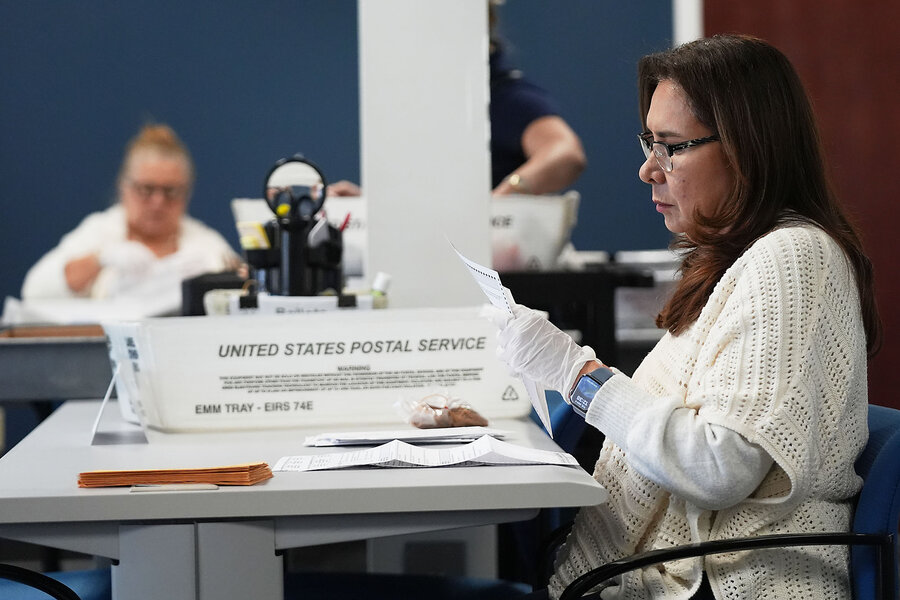
In more than two hours of oral arguments Monday, the U.S. Supreme Court debated whether federal law allows states to count mail-in ballots received after Election Day. A decision in the negative could alter voting procedures for at least 18 states and territories that count late mail-in ballots so long as they’re postmarked by Election Day.
At the heart of the debate before the court is what “Election Day” means.
“That’s been the central issue the entire time” as this case, Watson v. Republican National Committee, has worked its way through the courts, says Richard Briffault, a law professor at Columbia University. “Is the election completed when someone casts their ballot? Or when they are officially received and counted?”
Why We Wrote This
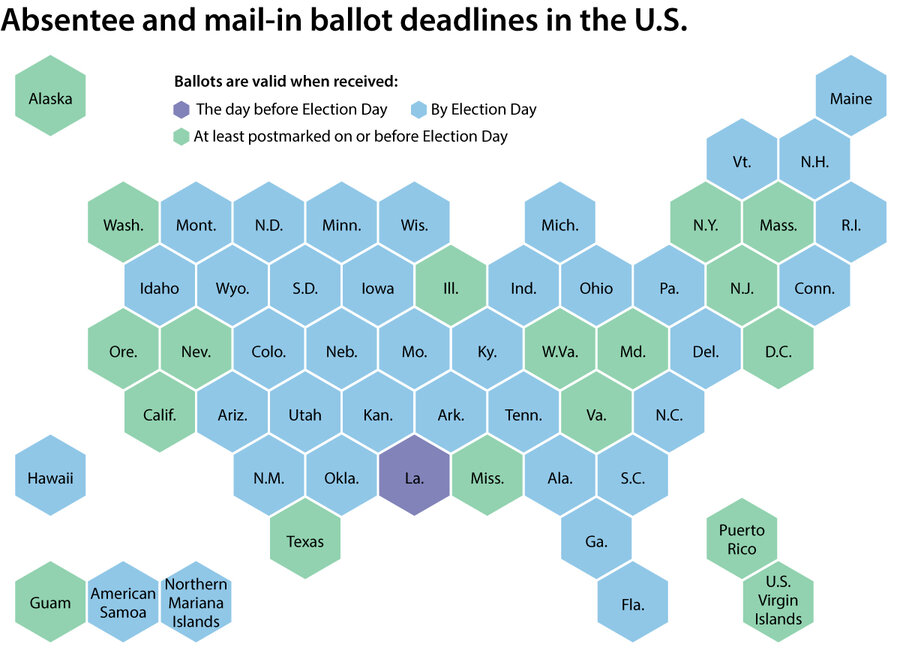
At least 18 U.S. states and territories allow officials to count ballots received after Election Day if they’re postmarked beforehand. The Supreme Court heard oral arguments on a case that could restrict this practice and affect this year’s midterm elections.
Many of the arguments Monday hinged on whether Mississippi, and other states that allow postmarked mail-in ballots to be counted, have violated federal election statutes. With their constitutional power to determine the timing of elections, Congress passed legislation in 1845 and chose the Tuesday after the first Monday in November as “Election Day” for the president and vice president. This law was expanded 30 years later to include congressional elections.
At issue is a statute from Mississippi, which in 2020 modified its election rules in response to the COVID-19 pandemic. The state’s law allows officials to count mail-in ballots received up to five business days after Election Day if they were postmarked by that day.
At least 13 other states allow grace periods for mail-in ballots that are postmarked by Election Day, though the exact length of that window varies. That practice expanded in the lead-up to the 2020 election, when six states extended mail-in deadlines in response to the COVID-19 pandemic. Additionally, 29 states and the District of Columbia allow extra time for mail-in ballots cast by service members and Americans abroad.
Since losing the 2020 presidential election, President Donald Trump has attacked mail-in voting, which surged that year due to the COVID-19 pandemic. Mr. Trump and other Republicans have accused mail-in voting as rife with fraud (although no evidence has substantiated these claims). Part of the context: This balloting method has typically been favored by Democratic voters, which undercuts early Republican leads as counting proceeds. As Republican House Speaker Mike Johnson recently claimed, several House Republican candidates were ahead on Election Day in 2024 before their leads were “magically whittled away” as mail in ballots were counted.
And while upending these states’ early voting rules would disproportionately affect Democrats, Republican voters rely on mail-in voting as well. As Justice Sonia Sotomayor pointed out during the oral arguments on Monday, late arriving military ballots helped push former Republican President George W. Bush over the line in the razor thin 2000 election.
Mail in voting wasn’t such a partisan issue before Mr. Trump began his crusade to end the practice. In April 2020, 70% of Americans favored allowing any voter to cast a ballot via mail according to Pew Research, including 49% of Republicans and 87% of Democrats. By 2025 that figure had dropped to 32% of Republicans.
How the justices analyzed the Mississippi case
Mississippi’s case began in 2024, when the Republican National Committee, the Mississippi Republican Party, a Mississippi voter, and a county election official challenged the post-election deadline in federal court. Weeks later, a Mississippi libertarian party filed a similar lawsuit, which was combined with the original.
The challengers argued that Mississippi’s policy conflicted with federal law designating a single election day. A district judge upheld the state law, prompting an appeal from the challengers. A panel of three judges on the U.S. Court of Appeals for the 5th Circuit reversed the district court’s decision, and the full court later declined to rehear the case. The Supreme Court agreed to take up the case last November.
On Monday, the court’s conservative majority seemed skeptical of Mississippi’s law. Justices Clarence Thomas and Neil Gorsuch repeatedly questioned the state’s lawyer on what makes a ballot final, and suggested that voters must make their choice on Election Day.
“We don’t have Election Day anymore,” said Justice Samuel Alito. “We have election month, or we have election months.”
Justice Brett Kavanaugh appeared to weigh practical concerns as well. He cited Richard Pildes, a law professor at New York University who argues that “charges of a rigged election could explode” if late-arriving mail-in ballots shift an election’s outcome late in the process.
Justice Kavanaugh also asked Paul Clement, who argued for the Republican National Committee, whether a decision against Mississippi would violate the court’s Purcell principle. That doctrine holds that courts should not alter election laws too close to voting. Mr. Clement replied that such a ruling would not violate the principle, since states would have ample time to implement changes before the midterms in November.
Justice Alito seemed similarly to zero in on the practical implications of Mississippi’s law, suggesting that it raises a number of questions about how elections ought to be run.
National Conference of State Legislatures
|
Jacob Turcotte/Staff
“Your position does require some difficult line drawing problems,” he told Scott Stewart, Mississippi’s solicitor general. The justice pointed to how much elections would rely on whoever delivers ballots, how long after Election Day they should be allowed to be counted, and whether they have to be postmarked.
The court’s liberal justices, by contrast, pushed back on the Republican National Committee’s position, arguing that states have a constitutional right to set their own election procedures. Justice Kentanji Brown Jackson repeatedly emphasized that the role of regulating elections belongs to Congress, not the courts, and suggested that Congress has granted states broad discretion to run elections.
“The question I think really is, ‘What did Congress intend with its statement about Election Day?’” she said. “Did it mean to cabin the states so that they did not have the discretion to make these kinds of decisions?”
As proponents of Mississippi’s law have argued, the history of federal election laws sets Election Day as the deadline for casting ballots – not for having the choices on those ballots registered. “Congress may determine the Time of chusing the Electors,” according to the Constitution, with “choosing” being the key word here, argues the Constitutional Accountability Center: “not the time of receiving, counting, or certifying those choices.”
Courts have traditionally held that the Constitution vests the power to run elections in the states – though Congress reserves the right to alter those regulations with federal legislation.
“This is a question about who decides,” says Leah Tulin, senior counsel at the Brennan Center for Justice, a liberal law and policy institute. “It’s clear that states decide on counting postmarked ballots after Election Day. And Congress could make a decision to adjust and change that and has not.”
Justice Elena Kagan also said that the RNC’s arguments could invalidate early voting as well as mail-in voting, a conclusion that the body’s lawyers denied. She also expressed concern that a ruling against Mississippi could make it harder for servicemembers abroad to vote. Many states, including Mississippi, allow those servicemembers to vote electronically rather than by mail.
Despite partisan breaks, the justices’ views might not break along simple lines. For example, questions from Justice Amy Coney Barrett, who is often a key swing vote, were harder to interpret than those from her conservative colleagues, says Professor Briffault.
“What stood out is that this is hard to read. There was vigorous argument on both sides,” he says. “I wouldn’t predict anything. I think it’s going to be close.”
Congress is also considering new voting legislation amid the legal debate. One such bill, the Make Elections Great Again Act, would mandate that mail-in ballots be received by the close of polls, among other measures. In a sharply divided Congress, the fate of that bill remains unclear. President Trump has largely focused public attention, however, on the SAVE America Act. That bill, which does not yet appear to have enough votes to pass, would require proof of citizenship to register to vote and a photo I.D. at the ballot box.
The court is expected to issue a decision by June.