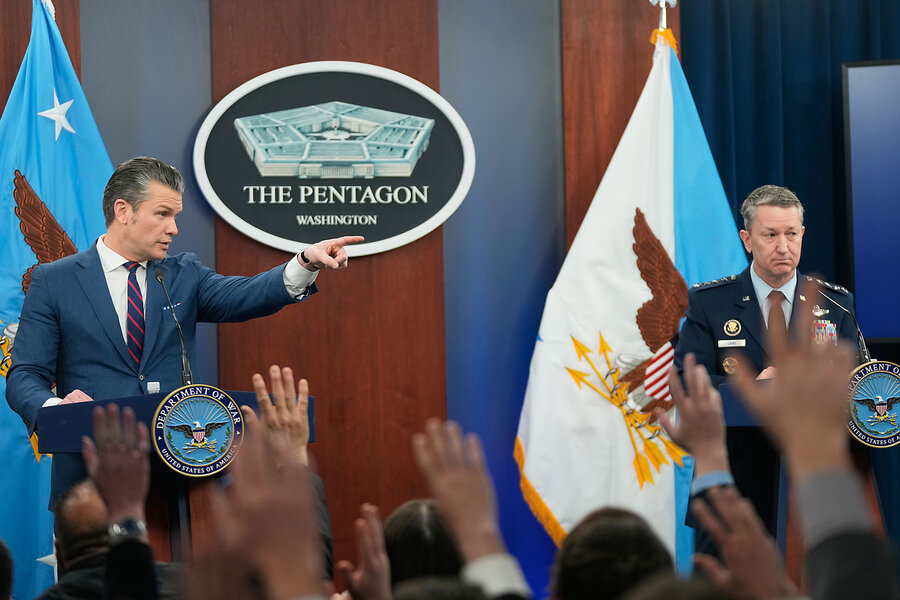
On a day when the Pentagon confirmed that six service members had been killed in the first days of the U.S.-Israel attacks in Iran, the nation’s top military commander warned Americans to brace for additional casualties.
The United States is now in “major combat operations” against Iran, which will involve “difficult and gritty work. We expect to take additional losses,’’ Gen. Dan Caine, chairman of the Joint Chiefs of Staff, told reporters at a news briefing on Monday.
These warnings have been a common refrain, echoed by President Donald Trump and Defense Secretary Pete Hegseth since the U.S. and Israeli attacks began early Saturday.
Why We Wrote This
Airstrikes against Iran were effective in the early days of the mission. But there’s more to do – both offensively and defensively – if the U.S. hopes to crack Iran’s regime.
By Monday, such expected losses were briefly feared to be borne out when footage began to circulate showing a U.S. F-15E fighter jet in a slow tailspin before crashing a few miles from Ali Al Salem, a U.S. military base in Kuwait. It was one of three U.S. warplanes downed by friendly fire from Kuwaiti air defenses, U.S. Central Command later confirmed.
And while all six of the U.S. military aircrew bailed out safely, the incidents served as stark reminders of the looming risks to the U.S. forces now massed in the Middle East.
The pace and scale of the U.S. military buildup is America’s largest in the Middle East since the Iraq War. And while the president has said that the use of force is needed to eliminate Iran’s nuclear capabilities, terrorist sponsorship, and long-range missiles, his administration’s ultimate military objective remains unclear, some analysts say.
The targeted strikes against Iranian leadership signal the ambitious goal of regime change. But Mr. Hegseth pushed back on that at Monday’s briefing. “This is not a so-called regime change war,” he said. President Trump has openly and repeatedly called for the Iranian people to overthrow their government. Even without its supreme leader, Ayatollah Ali Khamenei, the regime in Tehran remains in place.
While the administration’s narrative might be debated in Washington and across the country, “at least regime attitude change” is clearly a significant operational objective, says retired Rear Adm. Mark Montgomery, a senior fellow at the Foundation for Defense of Democracies.
As Mr. Hegseth laid it out on Monday, the U.S. military intends to “destroy Iranian offensive missiles, destroy Iranian missile production, destroy their navy and other security infrastructure — and they will never have nuclear weapons.”
Mr. Trump, for his part, has said that there are “many, many outcomes” possible for the current Iranian conflict, called Operation Epic Fury by the administration.
U.S. lawmakers, among others, are urging him to elaborate. “I mean, what is the strategic goal, and how do we achieve it?” Democratic Sen. Mark Kelly of Arizona asked on Sunday on NBC’s “Meet the Press.”
Debate also continues over whether the president’s Iran actions violate the 1973 War Powers Resolution. Though some say it falls under the chief executive’s self-defense authority, many argue that a prolonged conflict requires congressional approval.
The answers will shape the days ahead for the U.S. military, as it continues to launch airstrikes in what it says is an effort to empower internal Iranian opposition to overthrow the government of Mr. Khamenei, who had helped lead Iran since the 1979 Islamic Revolution. The supreme leader was killed on Saturday as U.S. and Israeli airstrikes targeted his compound in Tehran.
Yet there’s more to do, analysts say, if the goal is toppling the regime.
Protecting U.S. forces, their families, and allies from ongoing missile barrages is also becoming more difficult as defensive weapons are beginning to run low. Pentagon planners have been grappling with a diminished supply of missile interceptors needed to protect U.S. troops and allies from counterattacks. Qatar, meanwhile, is also reported to have only a four-day supply of Patriot interceptors remaining, given current usage rates.
As Iranian missiles and drones struck over the weekend near U.S. military installations – including Al Udeid Air Base in Qatar, Ali Al Salem in Kuwait, and the headquarters of U.S. Navy forces in Bahrain – thousands of U.S. military personnel and their families in the region were ordered to evacuate and abandon high-rise apartments for safer ground.
In Iran, the Red Crescent Society reported that at least 555 people have been killed by U.S.-Israeli strikes.
Naval buildup and logistics questions
The current U.S. naval “armada,” as President Trump calls it, includes two aircraft carrier battle groups and 16 other surface warfare ships. This means that roughly 40% of the Navy’s ships are engaged in operations in the Middle East, notes an analysis from the Center for Strategic and International Studies (CSIS).

More than 100 aircraft were launched over the weekend from land and sea in the Iranian attacks. And the first wave of strikes came from Tomahawk missiles launched by Navy ships. In total, the U.S. military fired “tens of thousands of pieces of ordnance,” General Caine said. It’s an effort, he added, that “continues to scale.”
The U.S. military debuted its new one-way LUCAS drones – for Low-cost Unmanned Combat Attack System – to target Islamic Revolutionary Guard Corps (IRGC) command-and-control facilities, as well as Iranian air defenses and drone launch sites, according to U.S. Central Command.
At Monday’s news briefing, General Caine alluded to forces being stretched thin as he made mention of Vermont Air National Guard units that had been mobilized for Venezuela but were redirected to support the operation across the Atlantic “instead of going home.”
And while the current U.S. military contingent is capable of carrying out strikes against Iran, “it lacks Marines, special operations forces for raids and ground operations, and the logistics for an extended air campaign” that could last weeks, the CSIS analysis adds.
Mr. Hegseth confirmed on Monday that there are no U.S. boots on the ground in Iran, though he didn’t expressly rule out the possibility in the days ahead. But the use of ground troops is improbable, given the current U.S. force posture, says retired Col. Mark Cancian, a defense analyst at CSIS.
“They’re sending out a few forces for force protection, but not anything that could be used for an invasion of Iran. There’s not even Marines aboard ships,” he says. “Air power alone has never been able to effect regime change. So, they need something else.”
“Destruction is not the strategy”
For now, while Israel focuses on the north of Iran, including Tehran, the U.S. will likely continue to strike at Iranian naval targets in the south, analysts say. U.S. forces have destroyed nine Iranian ships so far, in part to prevent the regime from being able to close the Strait of Hormuz.
As of Monday, the waterway’s commercial traffic had dropped significantly, with major shipping lines suspending operations following increased threats, vessel attacks, and navigation system disruptions by the IRGC.
Another Trump administration goal will be to reduce Iran’s ability to retaliate against U.S. forces “now and in the future,” says Admiral Montgomery, who also served as a policy director for the Senate Armed Services Committee under Sen. John McCain.
“You just don’t want them striking back,” as they have been at U.S. bases and allies in the past days, he says. “This hurts, [to see] people getting killed.”
Mr. Hegseth alluded to this during Monday’s news briefing when asked about the cause of death for four U.S. service members. While the U.S. has powerful air defenses, “Every once in a while, you might have one [enemy missile], unfortunately – we call it a ‘squirter’ – that makes its way through,” he said. “And in that particular case, it happened to hit a tactical operations center that was fortified. But these are powerful weapons.”
While the U.S. has enough offensive missiles to wage a four-to-six-week campaign against Iran, the shortage of missiles used in defensive systems continues to be a concern for America’s military. The U.S. also has limited counter-drone capabilities on the ground.
“I would prioritize a lot of effort into reducing their offensive strike capability,” says Admiral Montgomery, who estimates that Iran “still has more than half of their stuff left” to fire at U.S. forces.
In the meantime, some analysts say they are still waiting for the U.S. to articulate a strategy.
The Trump administration “has described target sets that they’re going to go out and destroy. Those are military objectives, maybe, on the way to a strategy,” Mr. Cancian says. “But just destruction is not the strategy.”