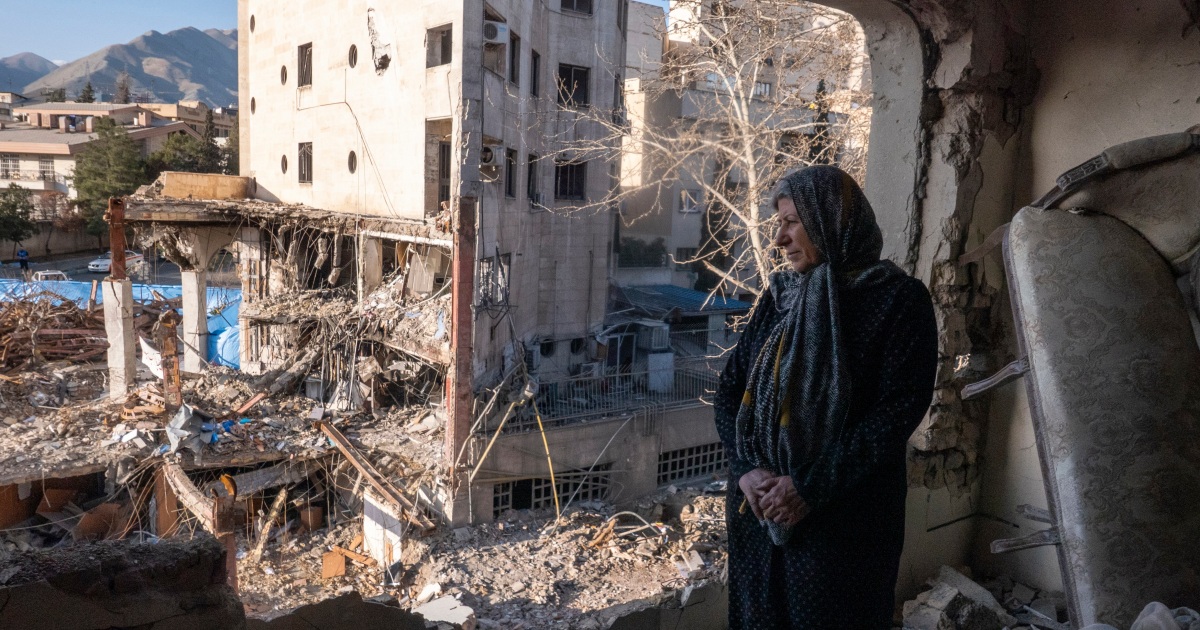
Tehran has threatened to escalate strikes on energy infrastructure and target critical water desalination facilities, should President Donald Trump make good on a promise to “obliterate” the country’s power plants if it does not reopen the Strait of Hormuz.
Trump on Saturday evening gave Tehran a 48-hour deadline to reopen the critical trade route, through which around 20% of the world’s oil passes, threatening in a post on Truth Social to target Iran’s energy infrastructure if the demand is not met.
Iran has effectively blocked the strait since the U.S. and Israel launched their attacks on the country on Feb. 28, sparking swift retaliation from the Islamic Republic and triggering a wider war in the region.
Threats of retaliation
Tehran on Sunday morning showed no signs of backing down, responding to Trump’s ultimatum with its own threat of retaliation as it vowed to strike U.S. and Israeli infrastructure in the region in response to any attack on its power plants.
“If Iran’s fuel and energy infrastructure is attacked, then fuel, energy, information technology systems and desalination infrastructure used by America and the regime in the region will be struck,” Col. Ebrahim Zolfaqari, spokesman for Iran’s Khatam al-Anbiya military command headquarters, warned on Sunday, according to the IRNA Iranian state news agency.
Desalination, the process of creating drinkable water from seawater, is critical to supplying water across Israel and many of Iran’s Gulf neighbors.
Mohammad-Bagher Ghalibaf, speaker of the Iranian parliament, echoed those threats in a post on X on Sunday, warning that “critical infrastructure, energy and oil across the region will be irreversibly destroyed and oil prices will rise for a long time” if Iran’s power plants are struck.
Trump’s ultimatum came as the war consuming the Middle East entered its fourth week, with Iran targeting a joint U.K.-U.S. base in the Indian Ocean on Saturday, while nuclear sites in both Iran and Israel were attacked.
The Iranian judiciary’s official news agency, Mizan, reported that there was no leakage following the strike on its Natanz nuclear facility.
The International Atomic Energy Agency said that no abnormal off-site radiation levels had been observed following that attack, or from an Iranian strike close to an Israeli nuclear site in Dimona.
‘Limited options’
Ross Harrison, a senior fellow at the Middle East Institute and author of “Decoding Iran’s Foreign Policy,” said Trump’s threat suggested the president is facing “limited options to open the strait – and I think that may be dawning on him.”
“Unless they completely obliterate all potential for the Iranians to respond, which is, I don’t believe would be the case, military means alone to open the strait probably would not have the desired effect of easing up on the oil markets and on pricing,” Harrison said in a phone interview Sunday.
FORSUBSCRIBERS
02:30
Trump weighing several options for U.S. troops inside Iran
00:0000:00
“The ships are not going to are not going to pass, and insurance companies aren’t going to insure ships as long as it’s an active war,” he said.
With Iranian attacks on ships in the area of the Strait of Hormuz effectively closing it off to maritime traffic, oil prices have soared globally, with retail gas prices rising 93 cents per gallon, and the price of U.S. crude oil going up more than 70% since the start of the year.
Iran has allowed a small number of vessels to transit through the strait. Ali Mousavi, the country’s representative to the U.N. maritime agency, told China’s state news agency Xinhua on Friday that vessels except those that “belong to our enemies” could seek Tehran’s permission to pass, though Iran has attacked a number of ships that are not American or Israeli.
The Trump administration said Friday it had lifted some sanctions to allow the sale of oil produced in Iran in the latest bid to temper soaring energy prices. Meanwhile, earlier this month, it also lifted the Jones Act, easing some shipping regulations on oil, with some sanctions on Russian oil also lifted temporarily.
Trump has repeatedly called on U.S. allies to aid in clearing the Strait of Hormuz to little avail, telling reporters on Friday that China, Japan and NATO should be intervening.
Unlikely to capitulate
Aniseh Bassiri Tabrizi, an associate fellow at Chatham House’s Middle East and North Africa program, said it was “unlikely” Tehran would “cave into the pressure” Trump is seeking to build.
“I think this is the result of lack of planning and the fact that the Trump administration didn’t foresee the … response from the Iranian side,” she said on Sunday. “But the threats are not likely to have any impact and Iran is actually going to continue trying to escalate the costs, thinking that this is the only way for the U.S. and therefore for Israel as well to stop threatening further action once this war is over.”
Harrison said it was time for Trump to start looking for a viable off-ramp to exit the war against Iran, rather than “moving up the escalation ladder.” The question remained, however, whether Tehran would be willing to “let him leave” the spiraling war.
Ali Abdollahi Aliabadi, Commander of Iran’s Khatam al-Anbiya Central Headquarters, said on Sunday that the armed forces’ military doctrine had “changed from defensive to offensive” and that “battlefield tactics” had been adjusted accordingly, the semiofficial Fars news agency reported.
“The outcome of the war depends on the will of both sides and in Iran there is unified determination among the people, fighters and leadership to continue until the aggressor is punished, damages are compensated and future deterrence is ensured,” he said.