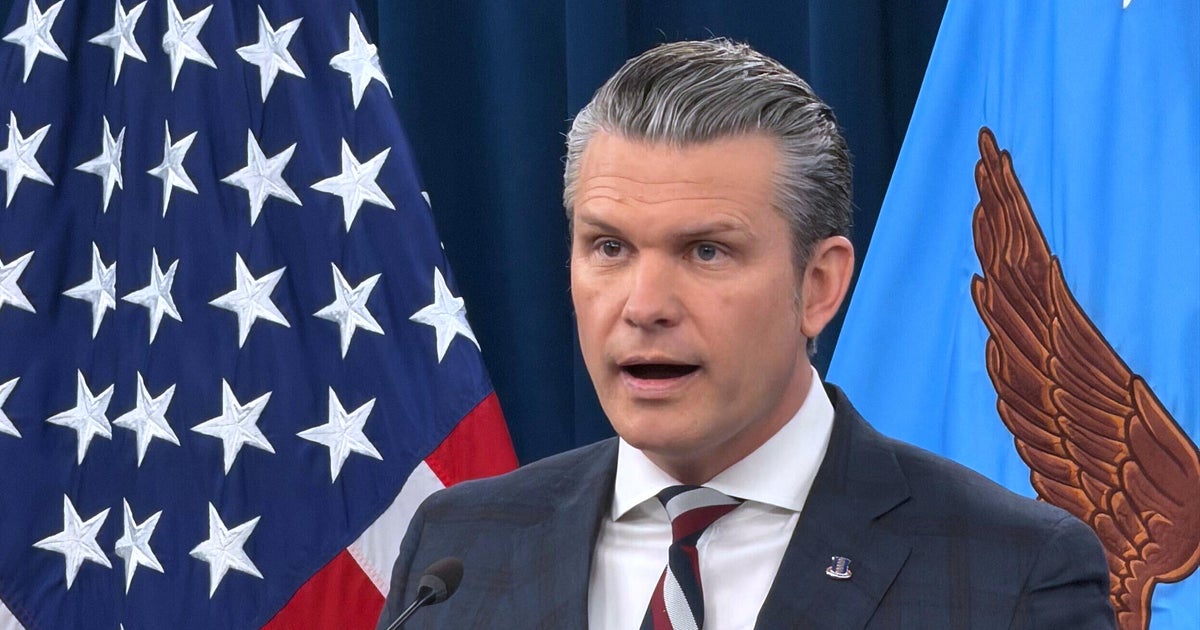
A federal judge has struck down some of the Defense Department’s strict controls on how journalists with access to the Pentagon are allowed to report — ending a policy that caused many news outlets to leave the Pentagon.
U.S. District Judge Paul L. Friedman sided with the New York Times and a reporter at the newspaper, Julian E. Barnes, who sued in December, arguing the new Pentagon policy violated the First Amendment, Fifth Amendment and due process provision of the Constitution.
The Pentagon rolled out its new press access policy last fall, requiring credentialed reporters to sign onto a host of restrictions in order to maintain daily access to the building.
Many media organizations — including CBS News, ABC News, NBC News, CNN and Fox News — declined to sign the new rules and stopped working out of the Pentagon on a day-to-day basis. The Pentagon’s in-house press corps is now mostly made up of conservative media outlets that agreed to sign.
Friedman’s ruling halts some of the restrictions that news outlets objected the most strenuously to, including one section that suggested reporters who “solicit” classified or sensitive information from military personnel could be deemed a security risk and barred from the building. He also struck down a section that referred to Pentagon access as a “privilege” rather than a “right.”
Some sections were left in place, including restrictions on where reporters are allowed to go in the Pentagon without an escort.
In a social media post, Pentagon spokesperson Sean Parnell said, “We disagree with the decision and are pursuing an immediate appeal.” The Justice Department did not immediately respond to requests for comment.
In a statement provided to CBS News Friday evening, the Pentagon Press Association said that it “celebrates the decision by a federal judge today that the Pentagon’s press credentialling policy violated the U.S. Constitution,” and called for the “immediate reinstatement of the credentials of all PPA members.”
The Pentagon has argued that it isn’t forcing reporters to clear their stories with the military, and is instead trying to protect national security by preventing leaks of highly sensitive information. The military also says it has tried to negotiate with news outlets. But many reporters who cover the military, and the Pentagon Press Association, argued the policy could effectively restrict journalists from interacting with sources without the government’s permission.
Friedman ordered the Pentagon to reinstate Barnes and several other Times reporters’ press passes, and vacated key parts of the policy. It’s not clear what the impact will be on other news outlets.
The judge said he “recognizes that national security must be protected, the security of our troops must be protected, and war plans must be protected.”
“But especially in light of the country’s recent incursion into Venezuela and its ongoing war with Iran, it is more important than ever that the public have access to information from a variety of perspectives about what its government is doing—so that the public can support government policies, if it wants to support them; protest, if it wants to protest; and decide based on full, complete, and open information who they are going to vote for in the next election,” he said.
Friedman found that the restrictions on “soliciting” information were so vague that it wasn’t clear what kinds of conduct did and didn’t violate the rules, so “one could easily predict that journalists would opt not to ask any questions rather than risk losing their [credential].”
He also argued that the policy violates the First Amendment by engaging in viewpoint discrimination, writing that it seeks to chill critical speech and “weed out disfavored journalists.”
The Pentagon has argued that its new policy isn’t aimed at punishing certain outlets or discriminating against views that it disagrees with, pointing to the military’s efforts to negotiate with news outlets.
Friedman pointed to instances of Defense Secretary Pete Hegseth and other top Pentagon officials criticizing news outlets in harsh terms. He said the evidence “tells the story of a Department whose leadership has been and continues to be openly hostile to the ‘mainstream media’ whose reporting it views as unfavorable,” and warmer to more supportive outlets.
And he pointed to the fact that right-wing influencer Laura Loomer was allowed access to the Pentagon despite setting up a “tip line,” even though a similar request for tips by The Washington Post was deemed inappropriate.
That issue was raised during a court hearing earlier this month, when Friedman grilled government lawyers on why Loomer’s tip line was permitted and the Post’s wasn’t
“Is the Washington Post tip line criminal solicitation?” Friedman asked.
“I don’t think so, your honor,” Justice Department attorney Michael Bruns responded.
“You’re not clear whether the Washington Post tip line constitutes criminal solicitation?” Friedman asked again.
“No, your honor,” Bruns said.
“So, if you’re not clear, how can they be clear?” Friedman retorted.
Bruns then told Friedman that The Washington Post tip line was problematic because it asked for information from military members, while Loomer’s is more general in nature.
In another tense exchange during that hearing, Friedman said he has lived through many military and national security conflicts, from the Vietnam War to the Sept. 11 attacks, and noted that through those events, the press played a vital role in helping the American public understand what its government was doing.
Regarding the Vietnam War, he said that “the public, I think it’s fair to say, was lied to about a lot of things,” and added, “A lot of things need to be held tightly and securely, but openness and transparency allow members of the public to know what their government is doing.”