NEWYou can now listen to Fox News articles!
President Donald Trump’s suggestion that Iranian oil infrastructure could be a U.S. target sent oil and gasoline prices higher on Monday, as traders weighed the risk of a deeper confrontation that could further exacerbate global energy supplies.
On Friday, Trump ordered strikes on military assets on Iran’s Kharg Island, a strategically vital island in the Persian Gulf that serves as Tehran’s largest oil terminal and a key hub for its crude exports. Over the weekend, he raised the prospect of another bombing raid targeting the island’s oil infrastructure.
“We can do that on five minutes’ notice. We have it all locked and loaded and ready to go if we want to do it,” he said. “We chose not to do it. I chose not to do it again. We’ll see what happens,” Trump told reporters on Air Force One.
A satellite image shows an oil terminal at Kharg Island, Iran, Feb. 25, 2026. (2026 Planet Labs PBC/Handout via Reuters)
The island, located roughly 35 miles off Iran’s Bushehr province in the country’s southwest, is about the size of New York City’s Central Park but carries huge importance for Iran’s economy.
It has a loading capacity of about 7 million barrels per day, and roughly 90% of Iran’s crude oil exports pass through it. Most of those exports are shipped to China and India, underscoring the island’s importance not only to Iran’s energy trade but also to broader global oil markets.
Fears of a fresh strike sent oil prices higher Monday, as traders braced for the possibility that fighting could further disrupt exports from the Persian Gulf, including through the Strait of Hormuz, a critical shipping corridor for global energy supplies.
BEFORE-AND-AFTER SATELLITE IMAGERY OFFERS A RARE LOOK AT DAMAGE INSIDE IRAN
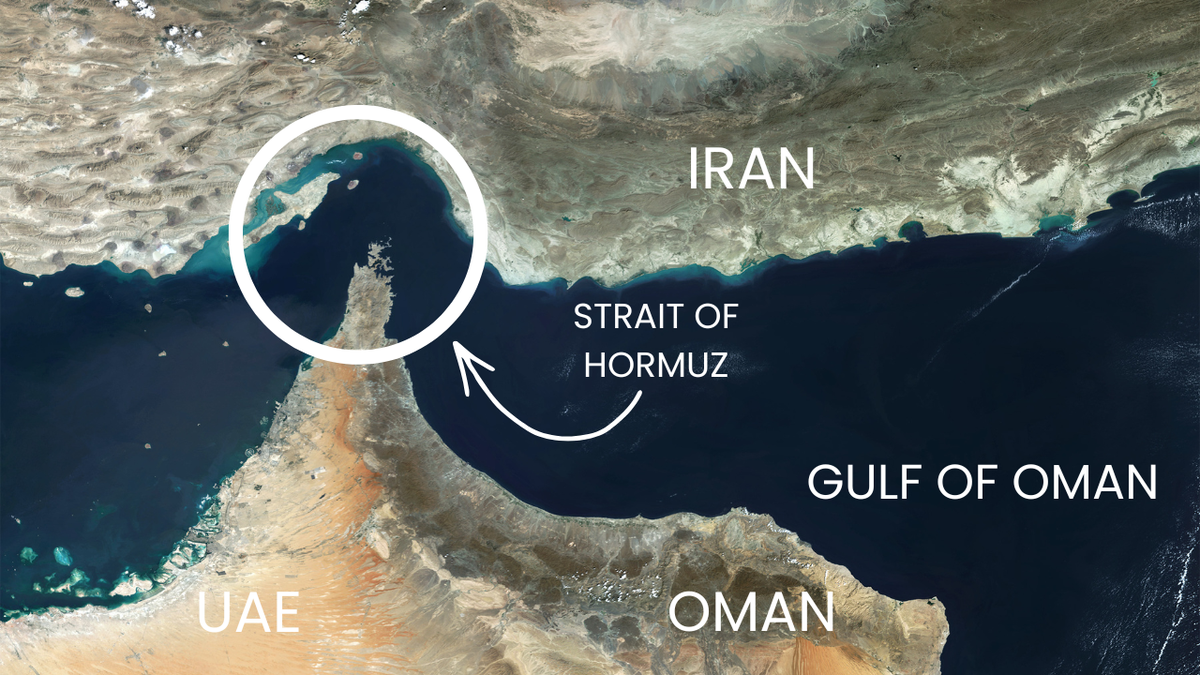
A satellite image shows the Strait of Hormuz, a key maritime passage connecting the Persian Gulf to the Gulf of Oman, vital for global energy supply. (Amanda Macias/Fox News Digital)
Those concerns helped drive oil above $100 a barrel last week for the first time since 2022, as fallout from the U.S.-Israeli conflict with Iran roiled global markets and investors priced in the risk of tighter supply.
Now, that surge is beginning to hit consumers. As crude prices climb, gasoline and diesel prices are rising quickly — especially diesel, which often reacts faster because of its close ties to freight and industrial demand.
As of March 16, AAA put the national average for regular gasoline at $3.70 a gallon, up 77 cents from a month earlier, while diesel climbed to $4.97, up $1.31 over the same period.
THE UNLIKELY TOOL TRUMP IS EYEING TO TACKLE RISING OIL PRICES AMID THE IRAN CONFLICT
Price increases have not been spread evenly across the country. The lowest averages were in Kansas, North Dakota and Oklahoma, at roughly $3.08 to $3.14 a gallon, while the highest were in California, Hawaii and Washington.
“Americans today will spend $275 million more on gasoline than they did before the U.S. attacked Iran, now totaling nearly $2.5 billion since the start,” wrote Patrick De Haan, head of petroleum analysis at GasBuddy.
The run-up has extended beyond gasoline and diesel.
In the U.S., the Argus U.S. Jet Fuel Index — a daily benchmark averaging prices in Chicago, Houston, Los Angeles and New York — climbed to $3.88 a gallon on Friday, after hovering mostly in the low-to-mid $2 range for weeks.
TRAVEL IS ABOUT TO GET MORE EXPENSIVE AS IRAN CONFLICT SPARKS JET FUEL CRUNCH
Higher fuel prices could ripple through the broader economy if they persist, raising costs for airlines, trucking firms and other businesses that depend heavily on transportation. For consumers, sustained increases at the pump also threaten to squeeze household budgets at a time when inflation remains a key concern.
What happens next will likely depend on whether the conflict escalates further and whether oil infrastructure or major shipping lanes are affected.
CLICK HERE TO DOWNLOAD THE FOX NEWS APP
With that risk in mind, the White House is weighing steps to protect commercial shipping through the Strait of Hormuz and considering the use of emergency oil stockpiles to help blunt the impact.
Before boarding Air Force One for Mar-a-Lago late Friday, Trump told reporters the U.S. Navy may begin escorting tankers through the strait “very soon.”