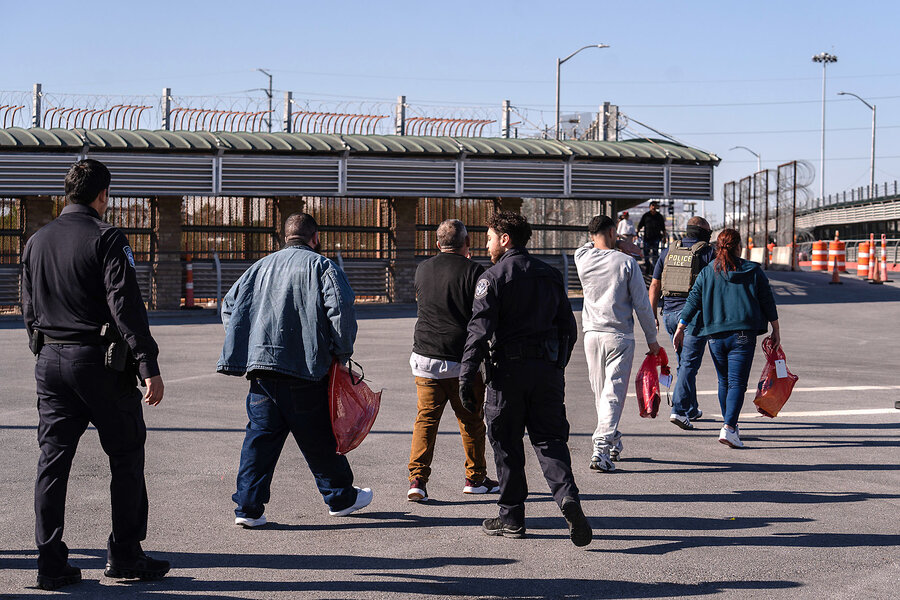
The Trump administration is signaling a shift in immigration enforcement to more workplace arrests as hard-liners in the president’s base push him to begin a second, broader phase of his promised mass deportations.
Some inside the White House have reportedly urged less talk of mass deportations ahead of the congressional midterms, as Americans express dissatisfaction with the high-profile immigration arrest tactics in the heartland. But a network of Trump allies says the administration will not achieve its deportation goals without pursuing a much larger pool of targets.
Following the confirmation of Homeland Security Secretary Markwayne Mullin last month, the coalition is pitching a reset away from a stated goal of deporting the “worst of the worst” to “populations that are easier to remove,” such as immigrants with final orders of removal and those who have overstayed their visas. Policies such as worksite enforcement will be key, the group’s plan says, raising the risk of the pushback seen after earlier workplace raids.
Why We Wrote This
Conservative groups allied with President Trump are calling for the White House to broaden its immigration enforcement strategy with worksite raids to deport anyone in the country illegally. Some critics say the government has already been doing that, but hard-liners want more to achieve the president’s promised mass deportations.
After the Mass Deportation Coalition published its recommendations last week, White House border czar Tom Homan told Fox News, “You’re going to see more worksite enforcement operations coming.”
Expanding deportations
President Donald Trump pledged the largest deportation operation in U.S. history. After record-high illegal border crossings under the Biden administration, the White House has wielded a wholesale crackdown that has ended status even for immigrants lawfully living in the United States.
While the government withholds key statistics, formal removals of immigrants so far appear to number in the hundreds of thousands. (Also among the coalition’s demands is full transparency by the Trump administration about its enforcement numbers.)
Enter the Mass Deportation Coalition, a collection of conservative groups ranging from Washington insiders to college Republicans. The group says it formed in February.
One high-profile member is the Heritage Foundation, the conservative Washington think tank behind Project 2025. The Trump administration has implemented about half of that blueprint for a complete overhaul of the federal government.
Another key voice is Mark Morgan, a former Border Patrol chief during the Obama administration, who also served as acting head of Immigration and Customs Enforcement, and Customs and Border Protection in Mr. Trump’s first term.
Amid concerns about aggressive immigration enforcement – and what the public’s response to that might mean for the midterm congressional elections – “there is a push within the administration, and among many conservatives, to back off,” Mr. Morgan says, adding that the president campaigned on a clear promise: historically high deportations.
Expanding worksite enforcement could boost those numbers, while encouraging “self-deportations” – people who leave because they’re afraid the federal government will apprehend them – and deterring illegal entries, says Mr. Morgan. He also says the administration shouldn’t just prioritize unauthorized immigrants with criminal records.
The goal: at least 1 million deportations this year. “Everyone that’s here illegally should be removed,” he says.
Asked about the coalition’s goals and the administration’s plans, Abigail Jackson, a White House spokesperson, said in a statement that no one is changing the administration’s immigration enforcement agenda. “President Trump’s highest priority has always been the deportation of illegal alien criminals who endanger American communities.”
Lacking consensus
The GOP has generally united around arguments that illegal immigration strains public resources and introduces public-safety risks, though research contradicts assertions that immigrants are more likely to commit crimes than Americans.
But surges in interior enforcement have shown cracks in the conservative base, from the Oklahoma governor questioning the president’s “endgame” to Florida sheriffs raising concerns about the scope of immigrant arrests. Public outcry, including from some Republicans, followed the killings of two U.S. citizens by Department of Homeland Security law enforcement in Minneapolis.
With that in mind, the White House in recent weeks has asked Republican lawmakers to de-emphasize mass deportations. An analysis by Politico of official social media accounts marked a similar retreat – at least in messaging.
Last year, federal raids at farms, factories, and other jobsites shook red and blue states alike. Arrests of workers at a Hyundai plant in Georgia even caused a diplomatic rift with South Korea. As public outrage grew, the government ping-ponged between pausing and then promising more arrests. Mr. Trump himself acknowledged the toll on employers at the time.
The farming and hospitality sectors report that “our very aggressive policy on immigration is taking very good, long time workers away from them,” he wrote in a June post.
Mr. Morgan says the coalition doesn’t support “random patrols in sanctuary cities,” and immigration officers shouldn’t be “walking the parking lots of Home Depot or Target.” That’s not efficient, though enforcement must expand in other ways, he says.
“If Congress doesn’t want the executive branch to enforce the laws that they passed, then Congress should change them,” Mr. Morgan says.
What should enforcement look like?
Immigrant advocates also want reforms, but say DHS flouts legal standards that already exist. This year, the government has violated over 300 court orders related to immigrant detention, according to the publication Lawfare.
“We need some actual respect for the rule of law, for the laws that exist on the books,” says Sarah Mehta, deputy director of policy and government affairs at the American Civil Liberties Union. She rejects the government’s claims of targeting “the worst of the worst,” noting how children, military spouses, and lawfully present refugees have been swept up in arrests. U.S. citizens, too.

Secretary Mullin says he wants to keep DHS out of lead stories in the daily news. “But large-scale enforcement operations against people that are contributing to and sustaining our communities?” says Ms. Mehta. “That does the exact opposite.”
Moving forward, more worksite enforcement “might take a less visible form,” says Mark Krikorian, executive director of the Center for Immigration Studies. There may be fewer raids but more “briefcase enforcement,” he says, such as audits.
Still, targeting more workplaces could double deterrence, says Mr. Krikorian, whose think tank supports low immigration but isn’t part of the new coalition. More jobsite scrutiny not only nudges unauthorized immigrants to consider leaving the country, he says, it also “gives your employer more incentive to say, ‘Look, you know, I can’t keep you here.’”
Reality check
Beyond Washington, however, solutions aren’t straightforward. Not at Glenn Valley Foods in red-state Nebraska, which federal agents targeted last year.
The Mass Deportation Coalition calls for moving the whole employee verification process online and mandating a system called E-Verify. The owner of the Omaha meatpacking plant says he does use E-Verify. But Homeland Security still detained more than 70 of his workers in a June raid.
“The government is the problem. It’s not the immigrants,” says Gary Rohwer, owner of Glenn Valley Foods. He says workers buy false IDs knowing the system to catch them fails. Mr. Rohwer also says the government’s widespread termination of work permits has jeopardized his workers’ employability.
“They’re family-oriented. They pay taxes. They show up for work on time,” he says. “I can’t hire Americans. They won’t do the work.”