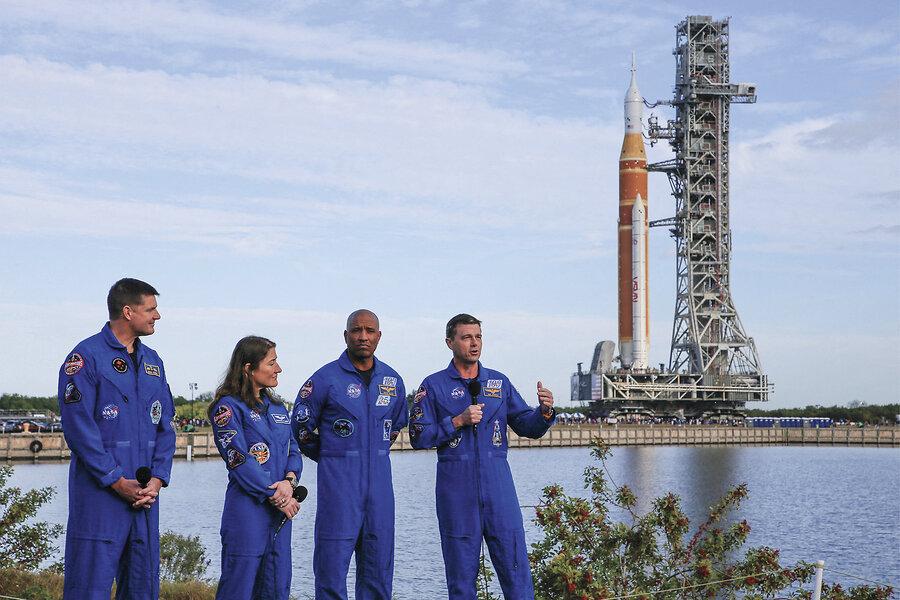
The Artemis program’s Space Launch System has a maximum speed of more than 24,000 miles per hour, but it still isn’t fast enough to escape comparisons to Apollo 11.
Yet, those preparing the SLS (to use its NASA-designated acronym) have loftier ambitions than matching the Apollo program in taking humans to the moon and returning them safely. The Artemis program – which uses the SLS as its main launch vehicle – aims to both return Americans to the moon and begin creating a long-term human presence in outer space.
Artemis is NASA’s first venture in what can be described as the third era of human space travel. The 1960s race between the United States and the Soviet Union to land a man on the moon is viewed as the first era.
Why We Wrote This
The Artemis II mission will take astronauts beyond low-Earth orbit for the first time in 50 years. This next era of the U.S. space program marks a step toward building a permanent presence in outer space.
It ended with a definitive American victory when Neil Armstrong planted the U.S. flag on the lunar surface in July 1969. The second era – embodied by the space shuttle and the International Space Station (ISS) – heralded a focus on reusability as well as cooperation between nations and the private sector.
This third era is a blend of the previous two. Both the U.S. and China are pushing to return humans to the moon by the end of this decade. Meanwhile, international coalitions and private aerospace companies are sketching out ambitious visions for a lunar-centered space economy that can advance technology on Earth and help fuel (literally) further exploration into deep space.
The Artemis program “is huge, it is historic. But it’s also important that it is not a flags-and-footprint thing anymore,” says Jan Osburg, a senior engineer at RAND.
“We have the technology, we should have the management capability and the political will to make it something that lasts beyond just a handful of missions,” he adds.
A new space race?
NASA aims to launch the Artemis II mission as soon as April 1. The roughly 10-day mission aims to fly four astronauts around the moon and back to Earth, testing the SLS, the Orion spacecraft, and every other engineering and communications system that NASA and its private partners have built for the Artemis program.
The mission will take astronauts beyond low-Earth orbit for the first time in 50 years, and the four-person crew will include the first woman, the first person of color, and the first Canadian to fly around the moon. (The Artemis name is a nod to other NASA eras: In Greek mythology, Artemis is the twin sister of Apollo.)
This year’s mission follows Artemis I in 2022, which performed an uncrewed orbital flight around the moon. The Artemis IV mission, tentatively scheduled for 2028, is when NASA hopes to land humans on the moon for the first time in more than half a century.
The 2028 timeline is notable. China has been making steady progress with its own lunar exploration program, the Chang’e Project, and aims for a moon landing by 2030. Not much information comes out from the China National Space Administration (CNSA), but observers say that Chang’e is enjoying steady progress, aided by the country’s autocratic government being able to fund the program as it sees fit.
It has all the hallmarks of a new space race. For NASA, that might not be a bad thing. “Portraying this as a new space race, like the 1960s, can be an effective political argument that frees up money from the White House and Congress despite demands to reduce the deficit,” says Marcia Smith, a veteran space policy analyst. “I’m not sure it’s actually true, but it’s an effective argument politically and financially at this time.”
Some in the space exploration community say a longer-term outlook is needed. Getting humans back to the moon first might have symbolic significance, but this era of space travel will be defined by achieving a long-term human presence beyond low-Earth orbit. In that context, some experts say, rushing might be the wrong approach.

“Sustained human presence on the moon is an ultra-marathon, not a sprint,” says Bruce McClintock, head of the Space Enterprise Initiative at RAND.
“A century from now, in my view, nobody is really going to care who got there first.”
Mining the moon
In January 2025, Elon Musk – the billionaire founder of private space company SpaceX – described the moon as “a distraction” from Mars.
Just over a year later, however, he has changed his tune.
“SpaceX has already shifted focus to building a self-growing city on the Moon,” he wrote in a social media post on Feb. 8. “The overriding priority is securing the future of civilization and the Moon is faster.”
A stated long-term goal of NASA is to “expand permanent human presence beyond low-Earth orbit.” Artemis is intended to lay the groundwork for that permanent human presence. This government-led effort, NASA hopes, could lead to a new “space economy” on and around the moon.
There is some skepticism, however.
“The idea of a sustained presence on the moon is orders of magnitude more complicated than just sending somebody to the moon,” says Mr. McClintock.
This process was scheduled to begin with Artemis IV and the construction of a small moon-orbiting space station, known as Lunar Gateway. The station would allow astronauts to live for extended periods in space, conduct scientific experiments, more easily access the lunar surface, and stage for missions to Mars and into deep space. With Artemis IV now focused on a lunar landing, however, the proposed station has been sidelined. In late March, NASA Administrator Jared Isaacman said the agency is “pausing Gateway in its current form and focusing on infrastructure that supports sustained operations on the lunar surface.”

In turn, as Mr. Musk’s dream of a “Moon city” illustrates, this presence could lead to private industry establishing a new economy beyond low-Earth orbit.
Most experts agree that it won’t happen overnight, however.
“I don’t think people are really comprehending the difficulty,” says Ms. Smith, the space policy analyst.
The lunar south pole is attracting lots of scientific and commercial interest, for example. It is believed to hold large amounts of water ice, a resource that is chemically different from ice on Earth and could be vital for human missions and settlements.
“But this ice is in permanently shadowed craters … and these craters are at minus-250 degrees [Fahrenheit], so mining that ice [will] be extraordinarily difficult,” Ms. Smith says.
This dynamic has already unfolded in low-Earth orbit, which extends to about 1,200 miles above the planet’s surface. From the 1980s through the 2010s, governments developed efficient ways to launch into this region of space. This enabled the construction and continued maintenance of the ISS.
Launches to low-Earth orbit, including the space station, are now routine. In 2025, SpaceX launched more than 120 Starlink communication satellites, averaging one launch every few days. The company’s Starlink-based internet service is now its main revenue driver.
But what helps make these services profitable is the relative affordability of accessing low-Earth orbit. The moon is 100 times farther away, making it much more expensive and dangerous for companies to reach. Discussions so far have focused on ventures such as mining the moon for critical minerals, as well as building private space stations for research, manufacturing, and tourism.

Recent surveys have found the moon to be rich in resources, including minerals, water ice (chemically complex deposits that could be turned into rocket fuel), and helium-3 (which could be used as fuel for nuclear fusion). The lunar economy could be worth around $170 billion over the next two decades, according to a 2021 PricewaterhouseCoopers analysis. NASA has partnered with a variety of commercial space companies in the hopes of stimulating a self-sustaining economy on and around the moon.
The discussions are almost entirely hypothetical. Few private companies have consistently launched a rocket beyond low-Earth orbit.
“Space is a very, very hostile environment, and it’s chokingly expensive,” says Joan Johnson-Freese, a senior fellow with Women in International Security and a former professor at the U.S. Naval War College. “I don’t think we can say much about a potential space economy until we have routine access to the moon. Otherwise, it’s aspirational rather than real.”
Preserving unity
When humanity first began venturing into space, only the United States and the Soviet Union were involved. That has changed dramatically over the past six decades. More than 70 nations had space programs as of 2023, and international collaboration has defined human space exploration since the space race.
Astronauts from 26 countries have visited the ISS. Key partners on Lunar Gateway include the European, Japanese, Canadian, and United Arab Emirates space agencies.
NASA has also been gathering global signatories to its Artemis Accords. Drafted in 2020, the accords lay out “best practices to enhance the governance of the civil exploration and use of outer space.” Sixty-one nations had signed on to the agreement as of January. Two notable exceptions: China and Russia.
China is looking for 50 countries to join its International Lunar Research Station project, a scientific outpost planned for the lunar south pole. Russia is China’s main partner on the project, but other nations have signed on as well. Seventeen countries and international organizations have joined, the Chinese government announced last year.
Both programs describe themselves as science-focused. But as the U.S. and China advance their respective moon missions, the geopolitical undercurrents are undeniable.
“They are deliberately trying to pull undecided nations into their orbit,” says Mr. Osburg, the RAND engineer.
“That doesn’t necessarily mean there has to be conflict between those two,” he adds. “Hopefully, as lunar exploration is going to take place, there will be cooperation between these two different systems and organizations.”
How meaningful these multinational agreements are in the long term remains to be seen. But recent shifts in the global international order are worrying members of the space community. For example, as tensions between it and the U.S. have heightened amid threats of tariffs and annexation, Canada has strengthened its relationship with China.
As America recalibrates its leadership role, there are concerns that changes on Earth could have ripple effects in outer space. And that could have consequences for every nation aiming for the stars.
Both China and Russia have had spacecraft hit by space debris recently, for example, and space debris is only expected to become a bigger problem in the coming years.
“Things like space debris can only be dealt with on an international basis,” says Dr. Johnson-Freese. “We’ve had that international cooperation in the past. How long it can continue, I think, is a big question.”
For now, with the Artemis program funded by Congress through 2032, the U.S. is a leader in returning humans to the moon. After two launch delays, Artemis II is hoping to lift off in early April. A successful lap around the moon would represent one small step toward returning to the footprints first left by Apollo 11.
John Logsdon was at Cape Kennedy that July morning in 1969. He saw the Saturn V rocket light up, and he heard the roar as it climbed through a blue sky toward the moon.
It was exhilarating, recalls Dr. Logsdon, a professor emeritus at George Washington University and founder of its Space Policy Institute. No Artemis launch will compare, he adds, but he is excited for the U.S. to go back.
“Going the second time is never going to have the impact of going the first time,” he says. “But if we’re going to go into space, we should explore, we should go beyond Earth orbit.”