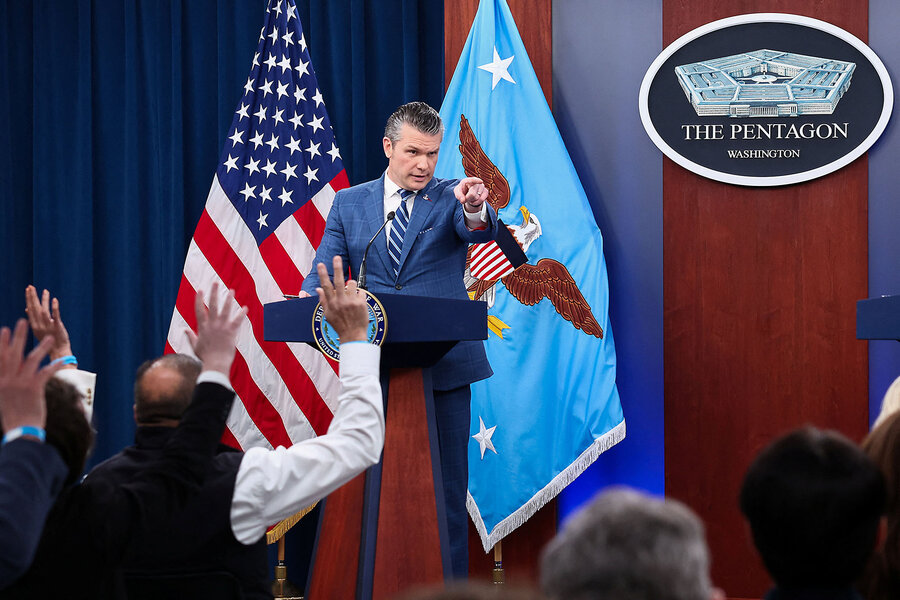
The United States paused its 38-day war against Iran on Wednesday, with President Donald Trump appearing eager to declare victory and Defense Secretary Pete Hegseth saying the military, “for now, has done its part.”
Announcing a two-week ceasefire just minutes before the Tuesday deadline he had set for reopening the Strait of Hormuz – an ultimatum that included threats that “a whole civilization will die” – President Trump hailed the truce as a “big day for world peace.” The Iranian regime has “had enough,” he said.
But hours after the truce, Iran and Gulf Arab countries reported new attacks, Israel bombarded Lebanon, and Iran once again closed the strait, through which 20% of the world’s oil flows, raising concerns about whether the deal would hold.
Why We Wrote This
President Donald Trump and his defense secretary are boasting of military success. But Iran’s peace proposal, which Mr. Trump says is a “workable” basis for talks, appeared to reflect Iran’s wishes without making meaningful concessions.
Meanwhile, the Trump administration came under criticism for being willing to negotiate an Iranian 10-point peace plan that appeared to give that country significant concessions while not addressing America’s stated reasons for starting the war.
Secretary Hegseth claimed “a capital V military victory,” and Iran’s army and navy suffered tremendous blows, analysts agree. Indeed, there was little doubt going into the war that America’s armed forces could beat Iran’s.
The question was at what cost – and to what end.
For now, all sides can make the case for victory. For the Iranian regime – more hardened than ever, some analysts say – success means having survived. For the U.S. and Israel, the win is in claiming to have dramatically curbed Iran’s ability to strike out militarily against the rest of the world.
At the Wednesday briefing, Mr. Trump said the U.S. action had resulted in a “very productive regime change” in Iran, while Mr. Hegseth seemed to blur the definition of what, exactly, regime change means.
“It’s a new group of people who’ve seen the full capability” of the U.S. military with “a new calculus about what it means to negotiate with us,” Mr. Hegseth said.
What the Iran peace plan says
Iran has submitted a 10-point peace proposal that Mr. Trump said Wednesday is a “workable basis on which to negotiate” with “almost all of the various points of past contention” resolved. The two-week ceasefire, announced Tuesday night, will allow the deal to be “finalized and consummated,” Mr. Trump added.
Under these terms, Iran’s military could retain its current control of the strait. And Iran and Oman could charge transit fees of up to $2 million on selected ships that pass through the waterway, with the collected funds used for postwar reconstruction rather than using reparations from the U.S. and Israel, according to other reports. The waterway operated under international, not Iranian, control before the war began, analysts point out.
When asked Wednesday morning whether the Strait of Hormuz, which Iran had effectively closed, was now reopened to ships, Gen. Dan Caine, America’s top military officer, did not appear certain. “I believe so,” he said.
Some leaked details of the peace proposal suggest that Iran is seeking acceptance of its right to continue with its nuclear enrichment program. Many analysts argue that such a concession by the U.S. is an unlikely prospect, since it would run counter to one of Mr. Trump’s stated reasons for attacking Iran in the first place.
This is bolstered by The New York Times reporting this week that the Trump administration, during talks in the February run-up to the war, offered to fund Iran’s nuclear fuel indefinitely to get the country’s civilian energy program going. That move, the report said, was to test whether Iran’s regime was truly interested in benign nuclear energy resources, as it claimed, or nuclear weapons. Iran reportedly rejected the offer, making the administration’s case, some officials argued, that the regime remained focused on developing a nuclear bomb.
At the Pentagon, officials say, they will soon be focused on retrieving enriched uranium that remains buried under rubble since the U.S. strike on Iran’s nuclear facilities last June.
“Right now it’s buried, and we’re watching it. We know exactly what they have,” Mr. Hegseth said Wednesday. The regime will give it to the U.S. “voluntarily,” or the U.S. will “take it out,” he added.
Destruction of many, but not all, weapons
Eager to bolster their claim of victory, Pentagon officials on Wednesday emphasized the destruction that the war had wrought on Iran’s military.
The U.S. has destroyed roughly 80% of Iran’s air defense systems, as well as 450 ballistic missile storage centers and 800 facilities that housed attack drones, General Caine said. The U.S. has also sunk 90% of Iran’s Navy, with 150 ships, along with half of its small attack boats, now “at the bottom of the ocean,” he added. Some 95% of Iran’s naval mines have also been decommissioned, according to military intelligence that the general cited.
But as these numbers suggest, Iran still has firepower. About 20% of Iranian air defenses are still functional, some analysts said. The number of storage facilities that U.S. and Israeli strikes have destroyed sounds impressive. Still, the remaining capacity is difficult to evaluate without knowing the overall total, Kelly Grieco, a senior fellow at the Stimson Center, said in a post on the social platform X.
And while the U.S.-Israel force’s destruction of 95% of Iran’s mines sounds promising, it leaves the Middle Eastern nation with potentially hundreds of mines, Ms. Grieco added. That’s plenty of explosives that could be used to close the strait again.
Analysts, meanwhile, remain split on how quickly Iran could rearm should the regime decide to do so. It could also reposition its weapons systems, including the shoulder-fired missile launchers known as MANPADS that shot down a U.S. F-15E fighter jet last week, setting off a search and rescue mission for two crew members.
The Pentagon is now analyzing the details of the downed fighter jet, including the “tactical lessons learned,” General Caine said.
For now, the U.S. military will ”be hanging around” the region to ensure Iran complies with the ceasefire, Mr. Hegseth said.
In the meantime, as Wednesday wore on, there were concerns about whether the ceasefire would hold as the United Arab Emirates reportedly carried out airstrikes on an Iranian refinery in retaliation for earlier Iranian strikes on the UAE’s infrastructure.
Even as military leaders were fielding reporters’ questions in Washington, Lebanon was undergoing some of the most intense attacks from Israel since the war began. Closing the strait once again was Iran’s response.
When asked whether there would be some “grace period” for the exchange of strikes to end, Mr. Hegseth was philosophical.
“It takes time, sometimes, for ceasefires to take hold,” he said.
Another reporter asked the Secretary whether the U.S. is still encouraging protesters in Iran to rise up, or whether it is satisfied with the country’s current leadership.
“They’re brave people,” he said. “We wish them the best.”