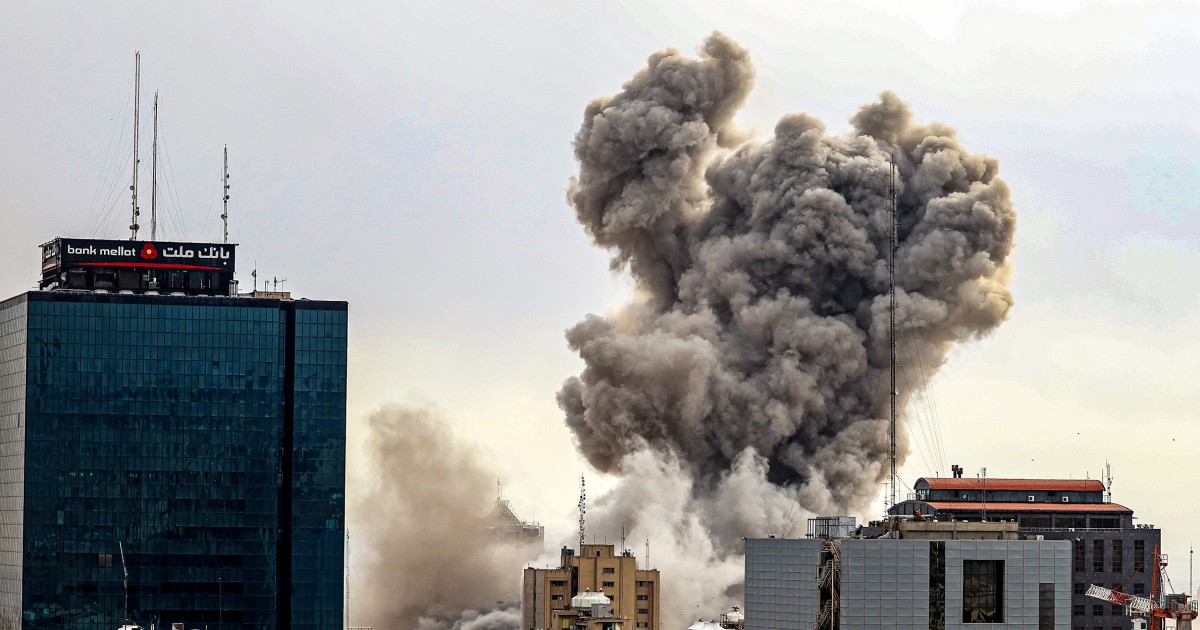
WASHINGTON — Top Trump administration officials told lawmakers in classified briefings Tuesday to expect an “overwhelming” and bigger wave of military strikes on Iran in the coming days.
“This regime is in its death throes. The amount of firepower coming in the next day or two from us is going to be overwhelming,” said Sen. Lindsey Graham, R-S.C., a key Trump ally and defense hawk who had been urging President Donald Trump to launch military strikes against Iran for months.
“What’s coming in the coming days from us is going to be a lot bigger than it’s been in the last couple of days. The Arabs are in the fight now, so stay tuned,” Graham continued. “What’s coming toward the remnants of the regime is going to be overwhelming. The liberation of Iran is at hand. The gateway to peace is about to open.”
Leaving the closed-door Senate briefing, Sen. Josh Hawley, R-Mo., said he learned that the scope of Operation Epic Fury is “very broad,” “rapidly evolving” and “really changing by the hour.”
Sen. Andy Kim, D-N.J., a former State Department official who also worked in national security roles in the Obama White House, confirmed that administration officials told lawmakers that a larger wave of strikes would target Iran.
Secretary of State Marco Rubio and other briefers for the administration told members of Congress “that we should expect even stronger strikes going forward, which is, again, just ominous for the protection of American citizens in the region,” Kim told reporters. “This is only just the beginning of what several of them said is going to be a very long operation. This is a war. This is the Iran war.”
Those comments were consistent with the message Rubio delivered to reporters just hours earlier.
The U.S. will “unleash” on Iran in “the next few hours and days,” Rubio, a former Senate Intelligence Committee chairman, told reporters before Tuesday’s briefings.
Just a day earlier, he told reporters in the Capitol that the “hardest hits are yet to come.”
Rubio briefed House and Senate lawmakers on Tuesday alongside Defense Secretary Pete Hegseth, CIA Director John Ratcliffe and Gen. Dan Caine, the chairman of the Joint Chiefs of Staff.
Both chambers are preparing to hold votes on resolutions to curb Trump’s ability to carry out additional military action in Iran. The Senate will vote Wednesday afternoon, but the resolution is expected to fail, given that nearly all 53 Republicans back Trump on Iran. Sen. Rand Paul of Kentucky is the only Republican who has suggested he’ll vote for the resolution, while Sen. John Fetterman of Pennsylvania, a staunch supporter of Israel, is expected to be the only Democrat to join Republicans and vote against it.
“I’m the only Democrat because I’m not afraid of my base,” Fetterman said.
GOP lawmakers said they didn’t get the impression in the briefings that the administration was preparing to put American boots on the ground. But they reiterated that Trump is ruling nothing out.
“All of the people who work for the president don’t rule out any of his options, and that’s a really good position,” said Sen. Kevin Cramer, R-N.D., a member of the Armed Services Committee.
“Depending on what happens going forward, I’m not going to take any of my options off the table. Every situation requires the intelligence of the moment. But certainly, that would not be desirable,” he continued.
Across the Capitol, some House conservatives who were vocally critical of the Iraq and Afghanistan wars said they didn’t want to see another “forever war” in Iran. Trump has said he expects the war to last four to five weeks, though it could go longer. “Whatever it takes,” he said Monday.
GOP Rep. Nancy Mace, who is running for governor of South Carolina, said: “I don’t want a 20-year war, trillions of dollars, thousands of lives lost. And so I do believe that this can be done in a succinct and surgical way. I don’t want troops on the ground. That is my No. 1 concern — I don’t want boots on the ground.”
And Rep. Chip Roy, R-Texas, a member of the far-right Freedom Caucus, said “my antenna starts going up” the longer it drags out and if the U.S. puts boots on the ground.
However, multiple House and Senate Republicans leaving the briefings said they expected the White House to request a supplemental funding package on Iran from Congress. They said they would support the request.
“Yes, absolutely, yes,” said Sen. Markwayne Mullin, R-Okla., who spoke to Trump after strikes on Iran began early Saturday.
The initial joint U.S. and Israeli strikes on Iran killed Iran’s supreme leader, Ayatollah Ali Khamenei, and many of his top lieutenants and severely damaged much of the country’s key military capabilities.
But in the past 72 hours, Iran retaliated by striking U.S. embassies, consulates and other “soft” targets in allied nations in the Middle East. Meanwhile, the State Department urged thousands of Americans traveling or living in 14 countries in the region to leave immediately — despite flight cancellations and other travel restrictions.
Six American service members have been killed in the operation. Four of them, all Army reservists who were killed when a drone struck Kuwait, were publicly identified Tuesday evening.
Kim, who was a civilian adviser during the war in Afghanistan, said he feared that the Iranian regime could target U.S. civilians as Trump ramps up his attacks on Tehran.
“It’s not going to be just our troops that are under attack. We see the Iranian regime targeting our embassies, targeting some of these softer targets that don’t have air defense systems,” Kim told reporters. “And we know that they have thousands of drones and other capabilities that are out there that have a tremendous amount of lethal force. I am very worried about that.”
“The way that Trump talks about the death of Americans, he’s like, ‘Well, that’s what comes of war.’ No, no, it’s not inevitable. This was Trump’s choosing,” he said. “He chose to start this war, and as a result, he chose to put these Americans in harm’s way.”