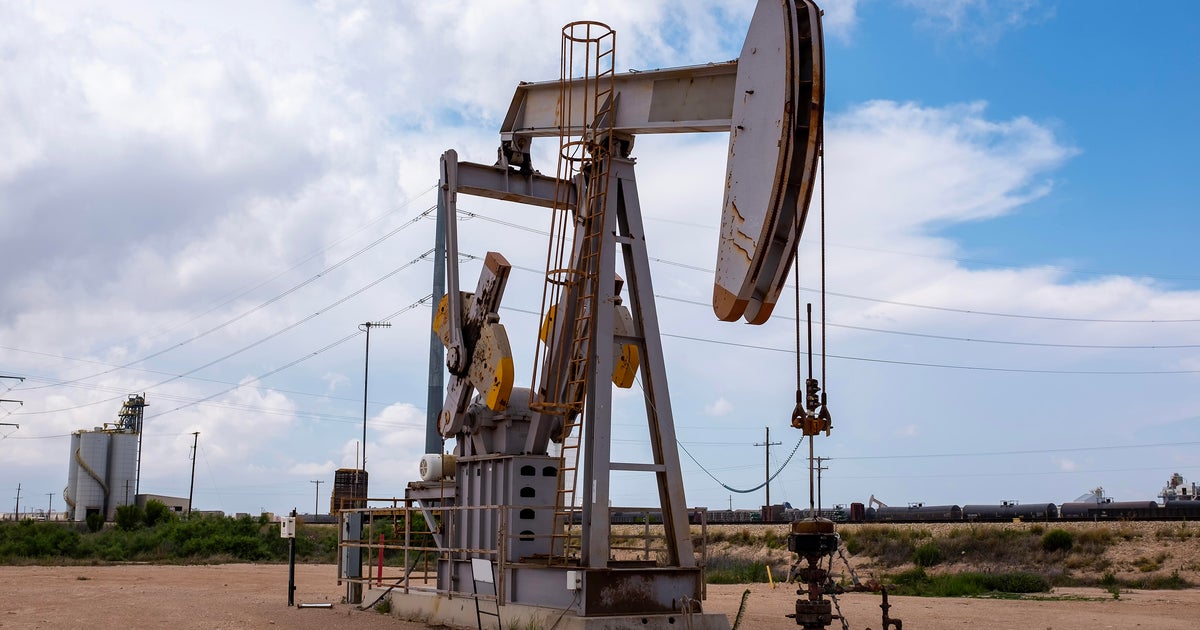
Soaring energy prices due to the Iran war could provide a massive windfall for U.S. oil companies.
Rystad Energy, a market research firm, estimates that shale oil producers in the U.S. could earn an additional $63 billion in sales as prices soar past $100 a barrel.
If oil prices averaged $70 a barrel — their approximate level before the outbreak of hostilities in the Middle East last month — U.S. producers would generate generate $99 billion in free cash flow for the year. At an average of $100 a barrel, that figure would jump to $162 billion, according to the firm. Among the companies poised to benefit: BP, Chevron, ConocoPhillips, ExxonMobil and Shell.
Brent crude, the international oil benchmark most directly linked to the price of gas in the U.S., topped $119 on Thursday after signs of escalating violence in the region, before ending the day at $108.65.
The U.S. is the world’s largest crude producer, with an output of 13 million barrels per day, according to the Energy Information Administration (EIA). It exports roughly 11 million barrels of oil daily, and imports 8 million, making the U.S. a net oil exporter.
Oil prices have soared as Iran effectively blocks the Strait of Hormuz following the February 28 attack by the U.S. and Israel. Normally, roughly 20% of the world’s oil and natural gas supplies pass through the key waterway.
“Demand destruction” risk
In a social media post on X last week, President Trump touted the benefits to the U.S. of higher oil prices. “The United States is the largest Oil Producer in the World, by far, so when oil prices go up, we make a lot of money,” he said in the post.
But while U.S. oil producers could benefit in the short-term, financial gains from sustained higher oil prices could be short-lived as higher energy costs wash over consumers, Rystad Energy analyst Thomas Liles told CBS News.
“It’s good for U.S. producers, but in the short-term primarily,” he said. “Once prices increase to very high levels, the question from a producer perspective is how long the good times can last, because once you get to a certain price, you see demand destruction.”
If oil prices jumped to $150 per barrel, consumers would likely cut their spending, which accounts for roughly two-thirds of U.S. economic activity, to offset higher gasoline and other energy-related costs. A reduction in energy consumption, in turn, could lead
to an economic slowdown depending on how long the conflict lasts and how oil prices react, Liles said.
“The bigger question is what happens next, and if the disruption continues and prices continue to rise, all this sends the economy into a tailspin,” he said.
For now, oil prices remain well below their all-time highs. That came in July 2008, as the housing crash was denting the economy, when both Brent crude and West Texas Intermediate, the U.S. benchmark, reached around $145 per barrel, or about $215 on an inflation-adjusted basis, according to data from FactSet.
Will U.S. oil producers boost production?
The risks of runaway oil costs are not lost on industry executives. In a meeting with White House officials earlier this week, energy company leaders expressed concern about the Iran war’s impact on the broader economy, the Wall Street Journal reported.
Meanwhile, U.S. energy companies are hesitant to boost oil production despite the incentive of higher prices, Rystad analysts note.
“U.S. shale producers are not poised to quickly ramp up production for two major reasons — strategic caution and a lack of [drilled, uncompleted wells] to quickly bring online,” Rystad Energy analyst Matthew Bernstein wrote in a report. Domestic oil players are unlikely to increase production so long as the duration of the Iran conflict remains hard to predict, he noted.
Yet sustained oil prices above $100 a barrel are far from guaranteed, Liles told CBS News. “The story a few quarters out is more uncertain,” he said.