As the United States began attacks on Iran in late February, the federal government braced for possible retaliation at home. To increase security, Hunter Army Airfield in Savannah, Georgia, joined hundreds of other installations in suspending the “trusted traveler” program at its main gate.
Alerts then went out to the nation’s 55 Joint Terrorism Task Forces, local law enforcement, and sensitive industries, reminding them that Iran and its proxies have the capability of striking the U.S. in retaliation for U.S. strikes in the Middle East.
Since the start of the war, the U.S. has sustained a series of small but deadly attacks – including a fatal shooting at a Texas bar – said to be linked to recent Middle East violence. Then came an Iran-sponsored cyberattack on a Michigan medical equipment company. Last week, reports of unidentified drones flying over Fort McNair, a Washington, D.C., military base where top officials, including Secretary of State Marco Rubio and Defense Secretary Pete Hegseth, live, raised concerns about foreign attacks.
Why We Wrote This
Keeping foiled plots that threaten Americans’ safety quiet could prevent unnecessary worry. Or it could make the public more vulnerable.
The drones, along with other isolated security threats, have prompted several U.S. military bases to increase force protection levels, according to a Washington Post report. The concerns have served as a reminder that entities opposing America – including Iran and its proxies – have the capacity to carry out asymmetrical warfare against U.S. targets.
U.S. Cyber Command has been specifically tasked with trying “to try to stop some of these attacks before they can reach the U.S.,” says Matthew Ferren, a national security expert at the Council on Foreign Relations in Washington.
Keeping citizens informed
In recent years, the number of reported foiled terror plots against the U.S. has more than doubled, from 299 in 2020 to 640 in 2025, according to FBI data. Last week, administration officials testified before Congress on heightened concerns about increased challenges around domestic terrorism.
While many Trump administration officials say that President Donald Trump and his policies have made the U.S. safer, the number of threats has actually grown.
Those threats, however, have gone without any public notice from the National Terrorism Advisory System (NTAS), the government’s main portal for communicating threats to the public.
The last NTAS alert was issued almost nine months ago after the U.S. attacked an Iranian nuclear facility. That public alert expired on Sept. 22, 2025.
Since then, nothing.
“People are working hard to make sure bad things don’t happen,” says counterterrorism specialist Javed Ali, who sat on the National Security Council during President Trump’s first term. Given the rising number of lone-offender terrorism threats or Iranian-sponsored cyberattacks, he says the lack of an NTAS bulletin is “kind of mystifying.”
That NTAS radio silence, former counterterrorism officials say, could be due to staffing reductions as well as the partial shutdown of Department of Homeland Security funding over its immigration enforcement tactics. But it’s also possible, these former officials say, that it’s part of a needle-threading struggle by the Trump administration to prepare Americans for the repercussions of war without raising fears or denting already-thin public support.
Others say the decision not to inform the American public, along with federal employment cuts, internal shake-ups, and the DHS shift from threat reduction to law enforcement, raises questions about whether Americans are more vulnerable at a time of increased risks of a domestic attack.
Coordinating and communicating plans to protect and defend Americans “is the government’s role,’’ says Mr. Ferren, at the Council on Foreign Relations. “Right now, we just don’t have the people and resources we need to make sure there’s a clear and consistent message.”
When the government knows about threats
The FBI says that last year saw a 35% increase in counterintelligence arrests, six of the “10 most wanted fugitives” captured, and multiple foiled terrorism plots. More specifically, U.S. counterterror agencies have discovered and stopped 17 Iranian-inspired plots in the past five years, according to the Combating Terrorism Center at West Point, in New York.

Mikala Compton/Austin American-Statesman/AP
The FBI, in a statement to the Monitor, declined to answer whether staff shake-ups have affected agency readiness. “But the FBI continuously assesses and realigns our resources to ensure the safety of the American people,” the statement said.
“The machinery of counterterrorism at home and abroad is still grinding away,” says Professor Ali, now a professor at the University of Michigan in Ann Arbor.
But that machinery is being tested as the war in Iran wears on.
Frustration or anger about the U.S. and Israeli attacks can ignite acts of random violence by supporters or others who are disgruntled, says Erin Kearns, director of law enforcement partnerships at the National Counterterrorism Innovation, Technology, and Education Center at the University of Nebraska at Omaha.
Moreover, America’s ability to anticipate – and prevent – attacks has changed. Since Mr. Trump took office, the FBI, the nation’s main counterterror organization, has seen several high-level firings and resignations, including 10 to 12 agents and staff from a New York counterintelligence unit that specializes in Iran threats, tracking foreign spies, and investigating plots to assassinate U.S. officials.
FBI Director Kash Patel ordered the dismissals just days before the U.S. launched Operation Epic Fury, with Mr. Patel alleging the agents took “improper investigative steps” in a court case about President Trump’s handling of classified documents.
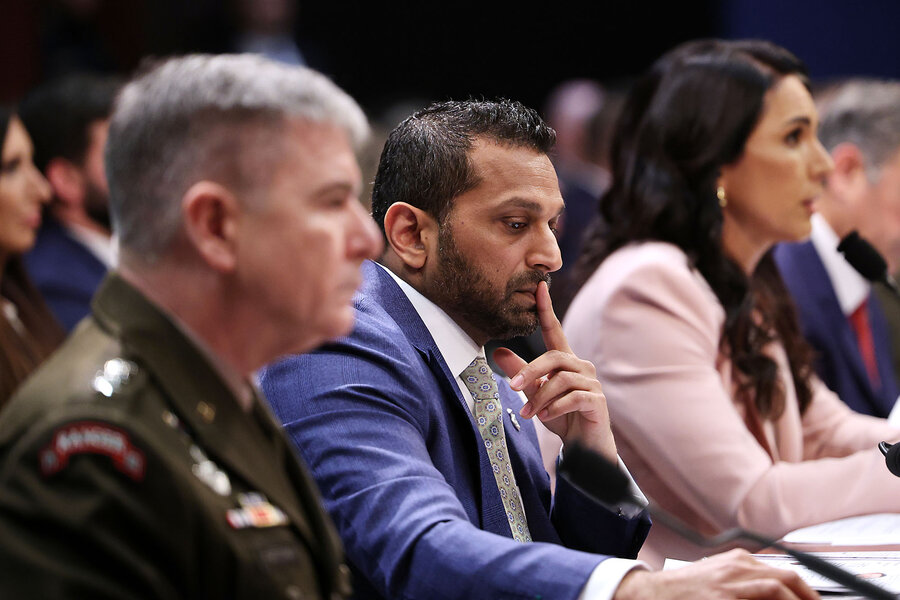
“I’m worried that we’re taking qualified people and picking fights with one another across party lines rather than making sure we protect ourselves and keep ourselves safe,” said Rep. Chrissy Houlahan, a Democrat from Pennsylvania, during a House Select Committee on Intelligence hearing on Thursday.
Meanwhile, the sprawling DHS oversees about a quarter-million employees. The recent resignation of Joe Kent, director of the National Counterterrorism Center, has also raised eyebrows.
DHS says it has been actively monitoring the nation’s domestic security situation despite the partial shutdown.
On March 7, the Office of Intelligence and Analysis held a conference call with nearly 1,500 law enforcement officials to discuss specific details about heightened threats.
“Iran does pose a continuing threat to the homeland,” Mr. Patel told the House intelligence hearing last Thursday. “Last year, [we] saw a 43% increase in Iranian spy actors willing to steal our information and attack our citizens.” Later, in response to questions about whether the firings of Iran experts in New York had weakened America’s ability to defend itself against domestic terrorism from Iran, he said, “The Iranian threat mission center has never been stronger.”
A time for caution
Regardless, many Americans are already unnerved. Research shows that extremist violence jumped some 40% in early 2025 and stayed high throughout the year. Most of these threats come from individuals or small groups radicalized online rather than from large, organized networks. Attackers typically target places of worship, police, and government buildings.
This month has exemplified such patterns.
On March 1, a Senegalese-born U.S. citizen wearing a T-shirt with the colors of the Iranian flag opened fire outside a bar in Austin, Texas, killing three people.
Several days later, police arrested two young men accused of trying to set off explosives among anti-Muslim protesters near the home of Zohran Mamdani, New York’s first Muslim mayor.
And two weeks ago, a Lebanese-born U.S. citizen ran a truck loaded with fireworks into a synagogue in Michigan, just minutes from where Professor Ali grew up. That same day, a naturalized citizen from Sierra Leone shouted “Allahu Akbar” (an Arabic phrase that translates to “God is the greatest”), before killing Army Lt. Col. Brandon Shah in an attack at Old Dominion University in Virginia, according to authorities.
The Iranian regime is likely keen to exploit American fault lines, warns Jason Blazakis, the director of the Center on Terrorism, Extremism, and Counterterrorism at the Middlebury Institute of International Studies, in Monterey, California.
“Iranians will be looking to animate the American people to potentially speak out about the outrage of the war or, worse, motivate people … to carry out acts,” he says.