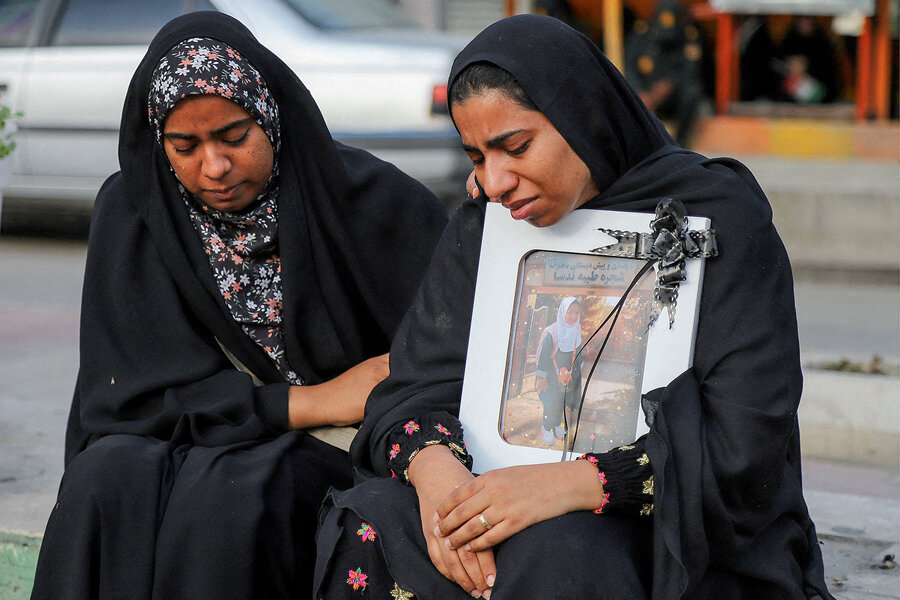
The U.S. military confirmed this week that it is investigating an air strike on an Iranian primary school that officials in Tehran say killed more than 150 children.
The school for girls in Minab, a coastal city in southern Iran, was struck while classes were in session on Feb. 28, the first day of the U.S. and Israeli operations against Iran, according to Iranian state media.
Now, one week later, the Minab strike remains the deadliest reported event since the military operations began. A precise count remains unconfirmed, but Iranian state media and local officials have reported between 168 and 180 deaths, saying most were schoolchildren. Some international groups put the toll closer to 80.
Why We Wrote This
Military rules of engagement are meant to protect civilians – and soldiers – during wartime. The strike on a girls’ school raises questions about U.S. targeting and intelligence.
The incident raises serious questions about military intelligence and targeting accuracy, defense analysts say, including whether the school was an accidental hit or part of a calculated decision using outdated or inaccurate information, near a compound linked to the Islamic Revolutionary Guard Corps.
While a final conclusion has not been reached, U.S. military investigators told Reuters it is “likely” that U.S. forces were responsible in some way. The Pentagon has said that the number of strikes carried out in its war on Iran has been double the air power of the “shock and awe” campaign against Iraq in 2003.
“All I can say is we’re investigating that,” Defense Secretary Pete Hegseth said in a Pentagon briefing on Wednesday, when asked about the strike that hit the Shajareh Tayyebeh girls’ elementary school. “We, of course, never target civilian targets. But we’re taking a look.”
The school was located next to a facility that has been used by the Islamic Revolutionary Guard Corps, a branch of Iran’s armed forces that runs intelligence networks and regional proxy forces, according to news reports citing U.S. officials.
Seeking information
During the Wednesday news briefing, reporters asked why, given the U.S. military’s high-tech reconnaissance capabilities, more information about the strike wasn’t yet available.
The United Nations’ Committee on the Rights of the Child said in a statement on Tuesday that children must be protected from war. “The committee is alarmed by reports of strikes on civilian infrastructure, including schools and hospitals, which have injured and traumatized children, and claimed many young lives.”
The committee also called on “the forces behind” the attack to conduct an investigation and make its findings public.
Secretary Hegseth appeared to allude to this statement during an earlier Pentagon briefing.
“America, regardless of what so-called international institutions say, is unleashing the most lethal and precise air power campaign in history,” he said on Monday. “All on our own terms with maximum authorities. No stupid rules of engagement.”
Rules of engagement – ROE in military parlance – lay out when, where, and against whom troops can use military force. They help service members apply the law of war when they’re making split-second decisions.
Earlier this week, in response to questions about the strike, Secretary of State Marco Rubio said that U.S. forces “would not deliberately target a school.” White House press secretary Karoline Leavitt told reporters on Wednesday that the Defense Department was investigating the incident. “But again, I will reaffirm that the Department of War and the United States Armed Forces do not target civilians,” she said.
An outside perspective
Larry Lewis, research director of the civilian harm mitigation program at CNA, a nonprofit security research organization, has conducted more than a dozen independent assessments for the Pentagon on civilian harm and analyzed thousands of incidents for other U.S. military commands.
“You see a lot of patterns come up when you’re looking at that many, right?” he says.
Mr. Lewis recalls being called in to work with frustrated commanders in Afghanistan during the U.S. war there. He found that more than half of accidental strikes on civilians were a result of what he calls “misidentifications,” where the military identifies what it thinks is a valid military target, attacks it, and then discovers it has attacked civilians instead.
“Militaries just don’t imagine that they’re attacking the wrong thing,’’ Mr. Lewis says. They don’t allow themselves to think that way, he adds. “It’s cognitive bias.’’
So, when allegations come up that civilians were harmed, the response is often, “It’s probably not right, because our information is better,” he adds.
But while the U.S. military often regards information from non-military reports about civilian casualties as suspect, the Pentagon ultimately agreed with external sources in 60% of the cases in one analysis that Mr. Lewis conducted in 2018 for Jim Mattis, then secretary of defense.
“What that tells us is the Pentagon often fails to detect the presence of civilian harm,’’ he says.
For some analysts, one concern is that Mr. Hegseth and other current U.S. defense leaders will continue to insist that restrictive rules of engagement (often meant to protect civilians) prevent U.S. forces from being effective.
Operational data shows that when militaries work to prevent civilian casualties, “not only does civilian harm go down, but mission effectiveness goes up,” Mr. Lewis says. Why? “Because we are avoiding these recurring problems that lead us to attack the wrong targets.”
Time will tell.
Mr. Hegseth said during a press briefing on Thursday with Adm. Brad Cooper, the head of U.S. Central Command, “The amount of firepower over Iran and over Tehran is about to surge dramatically.”