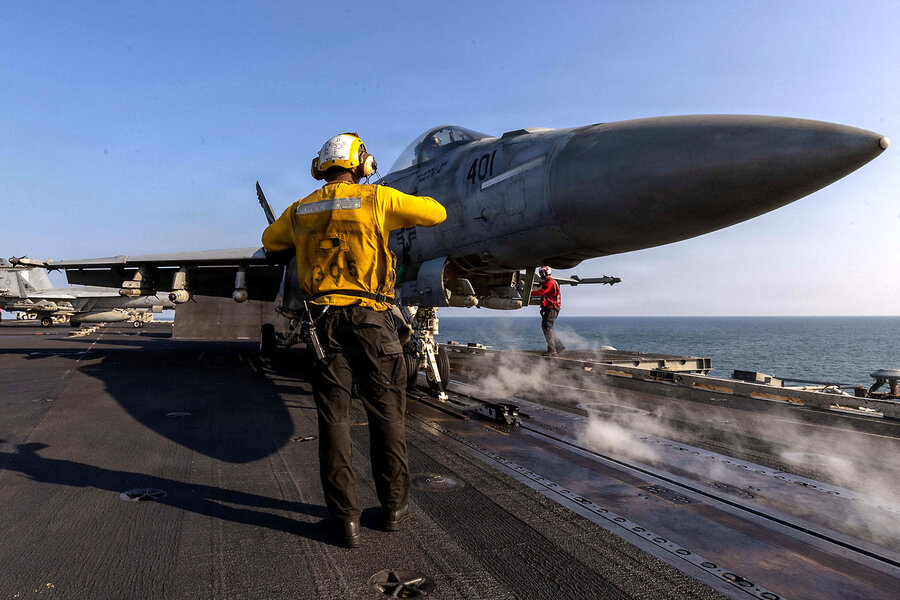
More than twice the area of the state of Texas, Iran has been on the receiving end of a great deal of U.S. military resources and firepower since Feb. 28.
War costs sustained by the United States started high and grew by the day, analysts say. Those costs can be measured in the cost of replenishing weapons stockpiles, in damage to U.S. base infrastructure in the region, and in the impact on global markets.
One example: The Department of Defense is one of the largest consumers of fuel in the world, and though the fuel on which its operations rely includes a mix of long-term contracts and stockpiles, a $10 increase in the price of a barrel of oil can raise overall Pentagon annual operating costs by an estimated $1.3 billion.
Why We Wrote This
The U.S.-Israeli attacks on Iran have had wide impacts on the Middle East and beyond. The attacks have also burned through a costly chunk of U.S. weapons stockpiles.
Lawmakers are demanding that the Trump administration give a clear rundown of the costs of its military operation against Iran, which has been conducted in collaboration with Israel.
“It is strategically important for Americans and Congress to understand the costs of war, the scope of U.S. military operations, and what impact this conflict is having on the safety and finances of every American,” Rhode Island Sen. Jack Reed, the ranking Democrat on the Armed Services Committee, said in a March 11 statement.
“Americans are being forced to pay higher prices in the near term for things like fuel, as well as [in] long-term costs from this conflict, such as health care for veterans,” he added.
There is also the cost in lives. In its first two weeks, the war killed some 2,000 across the Middle East, including 13 American service members.
How much is the U.S. spending each day on the Iran war?
Trump administration officials estimated that the first six days of the Iran war cost the United States roughly $11.3 billion, according to attendees leaving a closed-door congressional briefing. Defense Secretary Pete Hegseth has described the effort as delivering twice the airpower as the “shock and awe” campaign against Iraq in 2003.
Defense analysts say $11.3 billion isn’t the total price for those early days. Even before hostilities began, repositioning a dozen U.S. Navy vessels and more than 100 U.S. military aircraft to the region since the end of December cost U.S. taxpayers roughly $630 million, according to estimates by Elaine McCusker, a senior fellow at the American Enterprise Institute.
Broken down, the cost drivers in the war’s opening days included some $5.6 billion each for interceptors and missile strikes, as well as $2.3 billion for air operations and $310 million for the replacement of three F-15 fighter jets, according to Ms. McCusker’s analysis.
Drawing on Congressional Budget Office estimates of operating costs for each unit, defense analysts at the Center for Strategic and International Studies projected future costs.
Munitions expenditures are huge. Using past air campaigns as a guide, it will cost billions to replenish the U.S. munitions inventory, with the expense increasing by as much as $760 million a day.
Considering that 200 fighter jets are conducting operations, air operations run about $30 million daily. Costs for the Navy, with its two aircraft carriers and 14 destroyers, among other ships in the region, amount to about $15 million per day, the think tank says.
Costs for the 582 soldiers permanently stationed across the Middle East, along with those deployed to the region, average about $1.6 million every day. An estimated $10.5 million daily goes toward hazard pay and family separation allowances.
While some of these costs are already budgeted by the Department of Defense, many are not. The Pentagon will likely make a supplemental request to Congress for as much as $50 billion. The request is meant “to address both the overall strain on the force and deficiencies in stockpiles, the reconstitution of which could take years,” Ms. McCusker said.
The request is likely to prompt a heated debate in Congress.
“You’ve got to be able to provide us with information, as requested, [and] justification,” Republican Sen. Lisa Murkowski of Alaska, who sits on the Appropriations Committee, warned Pentagon officials on March 12. “Don’t just take for granted that Congress’ role is basically just to write the check.”

How much has this conflict depleted U.S. stockpiles?
Lawmakers have expressed concern that the war with Iran has depleted “years’ worth” of U.S. weapons stockpiles at a time when defense companies have struggled to keep up with demand.
Exact weapons stockpile figures are classified, but some reports suggest that the U.S. used close to 2,000 munitions, including missiles and air defense interceptors, in the first days of the war.
That amounts, by the estimates of some experts, to roughly 10% of cruise missiles and a quarter of all Terminal High Altitude Area Defense (THAAD) missile interceptor weapons that have been used in the first days of the conflict. Some analysts warned that continued hostilities could consume half of the U.S. interceptor stockpile within the first four to five weeks of the conflict.
Mr. Hegseth has said the U.S. has “no shortage of munitions.”
At the same time, U.S. stockpiles are being depleted in part to destroy Iranian weapons supplies. As of March 13, Mr. Hegseth reported that Iran’s missile volume was down 90% and its one-way attack drone shots had decreased by 95%.
The U.S. has also destroyed an Iranian drone-launching ship roughly the size of a World War II aircraft carrier.
The ultimate U.S. military targeting aim, Mr. Hegseth has said, is to destroy all of Iran’s defense companies, including “every company that builds every component.”
Are America’s new drones helping lower costs?
The U.S. debuted its Low-Cost Uncrewed Combat Attack System, or LUCAS drone, during the war in Iran. It is an answer to Iran’s Shahed-136 one-way model, which has become ubiquitous on the battlefields of Ukraine.
“If I just walk back a couple of years, do you remember what you used to always hear, that we’re shooting down a $50,000 drone with a $2 million missile?” said Adm. Brad Cooper, the head of U.S. Central Command, which runs U.S. operations in the Middle East, in a March 5 briefing.
Then the U.S. retro-designed one of the Iranian drones, he said.
“We captured it, pulled the guts out, sent it back to America, put a little ‘Made in America’ on it, brought it back here, and we’re shooting it at the Iranians.”
The low cost of LUCAS is relative. But at $35,000, it’s far cheaper than a $2.5 million Tomahawk cruise missile.
Is this war affecting other U.S. commitments?
Though the president of South Korea expressed opposition to the removal of U.S. air-defense assets from his country so that they could be used against Iran, he also acknowledged that there was little he could do about it.
“However, one thing to consider is that if you ask whether this significantly disables our deterrence strategy against North Korea, my answer is absolutely not,” President Lee Jae-myung said in a March 10 meeting with his Cabinet.
The Pentagon is making an effort to show it remains a strong presence in the Pacific. It flew a military surveillance plane over the Taiwan Strait on March 11, ahead of an anticipated visit to China by President Donald Trump later this spring.
In Ukraine, the U.S. has long said it cannot provide missile defense interceptors to Kyiv because of limited American stockpiles.
But as the U.S. is working to bolster its anti-drone capabilities in the Iran war, Ukraine is seizing the opportunity to give back. It has proposed to the White House a deal to produce drones and air defenses that the U.S. can use against Iran.
The hope in Kyiv is that a drone deal with the U.S. could give Ukraine added diplomatic leverage in any future negotiations with Russia.