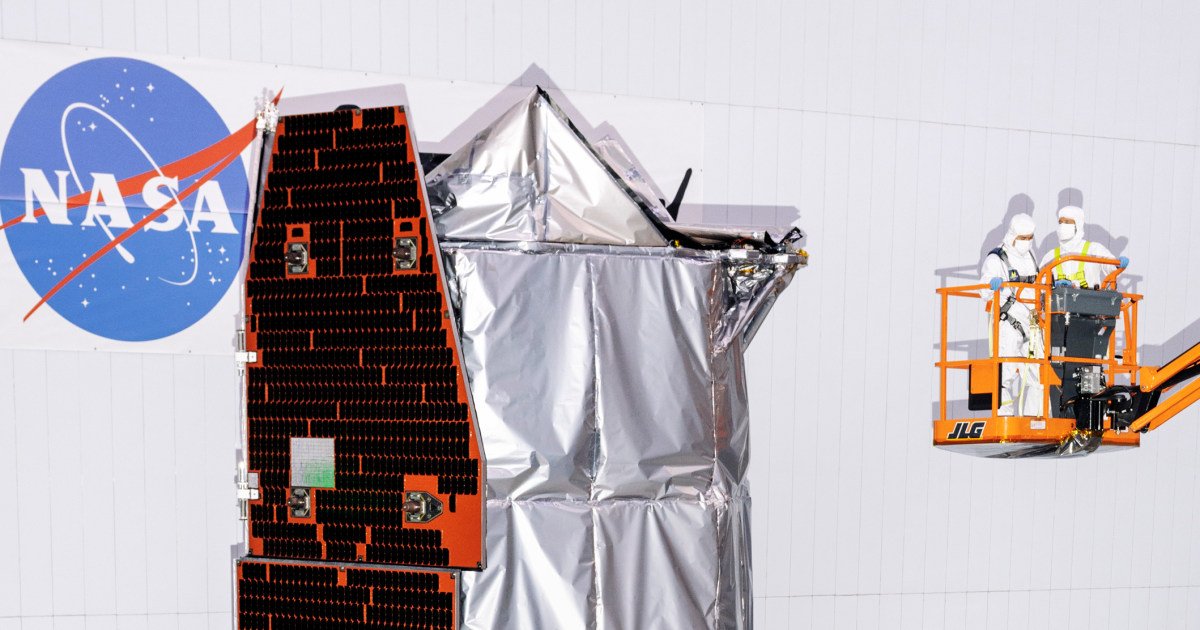
Unlike many other flagship NASA missions, the Roman telescope came in under budget and ahead of schedule — a feat that wasn’t easy, Benford said.
“It has been a huge focus of my professional life to get this observatory into operation in space, and for many years it really felt like it was a constant struggle to do that,” he said.
The project weathered major interruptions, including the Covid pandemic and the two longest government shutdowns in U.S. history (this year’s and last year’s). Originally, NASA had aimed to launch the Roman telescope no later than May 2027.
The observatory is slated to lift off atop a SpaceX Falcon Heavy rocket. After that, Benford said, the Roman telescope will journey for more than three months to its destination in space. Once it arrives, mission controllers will spend time testing the observatory’s instruments before scientific observations can begin.
If all goes according to plan, Benford said the telescope’s first images could be released by the end of this year.
“It could be around Christmas, so hopefully that’s a nice present,” he said.
NASA does not have another major space telescope in the pipeline. The agency has proposed a mission called the Habitable Worlds Observatory to search for signs of life on exoplanets, but even if that project moves forward, it would not launch until the 2040s.
As such, the Roman telescope’s launch is particularly meaningful to Goddard’s workforce, some of whom also worked on Hubble and Webb.
“Thrilled just seems insufficient — I’ve spent half my career on this,” said Mark Melton, a mission systems engineer. He anticipates he will tear up when the telescope is finally deployed.
“It was paper. And now it’s reality,” he said.