
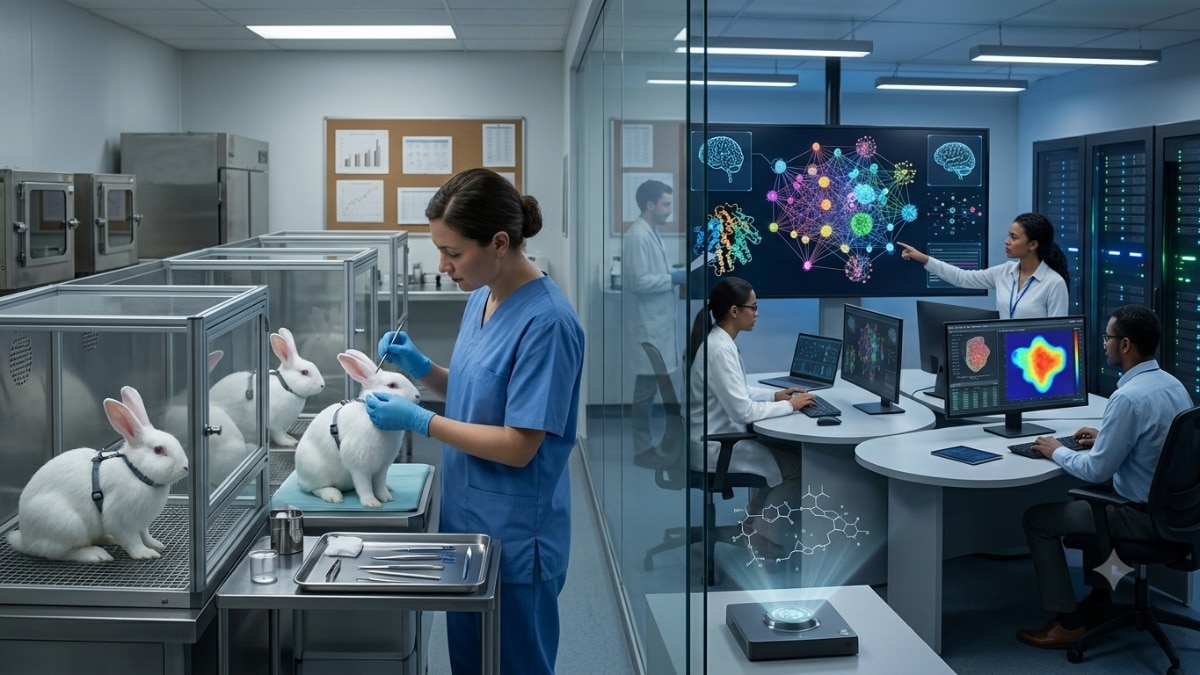
The emerging alternative is not simply to replace one animal experiment with one computer simulation. Scientists are building an entirely different system for chemical safety testing.
Why animal testing is being challenged
Under the EU’s REACH chemical-safety framework, companies must demonstrate that substances placed on the European market are safe. The rules also follow the principle of the “three Rs”: replace animal testing wherever possible, reduce the number of animals used and refine procedures to limit suffering.
There is also a scientific problem.
According to Mathieu Vinken, professor of toxicology at Vrije Universiteit Brussel, perhaps only around half of animal tests are representative of what happens in humans.
Long-term toxicity is particularly difficult to study. Some chemicals may produce subtle biological changes that eventually contribute to cancer, reproductive problems or damage to organs after years of exposure. Rodents, with much shorter lifespans than humans, cannot always reproduce these effects.
The economics are another obstacle. Some chronic toxicity studies can involve hundreds of animals, while testing a single substance can take three to seven years and cost as much as €15 million, according to researcher John Colbourne.
Where AI enters the picture
Researchers are developing what are known as new approach methodologies, or NAMs — a broad collection of techniques that can reduce or replace animal testing.
One major component is AI.
Instead of simply observing whether an animal becomes sick after exposure to a chemical, scientists can collect biological data from human cells and use computational models to identify patterns and predict potential toxicity.
The approach becomes particularly powerful when AI is combined with laboratory systems designed to mimic human biology.
One example is organ-on-a-chip technology. These tiny devices contain human cells and are designed to reproduce certain functions of organs. Researchers can expose them to chemicals and observe how human biological systems respond.
AI can then help interpret the resulting data and determine what those cellular changes could mean for organs such as the liver, kidney or brain.
‘Why’ matters as much as the ‘what’
Another EU-backed project, PrecisionTox, is taking a slightly different approach.
Researchers are comparing how different organisms and human cells respond to around 200 chemicals. The work involves 14 laboratories and looks at organisms including fruit flies, roundworms, water fleas, zebrafish and frog embryos, alongside human cells.
The idea is to identify biological mechanisms that are shared across species.
Instead of asking only, “At what concentration does this chemical harm an animal?”, scientists want to understand why the chemical causes harm in the first place.
That distinction could help researchers build models that are more relevant to human biology.
From laboratory results to real-world risk
Knowing that a chemical can damage cells is not enough to determine whether it represents a genuine danger to people. Scientists also need to know how much of that chemical humans are actually exposed to.
This is the focus of RISK-HUNT3R, another project within the EU’s €60 million ASPIS research cluster. It combines non-animal test results with real-world exposure information to assess the potential risk posed by chemicals.
Researchers tested the approach on 60 chemicals, split between toxic and non-toxic substances, to determine whether the combined data could produce safety assessments that regulators could eventually use. The goal is therefore bigger than simply finding a replacement for laboratory mice.
It is to create a new system in which human biology + laboratory models + exposure data + AI work together to predict chemical risks.
Could animal testing disappear completely?
Not yet. Researchers involved in the European projects acknowledge that completely eliminating animal testing is currently unrealistic. But they believe there is significant scope to reduce the number of animals used and improve testing methods.
Europe has already taken steps in this direction. Animal testing for cosmetics was phased out over two decades, with a full EU marketing ban taking effect in 2013. The policy helped encourage the development of alternatives such as reconstructed human skin models.
If AI can successfully combine data from human cells, organ-on-a-chip systems and other biological models, chemical safety testing could gradually move away from asking how an animal responds to a substance and towards a more direct question: how is the human body likely to respond?










Leave a Reply