

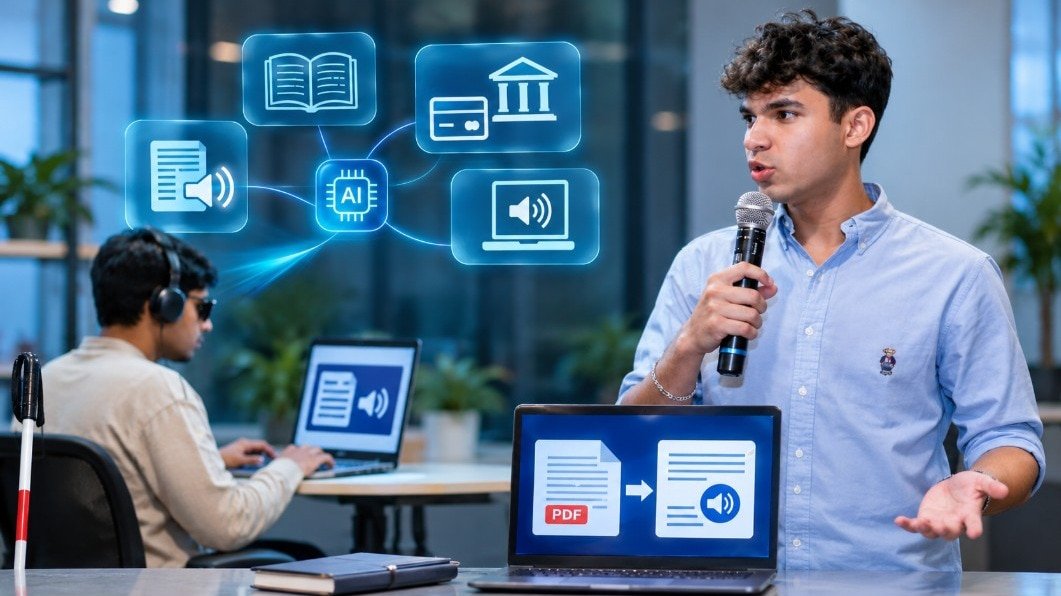
A 17-year-old coder from Gurugram is using artificial intelligence to address a problem that often goes unnoticed in the digital world: the inability of people with visual impairments to access everyday PDF documents, including bank statements, textbooks and official records. Yash Bhatnagar, a self-taught programmer, has developed Visionably, an AI-powered platform that helps organisations convert inaccessible PDFs into screen-reader-friendly documents.
His work has also highlighted gaps in digital accessibility across India’s banking sector, with an assessment identifying 2,221 accessibility barriers on the websites of 30 major banks. For Yash, the idea was driven by a simple observation: making information available online does not necessarily mean making it accessible to everyone.
FROM STUDENT PROJECTS TO SOLVING AN ACCESSIBILITY PROBLEM
Yash began learning programming at the age of 14, with his parents introducing him to the basics of coding. According to The Better India, he further developed his skills through online learning platforms such as Khan Academy and spent considerable time experimenting with technology during the COVID-19 pandemic.
Before working on accessibility, he had already developed tools aimed at improving the learning experience for students.
His first major project, LitGrades, was an AI-powered platform designed to generate flashcards and study materials. Launched in April 2023, the platform eventually reached around 720 students, including learners from Ukraine.
He subsequently developed Silenttype, an AI-assisted transcription tool that converts classroom lectures into written notes in real time.
His shift towards accessibility came after a conversation at IIM Ahmedabad in October 2025. While exploring how technology could support people with hearing impairments, he learnt about the difficulties faced by people with visual impairments when accessing PDFs.
Many documents that appear properly formatted on a computer screen are not structured for assistive technologies. Without appropriate tags and a logical reading sequence, screen readers may struggle to identify headings, tables, images and other elements.
With guidance from accessibility professionals, including Rashi from disability inclusion organisation V-Shesh, Yash began developing a solution to address the problem.
HOW VISIONABLY USES AI TO MAKE DOCUMENTS ACCESSIBLE
Visionably is designed to help organisations make their existing digital documents accessible rather than leaving individual users to find ways around inaccessible files.
Its AI-assisted remediation engine processes PDFs and adds the structural elements required by screen readers. These include accessibility tags, a logical reading order and descriptions for images, helping users navigate documents more independently.
The platform aims to align remediated documents with recognised accessibility standards, including WCAG 2.2 and PDF/UA.
Developing the technology involved extensive experimentation, as PDFs can contain complex layouts, financial tables, illustrations and other elements that are difficult to interpret consistently.
Yash says he worked through more than 1,000 test cases and iterations, incorporating feedback from accessibility professionals and people who regularly use screen readers. According to him, the platform currently achieves a success rate of around 95 per cent on the PDFs it tests.
The project has also moved beyond the development stage. V-Shesh is among its early paying clients, while Visionably is working with Pratham Books on making 10 children’s books available in accessible formats on its StoryWeaver platform, pro bono. Six books had been completed at the time of The Better India’s report.
AUDIT FINDS 2,221 ACCESSIBILITY BARRIERS ON 30 BANK WEBSITES
Beyond making PDFs accessible, Yash has been investigating another digital challenge faced by people with disabilities: navigating online banking services independently.
His Digital Banking Accessibility Index 2026 examined the public websites of 30 major Indian scheduled commercial banks. The exercise uncovered 2,221 accessibility barriers, of which 233 were classified as critical failures across 182 webpages.
Many of these issues may go unnoticed by regular users but can create significant difficulties for people with visual impairments. For example, a screen reader might identify a button without telling the user what action it performs. Similarly, misleading descriptions attached to images can make important information inaccessible.
Such shortcomings can affect a person’s ability to navigate banking websites, understand financial information and complete routine online activities without assistance.
Yash said the findings were shared with the banks. Kotak Mahindra Bank and Punjab National Bank responded that the concerns had been sent to their respective teams.
He is scheduled to reassess the websites in December 2026 to track the progress made in addressing these issues.
BUILDING TECHNOLOGY WITH A LARGER PURPOSE
Yash is currently a student at DPS International in Gurugram, where he also serves as the Technology and Wellness Secretary. His academic achievements include three consecutive Roll of Honour recognitions in MYP Grades 8, 9 and 10. He also scored 55 out of 56 in his Grade 10 MYP eAssessments.
His entrepreneurial interests extend beyond accessibility. He has also founded Slatemenu, an AI-powered contactless menu-generation platform designed for small cafes and restaurants.
However, with Visionably, Yash is taking on a challenge that goes beyond convenience: using technology to remove barriers that prevent people with disabilities from accessing information independently.
At 17, his journey demonstrates how young innovators can turn everyday problems into meaningful technology solutions. The bigger challenge now is to encourage organisations to adopt such solutions and make digital accessibility an essential part of their infrastructure, rather than something they address only after problems emerge.
– Ends









Leave a Reply