
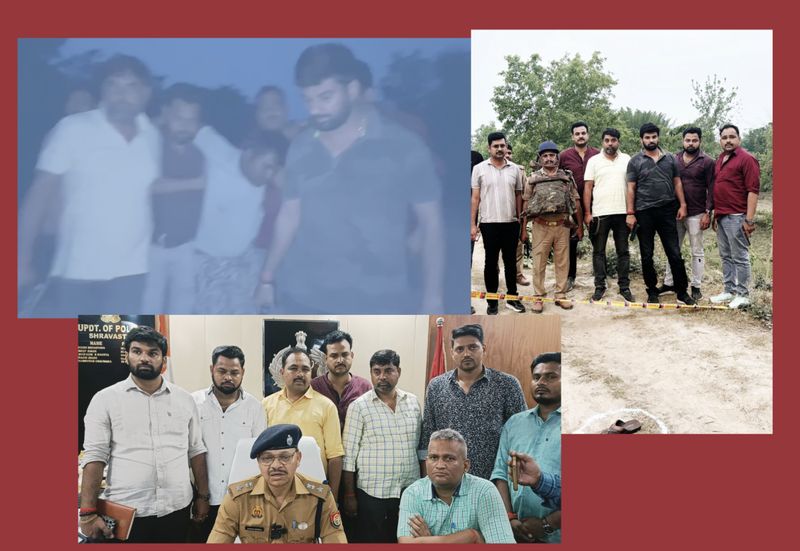
The court ruled prima facie that the account recorded in the First Information Report (FIR) following the encounter was ‘false’ and failed to adhere to guidelines laid down by the Supreme Court.
New Delhi: Finding glaring improbabilities in the official narrative, the Allahabad high court has ordered a thorough investigation by the Central Bureau of Investigation (CBI) into the police shooting of a man in Uttar Pradesh’s Shravasti district during an alleged encounter.
The court ruled prima facie that the account recorded in the First Information Report (FIR) following the encounter was “false” and failed to adhere to guidelines laid down by the Supreme Court.
The case involves Chotkau alias Allauddin, who was shot in both legs by the police in May 2025. The court found it improbable that a team of 23 police personnel, including ten from a Specialised Weapons and Tactics (SWAT) unit, could not intercept a man traveling in an e-rickshaw who was allegedly carrying only a country-made weapon and two cartridges.
In an order dated August 13, a single-judge bench of Justice Subhash Vidyarthi directed the CBI to nominate an officer for the investigation and submit a probe report within three months. The court specified that the inquiry must evaluate the marksmanship of then-Ikauna Police Station Station House Officer (SHO) Ashwini Kumar Dubey, who shot Chotkau.
Specifically, the CBI will assess whether Dubey was capable of accurately aiming and shooting from a distance of 15 meters with his 9 mm service pistol at night, guided solely by the sound of a weapon being loaded.
The case dates back to an FIR that was lodged at Ikauna police station at 10.16 pm on May 9, 2025. The complainant alleged that one Shafeeq and two of his unnamed accomplices had forcibly taken away his minor daughter (aged seven) around 9.15 pm on May 9 on an e-rickshaw.
Upon making a frantic search, the accused persons and the victim were found a little ahead of Mohinipur crossing. The other two unnamed accused persons escaped, but Shafeeq was caught on the spot and the complainant handed over Shafeeq and the girl to the police. The FIR was lodged under Section 137 (2) of the BNS, which deals with kidnapping a person from lawful guardianship.
Three days later, on May 12, 2025 SHO Ashwini Kumar Dubey lodged an FIR against Chotkau under attempted murder and the Arms Act alleging that he had been shot and arrested in an “encounter” while he was trying to flee to Nepal on his e-rickshaw after committing the crime on May 9. The police had identified him as one of the unnamed accused persons.
What does the FIR say?
According to the May 12 FIR lodged against Chotkau, police accused him of trying to flee to Nepal on his e-rickshaw.
The police version in the FIR goes like this:
The police said that they were patrolling and searching for suspects wanted in the May 9 crime in a government vehicle numbered UP 46 G 0161 when at around 22:55 hours, an informant said that the suspect could escape to Nepal at night using his vehicle. On receiving this input, SHO Dubey contacted Nitin Yadav, the officer-in-charge of the SWAT (Specialised Weapons and Tactics) team and requested reinforcement. The police teams were split into three teams. The police said that 13 persons including the SHO, five Sub-inspectors, one head constable and six constables were sitting in one vehicle. Police said they were engaged in searching for the suspect identified later as Chotkau when they received inputs that he was about to pass via Andharpurwa river bridge on his e-rickshaw on his way to Nepal via Bhinga. The SWAT team led by Nitin Yadav was asked to make an ambush near Andharpurwa bridge. The SHO and his team also reached the spot. A total of 23 police personnel took positions near the bridge after hiding their vehicles on the sides of the road. After some time, a light was seen coming from Ikauna; it was an e-rickshaw. The SWAT members came out of their hiding and signalled the e-rickshaw to stop. But the driver, having seen the police, turned left. The SHO asked him to stop but the driver of the e-rickshaw got frightened and collided with a tree. He then got down from his e-rickshaw and tried to run away. The SHO asked him to surrender. Finding himself surrounded by the police, Chotkau allegedly started firing gunshots towards the SHO and the entire team of 23 police personnel. The SHO claimed that he escaped unhurt as he was hiding. The SHO again asked the suspect to surrender. The suspect threatened that the police should not come behind him otherwise he would kill all of them and thereafter he again started loading his weapon. Upon hearing the noise of the loading of the weapon, the SHO fired two shots with his service pistol in “self-defense.” He asked his team to surround the accused. The SHO telephonically informed the police station regarding the encounter and asked the district control room to send further reinforcement. Meanwhile, the police heard the sound of a person writhing in pain. The SHO and his team went ahead crawling and saw that the suspect had fallen to the ground and was in pain. Blood was oozing out from both his legs. A country-made pistol and some cartridges were found near him.
The FIR further said that the police asked him about the case of the girl and that he confessed he had taken her on his e-rickshaw.
The FIR said that he allegedly confessed to taking the girl to Mohinipur and from there to Kailashpur Ghat and raping her on his e-rickshaw as well as on the ground. The girl suffered bleeding and was crying in pain, and he left her on the spot and ran away, and as he was escaping to Nepal, he got caught.
According to the FIR, he was taken into police custody at around 4.45 am on May 12, 2025. From there, he was sent for treatment in a vehicle, the solitary one mentioned in the FIR. The same vehicle had carried the SHO, five sub-inspectors, six constables and one head constable (HC). The SHO said that several persons were passing by the spot of the incident but nobody agreed to become a witness.
What did the court say?
Justice Vidyarthi found numerous glaring loopholes in the police narrative, and concluded that it appears that the guidelines formulated by the Supreme Court in case of police encounters as prescribed in the People’s Union for Civil Liberties (PUCL) judgment, were not compiled with.
The court demolished the police version point-by-point.
Justice Vidyarthi questioned the presence of a single police vehicle, which was used to carry the 13 policemen and to later take Chotkau for treatment. Unless the vehicle was a mini bus, it was “neither physically possible nor legally permissible” for 13 persons to sit in a government vehicle used by the police for patrolling and going to arrest an accused person, as normally jeeps, SUVs or MUVs are used by the police for such purposes and those vehicles normally do not have a sitting capacity of 13 persons, the court said.
“This narration of 13 persons sitting in one vehicle prima facie appears to be false and it could only be true if half of them were sitting on the roof top of the vehicle,” Justice Vidhyarti said.
It also appeared strange, the court noted, that when all the 13 persons officials claimed to be moving in one vehicle, how they allegedly split into three teams for the operation and moved in three different passages.
“It is impossible as to how a police team moving in one vehicle can split into three teams and move towards separate directions, unless they split the vehicle also in three vehicles. It also appears impossible that three police teams will go for an ambush during the night, on foot,” Justice Vidhyarthi said.
The court also raised a “serious doubt” about the FIR’s claims in which police mentioned that all of their vehicles were parked on the side of the road, whereas only one vehicle was mentioned by its number plate in the FIR.
The court found it to be “unbelievable” that a team of 13 policemen and 10 SWAT members could not stop a person moving on an e-rickshaw “unless all of them are thoroughly incompetent.”
The court said it was strange that such a large police team “got frightened, went into hiding and called for further reinforcement for tackling a person carrying a country made pistol and merely two cartridges.”
Justice Vidyarthi questioned SHO’s claims about the circumstances under which he shot Chotkau. The SHO, upon being asked, informed the court that he fired the shots from a distance of 15 metres. When the court asked him if he was capable of aiming and shooting from such a distance in the night, the officer said it was a moonlight night.
However, the court cast serious apprehensions about the correctness of the narration in the FIR and the manner of investigation conducted by the police. Prima facie, it appears that the narration is false, the court said.
The court rejected the SHO’s explanation that a 0.9 cm bullet could leave a 0.5 cm x 0.5 cm lacerated wound simply because the bullet’s tip is narrower, noting that the logic “did not appeal to reason.”
The SHO did not give a true narration in the FIR nor to the court, Justice Vidyarthi noted, adding that SHO “apparently tried to mislead the court.” These facts give rise to a reasonable apprehension that the SHO lodged a report containing a false narrative, concluded the court.
The court also raised questions about the initial FIR for which police set out to capture Chotkau, pointing out that while Shafeeq had been nabbed along with the minor girl and handed over to the police by the complainant, police claimed that it was not Shafeeq but Chotkau who committed the crime.
In the FIR lodged after the alleged encounter, police said that Chotkau confessed to raping the girl in his e-rickshaw even though there was no allegation of rape or bleeding in the initial FIR lodged within 61 minutes of the girl having been taken away.
The court noted that “prima facie it appears that the police has recorded a false confession” of Chotkau. Justice Vidyarthi said that Chotkau had been convicted in the initial FIR under the POCSO Act in “great haste” by the trial court.
Chotkau had been accused of murder and rape in the past, in 2012. A trial court had convicted and sentenced him in the case. The verdict was affirmed by the Allahabad high court but in 2022 the Supreme Court allowed his appeal challenging the conviction and the sentence.
The high court also referred to the Uttar Pradesh police’s trend of shooting suspects and accused persons in alleged encounters.
“The court is observing day in and day out that whenever the police apprehend a person, it often gives rise to another FIR alleging that when the accused was apprehended, he indulged into indiscriminate firing against the police team. Normally, not even a pellet touches even the uniform of any police person and all of them escape unhurt. The police fires one shot and it hits the accused on his knee or below it,” Justice Vidyarthi said.
Following the alleged encounter, a chargesheet was filed against Chotkau based on the FIR against him. He filed an application seeking discharge but a sessions judge rejected it on July 28, 2025. Chotkau challenged this before the Allahabad high court.
On March 26, 2026, a bench of the high court set aside the lower court’s order and remanded the matter back for a fresh decision.
On July 2, 2026, however, an additional sessions judge in Shravasti rejected Chotkau’s discharge application. Chotkau filed a criminal revision petition in the high court against this order.
While ordering a CBI inquiry into the alleged encounter, Justice Vidyarthi on August 13 also stayed the trial court’s order rejecting Chotkau’s discharge application. The high court granted the government counsel three months to file a counter affidavit.
This article went live on August twentieth, two thousand twenty six, at three minutes past one in the afternoon.
The Wire is now on WhatsApp. Follow our channel for sharp analysis and opinions on the latest developments.





Leave a Reply