
Detector.io could make AI content verification more useful by comparing five providers’ verdicts through one scan. For editors tired of pasting the same draft into separate tools, multiple AI detector results provide more context without adding five new tabs to the browser. Each provider still gives its own score, so disagreements remain visible.
The platform also connects results from five AI detectors with sentence-level review, humanization, and re-testing. This gives teams a practical way to investigate a flagged draft.
Chapters
AI content verification needs more context
AI-assisted writing is now part of daily content production. The challenge is deciding when AI assistance has made a draft too predictable, generic, or far removed from the writer’s intended voice.
A single AI text detector may help, but it only shows one model’s interpretation. Detection engines train on different data and weigh patterns such as repetition, sentence structure, predictability, and word choice differently.
This can produce a frustrating result: one tool reports a low AI probability, another raises a serious warning, and neither explains the disagreement in a way that settles the issue. A broader comparison does not erase uncertainty, but it makes that uncertainty easier to see.
Detector.io brings five detection models together
Detector.io runs one text submission across GPTZero, Winston AI, AIDetector.pro, ZeroGPT, and its own detection model. Their scores appear in a shared report, making it easier to spot agreement, outliers, and major gaps.
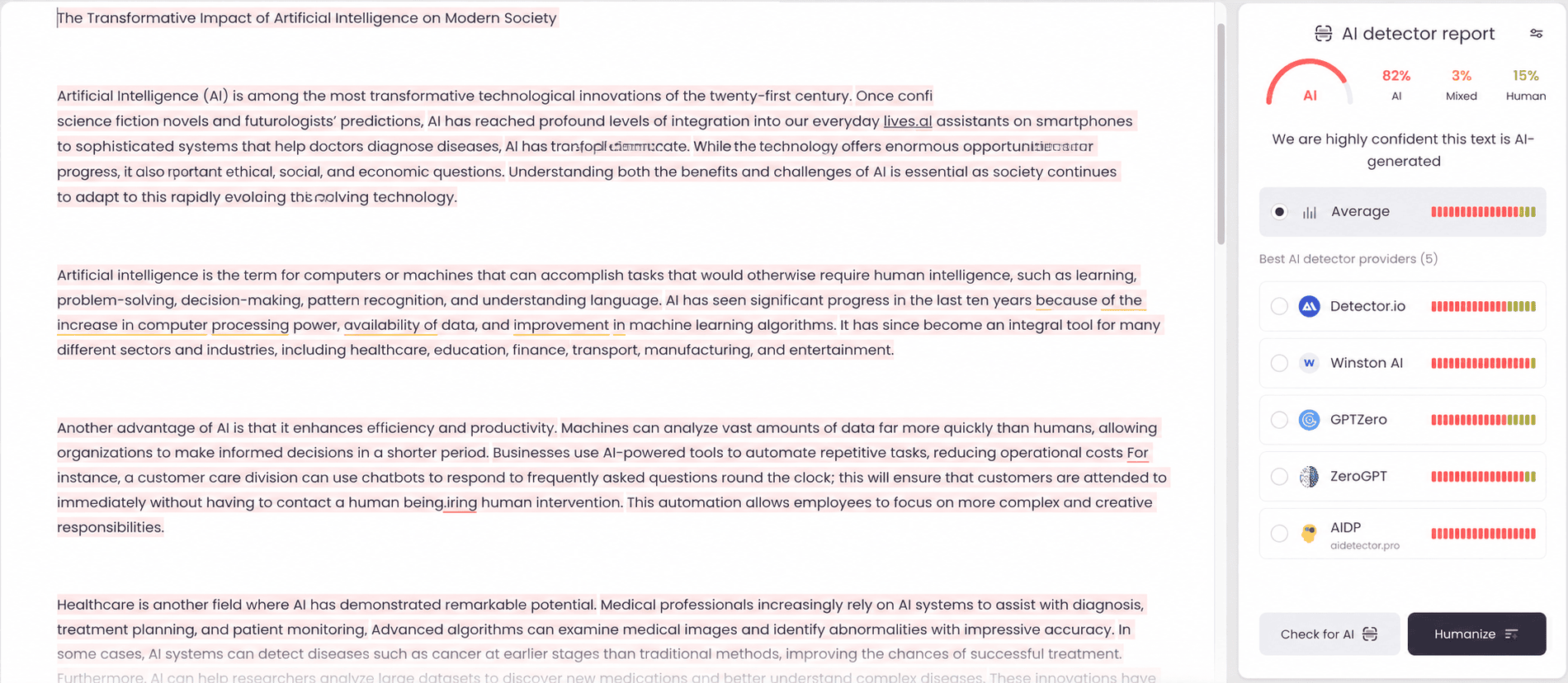
The point is to see how several models respond to the same text before deciding what deserves a closer read.
What makes the Detector.io workflow different
Detector.io combines detection and revision in one continuous process. That removes much of the repetitive work that usually comes with cross-checking a draft.
Five results from one submission
A writer pastes or uploads the text once. The platform forwards it to all five models and displays the results side by side.
This setup also preserves provider visibility. You can tell which score came from GPTZero, Winston AI, AIDetector.pro, the ZeroGPT AI detector, or Detector.io’s own model.
Humanization with sentence-level control
The built-in Humanizer focuses on passages that need attention. Writers can review proposed edits, accept or reject changes, and protect citations, headings, names, formatting, or selected sections.
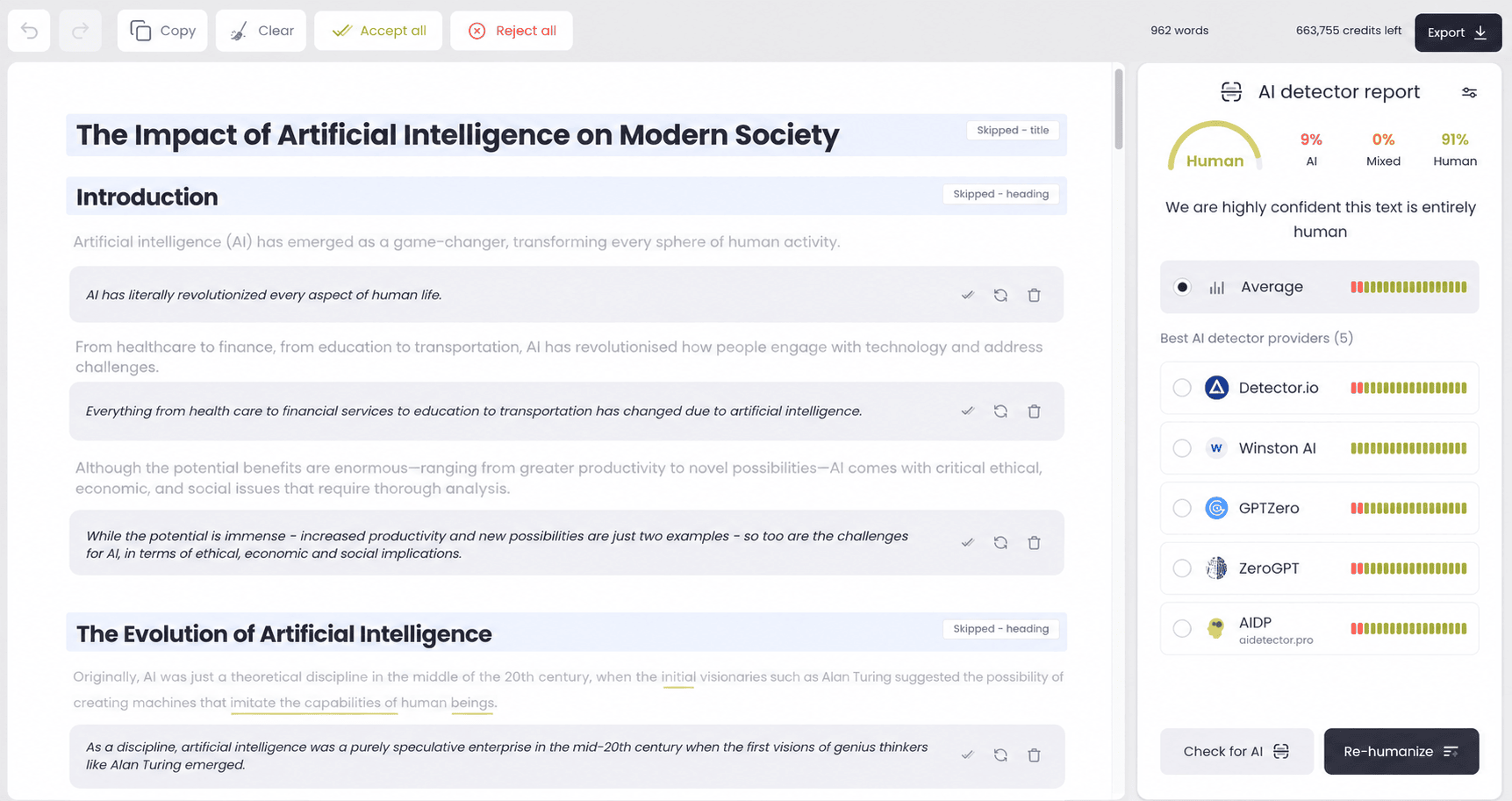
A blind full-document rewrite may smooth out the prose, but it can also flatten the writer’s point or alter details that should stay exact.
Immediate re-testing
After a passage is revised, the updated version can be tested again without starting over elsewhere. The AI writing detector workflow becomes a loop: scan, review, revise, and recheck.
This feature gives editors quick feedback on whether the changes affected detector scores. They can still judge the revised copy by meaning, accuracy, and readability before approving it.
Why a multi-detector view could improve verification
Comparing several models reduces the risk of trusting an unusual score from one provider. If four detectors report low AI probability and one produces a sharp warning, that outlier deserves context. If all five flag similar sections, the pattern may justify a closer editorial review.
The comparison also makes disagreement visible. That is more transparent than presenting one percentage as a fact.
Still, no detector can establish who wrote a passage. Human writing can be flagged, and edited AI text can pass. Detector.io is most useful as a review aid, not an authorship judge.
Where Detector.io fits into content workflows
Teams can use Detector.io at different checkpoints, from reviewing a freelance submission to checking a final draft before publication. The shared workflow is especially practical when several people need to check AI generated text using consistent steps.
How different teams can use the platform
| Role | Content Reviewed | Useful Workflow | Decision Supported |
|---|---|---|---|
| Marketing team | Campaign copy and articles | Compare scores before approval | Send back, edit, or publish |
| Agency | Client and freelancer drafts | Scan with five providers | Identify work needing review |
| SEO team | New pages and content updates | Check, revise, then retest | Approve the final version |
| Publisher | Articles and contributor copy | Inspect conflicting scores | Escalate questionable passages |
| Educator | Essays and similar assignments | Compare evidence across models | Begin a fairer manual review |
| Business team | Reports and internal documents | Protect names and key details | Improve prose without altering facts |
This process does not replace editorial judgment. It gives that judgment better evidence and cuts down on repetitive checks.
Pros and cons
Detector.io’s strongest advantage is convenience, but the platform still inherits the limits of AI detection technology.
A balanced view of Detector.io
| Pros | Cons |
|---|---|
| Five detector results from one submission | Different providers can still disagree |
| Real provider scores remain visible | No score can prove authorship |
| Side-by-side comparison exposes outliers | Results may vary by text type and length |
| Built-in Humanizer supports selective editing | Humanization still needs manual review |
| Citations, headings, and names can be protected | Frequent checks require a paid plan |
| Revised text can be tested immediately | A higher score does not explain writer intent |
Pricing and value
Detector.io offers a free limit and four paid billing options. The main value comes from accessing several providers through one AI checker workflow rather than maintaining separate routines for every tool.
Detector.io pricing options
| Plan | Price | Billing Period | Effective Monthly Cost | Best Suited To |
|---|---|---|---|---|
| Free | $0 | Ongoing | $0 | Occasional checks with 500 daily credits |
| Weekly | $7 | Every week | About $30 | Short, intensive projects |
| Monthly | $19 | Every month | $19 | Regular individual use |
| Quarterly | $39 | Every three months | $13 | Ongoing editorial work |
| Annual | $114 | Every year | $9.50 | Teams with steady verification needs |
Paid purchases come with a 30-day money-back guarantee. The annual plan has the lowest effective monthly price, but the free plan gives new customers room to test the workflow before paying.
Frequently asked questions
How much does Detector.io cost?
Detector.io costs $7 weekly, $19 monthly, $39 quarterly, or $114 annually. The annual plan offers the best long-term value at an effective $9.50 per month, and paid purchases include a 30-day money-back guarantee.
Which detectors does Detector.io include?
Detector.io includes GPTZero, Winston AI, AIDetector.pro, ZeroGPT, and its own detection model. One submission produces results from all five sources.
Can Detector.io prove that someone used AI?
No. Detection scores indicate patterns associated with AI-generated writing, but they cannot establish authorship on their own.
Can I edit flagged text without changing citations?
Yes. The Humanizer can leave citations, headings, names, formatting, and selected passages unchanged. You can review each proposed edit and re-test the updated draft afterward.