Mintlify made beautiful developer docs easy, but as teams grow the bill and the feature gates start to bite. Analytics, the AI assistant and grammar checks sit behind higher tiers, AI usage is metered in credits, and free workspaces cap the number of team members.
If that friction sounds familiar, you have options. This guide compares five of the best Mintlify alternatives for 2026, looking at pricing, what is included, migration effort and who each tool suits best.
Key Takeaways
- The biggest differences between docs platforms are pricing model and what is included by default, not the core editing experience.
- Jamdesk is the top pick for teams that want flat pricing with analytics, white-labeling and all AI features included on every plan.
- GitBook and Document360 suit product and knowledge-base docs, while ReadMe and Redocly lean toward API reference.
- If you are leaving Mintlify, check migration effort: some tools import your existing site in one command.
- Pricing and features change often, so confirm current details and take a free trial before you commit.
Comparison Table: Best Mintlify Alternatives
| Tool | Best For | Pricing Model | Standout |
|---|---|---|---|
| Jamdesk | All-in-one docs at a flat rate | Flat $29/month | Everything included, with no usage meters |
| GitBook | Product and team documentation | Free and paid tiers | Polished editing and Git synchronization |
| ReadMe | Interactive API references | Paid tiers | Personalized API explorer |
| Document360 | Knowledge bases and help centers | Paid tiers | Category management and search |
| Redocly | Large OpenAPI specifications | Paid tiers | Docs-as-code API rendering |
Chapters
How I evaluated these documentation tools
I focused on what actually changes your experience and your bill: pricing model and what is included by default, analytics and AI features, developer-experience essentials like MDX and OpenAPI support, and how hard it is to migrate an existing site.
Only Jamdesk was checked against its own live pages. Competitor capabilities and pricing come from public positioning and were not individually verified, so confirm current details on each vendor site.
1. Jamdesk
Jamdesk is a documentation platform for teams shipping developer docs from Markdown and MDX, and it is the standout here for one reason: everything is included at a flat rate. It shares the same modern core as Mintlify, with MDX, OpenAPI playgrounds and MCP support, then removes the tier gates that usually raise your bill.
Every plan on Jamdesk ships unlimited team members, built-in analytics, white-labeling and the full AI set (Ask AI chat, Fix with AI and an AI-readiness score) at one flat $29 a month, with no seat caps and no credit meters. It hosts on your own domain or a /docs subpath, generates interactive API references from OpenAPI specs, and moves an existing Mintlify site across with a single command.
That migration is a genuine differentiator. Running one CLI command imports your pages, navigation and configuration, and most teams finish in under ten minutes because Jamdesk supports Mintlify’s component set. Password protection and PDF export are on every plan too, rather than locked to an enterprise contract.
Strengths
- Flat $29/mo with unlimited members and no usage meters
- Analytics, white-labeling and all AI features included on every plan
- One-command migration from Mintlify in under ten minutes
- MDX, OpenAPI playgrounds and MCP support, plus build-time spec validation
- Broken-link and spellcheck detection with auto-fix
Consider
- It is a newer platform, so the community and template ecosystem is smaller than the incumbents
- Teams wedded to a rival tool’s specific component flavor should test compatibility first
Best for: teams that want a polished docs platform with analytics, AI and white-labeling included at a predictable flat rate, especially those migrating off Mintlify.
2. GitBook
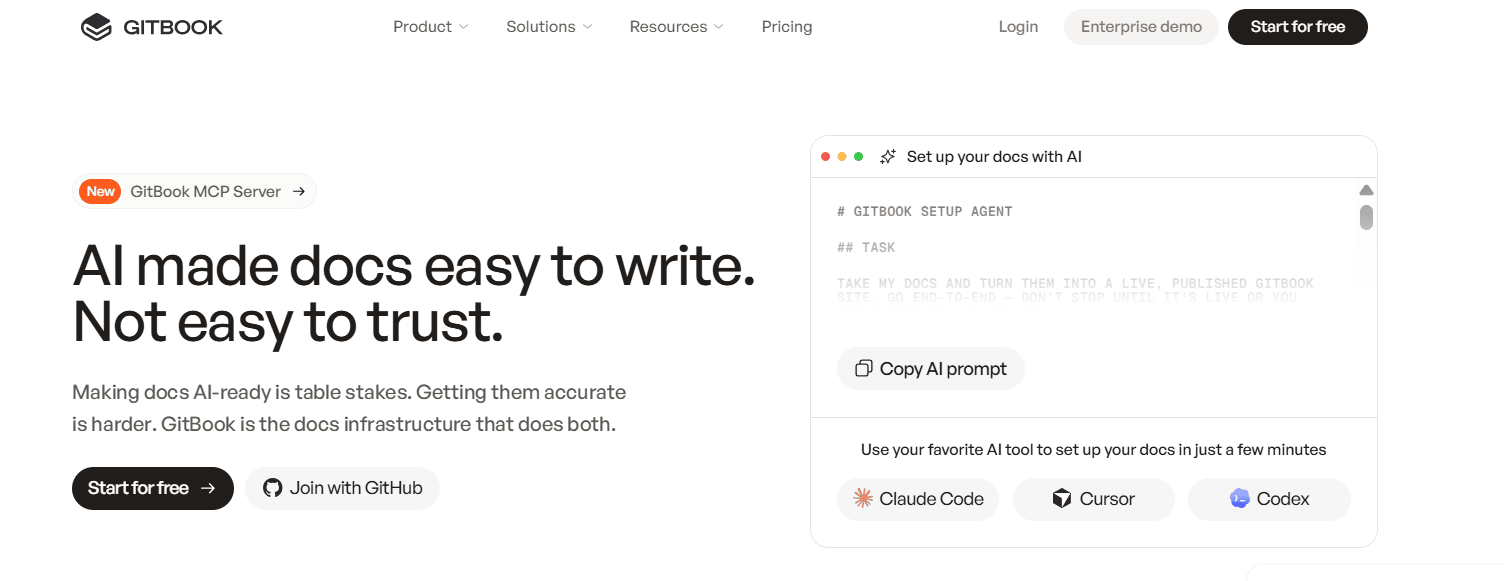
GitBook is a widely used documentation platform known for a clean editing experience and strong collaboration. It suits product and team documentation, with Git synchronization for teams that want docs to track their codebase.
Strengths
- Polished, approachable editor
- Git sync and good collaboration features
- Established platform with a large user base
Consider
- Advanced features and higher usage move you up paid tiers
- More product-docs oriented than pure API reference
Best for: product and team documentation where editing experience and collaboration matter most.
3. ReadMe
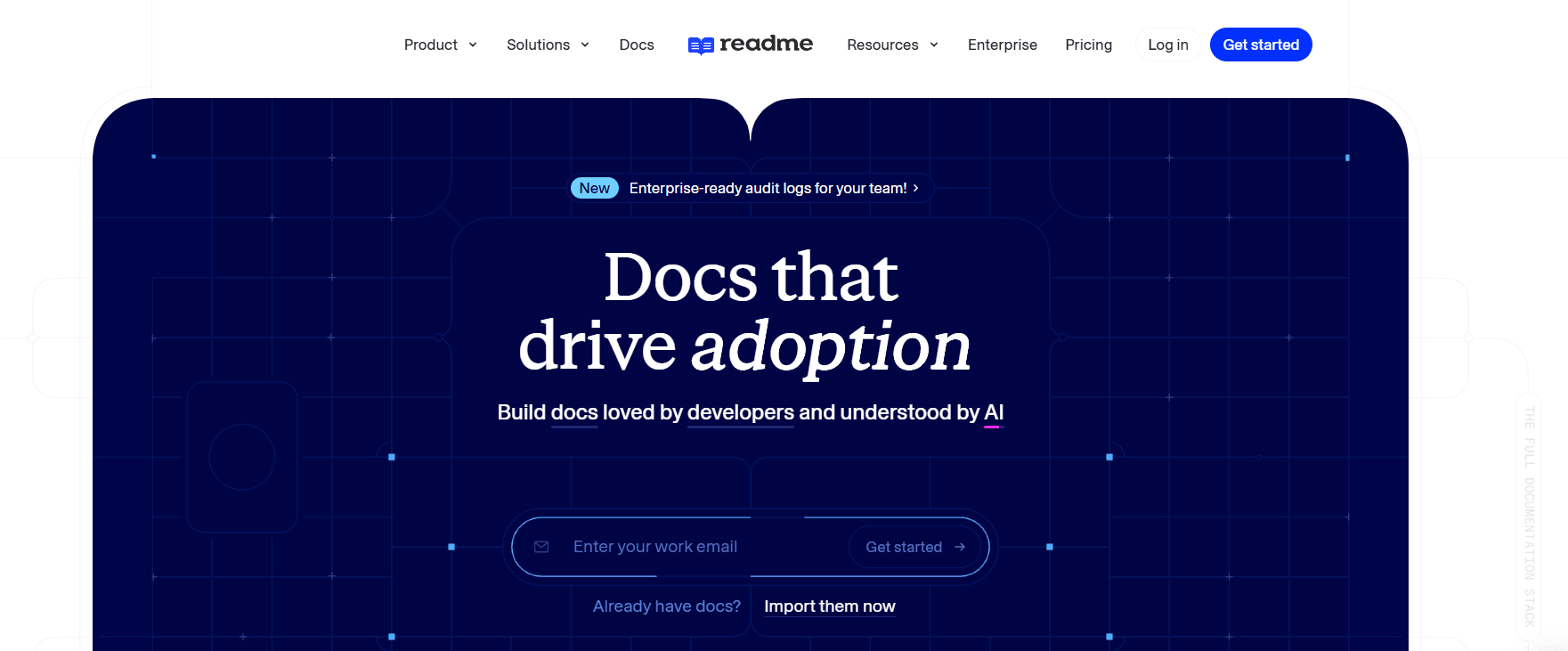
ReadMe is built around interactive API documentation, with an API explorer that lets developers make real calls from the docs. It is a strong choice for teams whose docs are primarily an API reference.
Strengths
- Interactive, try-it-now API explorer
- Personalized docs using a developer’s own API keys
- Usage metrics on how the API is consumed
Consider
- Priced for teams, so lighter projects may find it heavy
- Focused on API reference rather than broad product docs
Best for: API-first products that want a rich, interactive reference for developers.
4. Document360
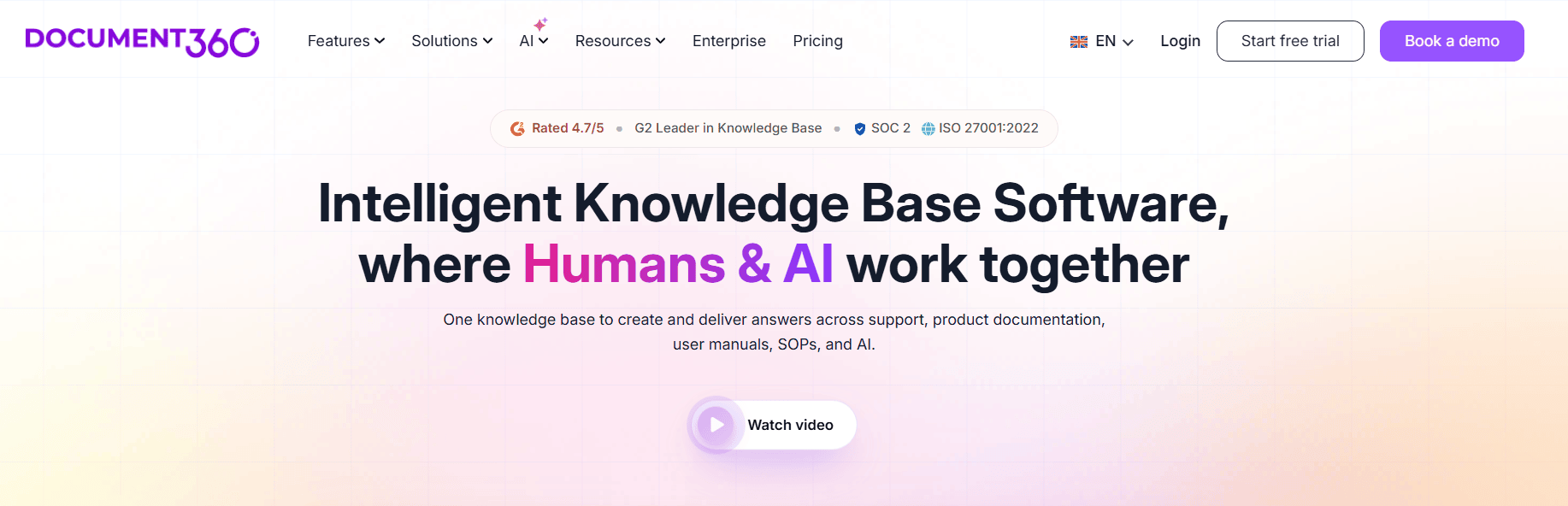
Document360 is a knowledge-base platform aimed at help centers and product documentation. It offers structured category management, analytics and AI-assisted search, which suits support and customer-facing docs.
Strengths
- Strong knowledge-base and category management
- Built-in analytics and AI search
- Good fit for customer-facing help centers
Consider
- Less docs-as-code oriented than developer-first tools
- Higher tiers needed for advanced features
Best for: support teams and product knowledge bases rather than pure developer API docs.
5. Redocly
Redocly specializes in API documentation built from OpenAPI specifications, with a docs-as-code workflow. It handles large, complex specs well and appeals to engineering teams that manage docs in their repository.
Strengths
- Excellent OpenAPI rendering for large specs
- Docs-as-code workflow that lives in Git
- Strong fit for engineering-owned API docs
Consider
- More technical setup than no-code editors
- Narrower focus on API reference
Best for: engineering teams with large OpenAPI specifications and a docs-as-code process.
Head-to-head comparisons
Jamdesk vs GitBook
Both are polished and easy to start with, but they differ on inclusion. Jamdesk bundles analytics, white-labeling and AI on every plan at a flat rate, while GitBook leans on paid tiers as your needs grow. Choose Jamdesk for predictable all-in pricing, and GitBook if its editor and collaboration are the priority.
Jamdesk vs ReadMe
ReadMe is purpose-built for interactive API reference, with an explorer and consumption metrics. Jamdesk covers API docs too through OpenAPI playgrounds, but adds broader docs, flat pricing and included AI. Choose ReadMe for an API-first reference, and Jamdesk for all-round docs at one rate.
Document360 vs Redocly
These solve different problems. Document360 is a knowledge base for help centers and product docs, while Redocly is an API-first, docs-as-code tool for large specifications. Choose Document360 for customer-facing support content, and Redocly for engineering-owned API reference.
How to choose a documentation platform
Start with your docs type
Decide whether your docs are mainly API reference, product and knowledge-base content, or a mix. API-first tools and knowledge-base tools optimize for different readers, so the right pick follows the content.
Look at the total cost, not the headline
Check what is gated behind higher tiers and whether AI is metered, because that is where bills grow. The same discipline applies to the rest of your stack, including the AI content tools you use to draft and maintain the docs themselves.
Test the migration path
If you are switching from Mintlify, migration effort matters. Favor a tool that imports your pages, navigation and configuration quickly, and budget a review pass before you go live.
Conclusion
The best Mintlify alternative depends on your docs and your team. For all-in pricing with analytics, white-labeling and AI included, Jamdesk is the standout, and its one-command migration makes switching low-risk.
If your docs are primarily an API reference, ReadMe or Redocly fit well, while GitBook and Document360 shine for product docs and knowledge bases. Whichever you choose, confirm current pricing and take a free trial before you commit.
Frequently Asked Questions
What is the best Mintlify alternative in 2026?
It depends on your needs, but Jamdesk is a strong all-round pick because it includes analytics, white-labeling and AI on every plan at a flat rate. For API-first docs, ReadMe and Redocly are worth a look, while GitBook and Document360 suit product and knowledge-base content.
Why do teams switch away from Mintlify?
The common reasons are cost and feature gating. Analytics, the AI assistant and grammar checks sit behind higher tiers, AI usage is metered in credits, and free workspaces cap team members, so growing teams can see the bill climb quickly.
How hard is it to migrate off Mintlify?
It can be quick with the right tool. Jamdesk, for example, imports your pages, navigation and configuration with a single command and supports Mintlify’s component set, so most teams finish in under ten minutes and then do a review pass.
Do these tools support OpenAPI and API playgrounds?
Most developer-focused options do. Jamdesk, ReadMe and Redocly all generate API reference from OpenAPI specs, and several include interactive playgrounds. Confirm the specifics for your spec size and features before choosing.
Are there free Mintlify alternatives?
Some tools offer free or low-cost entry tiers, and pricing models vary widely between flat-rate and usage-based plans. Check what is included at each tier and whether AI is metered, then take a free trial to test the fit.