Harvard packed up its library and moved it north to Andover, Massachusetts, while relocating 100 of its students west to Concord. At Princeton, Nassau Hall was captured by British soldiers and transformed into a hospital. The College of William & Mary in Virginia turned the Wren Building into a hospital as the Colonies fought for independence.
Today, students from around the world study on the campuses of the nine Colonial colleges that existed during the Revolutionary War. Back then, students halted studies to pick up rifles, muskets, and bayonets. Dormitories, libraries, and learning halls, some of which still stand, served as training grounds for fighters who would go on to help found the United States. Alumni of these schools would go on to be presidents, sign the Declaration of Independence, attend the Continental Congress, and draft the Constitution.
Like national, state, and local governments, the Colonial colleges have been highlighting their contributions to the country’s founding. In addition to the three mentioned above, Yale, Penn, Columbia, Dartmouth, Brown, and Rutgers round out this elite band of schools. Some have made dedicated webpages with archival information, organized lecture series, or have exhibits on campus.
Why We Wrote This
Nine colleges that predated the American Revolution not only housed soldiers on their campuses during that struggle in some cases, but also educated men who helped found the country and set the course for higher education today in the United States.
“Let us say that if the colleges had not been there, and had not provided a rigorous, demanding education, those same young men, it’s probably less likely that they would have been thoughtful, informed leaders,” says John Thelin, a retired University of Kentucky higher education and public policy professor.
Dr. Thelin, who wrote “A History of American Higher Education,” says that people like Thomas Jefferson (William & Mary), John Adams (Harvard), and James Madison (College of New Jersey, which would become Princeton) were all well-read and reasonably disciplined men who proved that the Colonial colleges trained sound future leaders.
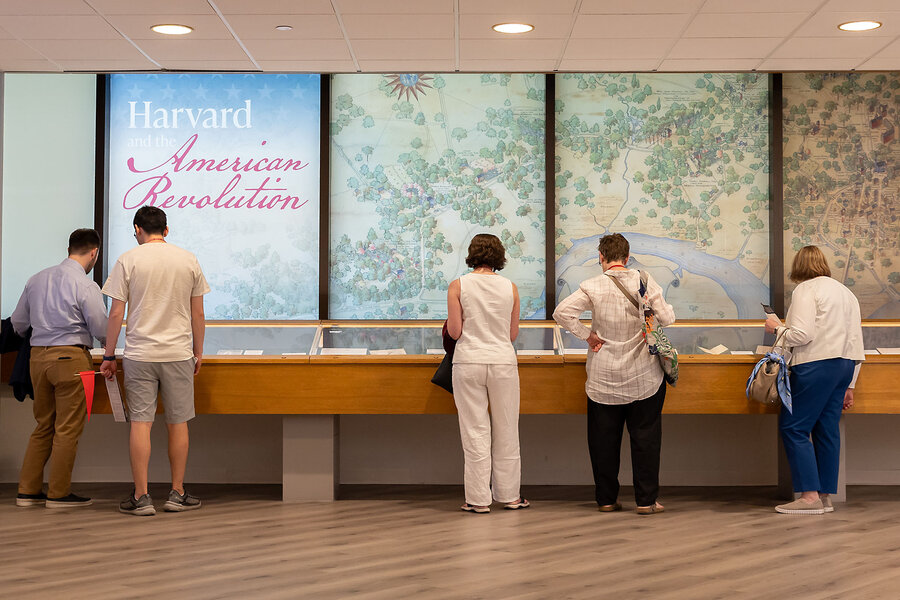
But during the Revolution, the attention on campuses shifted from the classroom to the battlefield. Harvard housed 1,600 soldiers in five campus buildings during the siege of Boston, which ran from 1775 to 1776. The university boasts eight alumni who signed the Declaration of Independence. The school’s Pusey Library is hosting the “Harvard and the American Revolution” exhibit, which is open to the public.
“It’s a very cool way to showcase [artifacts], because we don’t necessarily get to have a purpose to showcase them all that often,” says Sarah Martin, associate university archivist for community engagement at Harvard.

Courtesy of Harvard University Archives
Ms. Martin says a lot of people at Harvard had no idea what artifacts the university held, or its significance in the Revolution. Those artifacts include musket balls found in the floorboards years ago during a renovation of Hollis Hall, a dormitory that soldiers used during fighting.
“We really wanted to show this sort of interesting intersection of Harvard’s history with our national history,” she says. “Even if people think they know a lot about Harvard, they don’t necessarily know about this particular year in Harvard’s history, where the campus played such a role in the revolutionary struggle.”
This past school year, Robyn Schroeder taught a special history class about Williamsburg, Virginia, and the College of William & Mary’s involvement in the Revolution. She and students lead campus tours called Revolutionary Transformations, a project of the National Institute of American History & Democracy, of which she is assistant director.
“William & Mary calls itself the alma mater of the nation, and I think it’s earned in the sense that Thomas Jefferson attended this university and served on the board of visitors during the Revolution, as well as other patriots,” Dr. Schroeder says.

Courtesy of Robyn Schroeder
She points that out along with other insights during the walking tour of campus. Participants visit the Wren Building, the campus’s oldest building, used as a hospital for French soldiers; an area that was a military encampment, where soldiers, including students, trained; and the Hearth Memorial, dedicated to the enslaved people that William & Mary owned and profited from.
Dr. Schroeder says some tour participants are uncomfortable learning about slavery at William & Mary, but that she and her students like to paint a complete picture of the school’s history, which might force people to confront certain ideas. She says that overall, the Colonial colleges were needed because they helped educate leaders who went on to solve problems in a new country.
“I think these colleges represent a kind of aspiration, at least for the kind of young men, of ways in which they can make the world more civilized,” says Dr. Schroeder.
For Robert Allison, a history professor at Suffolk University in Boston, the Colonial colleges did educate leaders and spread ideas. But, he says, they represented a small number of the country’s population at the time, maybe 1%, and they were all white men, many of them sons of wealthy people.
Colonial colleges are the forebears of today’s higher education, Dr. Allison says. After the war, every state decided to open a state college because the country’s leaders recognized that there was a need to educate the citizenry.
The Colonial colleges produced Jefferson, Adams, and Madison, but the men who didn’t attend college, such as George Washington, Benjamin Franklin, and Henry Knox, were equally impressive, he says.
“Maybe I’m just jaded, but the really exceptional people are the ones who would have been exceptional whether they went to college or not,” Dr. Allison says.