
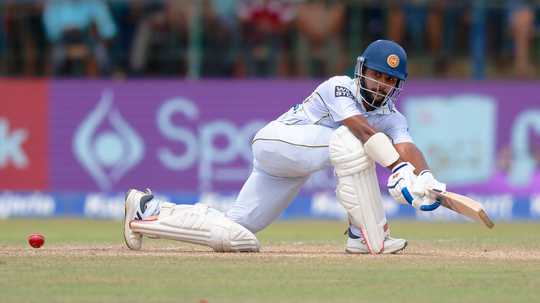
59/4, trailing by 403 runs.
137/5, trailing by 466 runs.
209/4, soon 218/6, still four runs behind after following on.
These were the entry points for Sonal Dinusha in his four innings against India. The Sri Lankan was only three Tests old coming into the series, and whatever soft landing he might have hoped for at home, this was anything but it.
Such situations can easily test a young batter’s resolve, but Dinusha instead used them to show the management his resolve and character. His 420 runs in four innings, including three centuries, did not translate into a win for Sri Lanka, but they revealed a batter with the temperament to thrive under pressure.
More importantly, there was a method behind those returns.
Navigating the good length
The Indian spin attack was miles ahead of Sri Lanka’s in quality and variety, as most of the hosts’ batters found out the hard way. In Sri Lankan conditions, the good length for spinners is generally in the 3-5m range, and how a batter negotiates that length is often central to his success.
Dinusha did it better than anyone in the series.
He scored 182 runs off good-length balls from spinners, averaging 91 at a strike rate of 58.89, comfortably above the series baseline of 26.42 and 45.36 respectively. No batter from either side scored more runs off balls in the good length band while only Niroshan Dickwella, who faced just 69 balls, had a higher strike rate at 71.01. Player of the Series Devdutt Padikkal, to bring in perspective, averaged 69.50 and struck at 49.82.

Dinusha was by far the best batter of the series in navigating good-length spin ©Cricbuzz
The key to Dinusha’s success was where he chose to meet the ball. His average interception point against good-length spin was 2.64m from the stumps, by far the farthest of any batter in the series. Padikkal, who often preferred to hang back, was at the other end of the spectrum with his average interception point recorded 2.02m.

Dinusha’s interception point to good-length spin was the farthest of all batters in the series ©Cricbuzz
Only 43.4% of good-length balls to Dinusha were met in the danger zone – the 1.5m to 3.5m distance between pitching and interception. That was the lowest among Sri Lankan batters and bettered only by Padikkal, Rishabh Pant and Ravindra Jadeja among all batters.

No Sri Lankan batter met more balls in the 1.5-3.5m danger zone than Dinusha in the series against India ©Cricbuzz
In other words, Dinusha was consistently finding ways to take the ball away from the most difficult area.
Two ways to disrupt length
Among batters who faced at least ten overs of spin in the series, Dinusha had the second-highest share of balls played off the front foot, at 73.6%, including those he stepped down the wicket. Only India captain Shubman Gill, at 77.3%, was higher.
Unlike Gill, a taller batter with a longer reach, Dinusha, listed at just five feet six, compensated with two distinct methods: he repeatedly came down the track, and he swept, forcing the spinners to constantly reassess their length.
He stepped down the wicket to 12% of the balls he faced, second only to Pant’s 13.3% while his sweep percentage was even higher: 21.6%, the most of any batter in the series.

Dinusha ranked high on both sweep percentage and stepping down the track ©Cricbuzz
The scale of his commitment to the sweep shot was striking. Dinusha attempted 120 sweeps, including the variants reverse and slog-sweeps, and scored 173 runs from them. Both figures are the highest recorded in a series of any length, surpassing Joe Root’s efforts in Sri Lanka in 2021. He scored at more than a run a ball through the sweep against all four of India’s frontline spinners.
Most runs playing sweep shots in a series
| Player | Against | Host | Season | Balls | Runs | Dis | Avg |
|---|---|---|---|---|---|---|---|
| GS Dinusha | Ind | SL | 2026 | 120 | 173 | 0 | – |
| JE Root | SL | SL | 2020/21 | 111 | 160 | 1 | 160 |
| BM Duckett | Pak | Pak | 2022/23 | 72 | 112 | 2 | 56 |
| JE Root | Ind | Ind | 2020/21 | 63 | 106 | 1 | 106 |
| Younis Khan | Aus | UAE | 2014/15 | 70 | 103 | 0 | – |
| Misbah-ul-Haq | Eng | UAE | 2015/16 | 48 | 103 | 0 | – |
| JE Root | Ind | Ind | 2016/17 | 47 | 101 | 3 | 33.66 |
| BM Duckett | Ind | Ind | 2023/24 | 43 | 101 | 0 | – |
The 4-5m band was the most disconcerting length for batters in the series, producing 27 wickets at 21.14. Dinusha faced 212 balls in that band and scored 125 runs for one dismissal. His response was to continue mixing his methods. He attempted 53 sweeps for 87 runs and stepped down the track to 32 balls to the balls in the 4-5m band.
Doing that against Ravindra Jadeja, with his pace and trajectory, was particularly impressive. Dinusha attempted 34 sweeps against him, the most by a batter off Jadeja in a series in the sub-continent. He also came down the track to 36 deliveries, only two fewer than Michael Clarke managed across five innings in the four-Test series in India in 2013.
It was not simply about hitting boundaries. Eighteen of Dinusha’s 30 boundaries against spin came through sweeps or their variants, with front of square on the leg side his preferred zone. He mixed in paddle and reverse sweeps and, on four occasions, began a new session with a slog sweep to the mid-wicket boundary.

Dinusha’s boundaries of sweep shots ©Cricbuzz
Those strokes did more than just added runs. They immediately challenged the bowler’s length and planted doubt about where to pitch next.
The value of what happened between the boundaries
Once Dinusha manipulated the bowlers’ lengths and fields, he was able to exploit the spaces created. He nudged, pushed, swept and worked the ball around for singles and twos, ensuring that the scoreboard kept moving.
Of his non-boundary runs through sweep shots, 61 came along the ground and another 22 through reverse sweeps.
That was also why his innings were not built around constant boundary hitting. Only 4.98% of the balls he faced resulted in boundaries, the second-lowest rate among specialist batters who faced a substantial volume in the series, ahead of only Jadeja.
A particularly revealing part of his method was what he chose not to do. Dinusha did not hit a single boundary through the front-of-square off-side against either pace or spin, effectively cutting out the risky drive.
It gave his innings a clear shape: disrupt the spinner’s length, manipulate the field, and then collect the low risk runs that followed.

Dinusha’s wagon wheel against spin ©Cricbuzz
Four high-quality knocks in as many innings against India showed that Dinusha was willing to trust that blueprint even when the match situation offered little margin for error.
The challenges will only get tougher. Opponents will eventually find ways to test the method, and Dinusha will have to adapt. But Test match batting is fundamentally an exercise in problem-solving, and this series offered encouraging evidence that he possesses both the mental discipline and the technical framework to keep solving those problems.











Leave a Reply