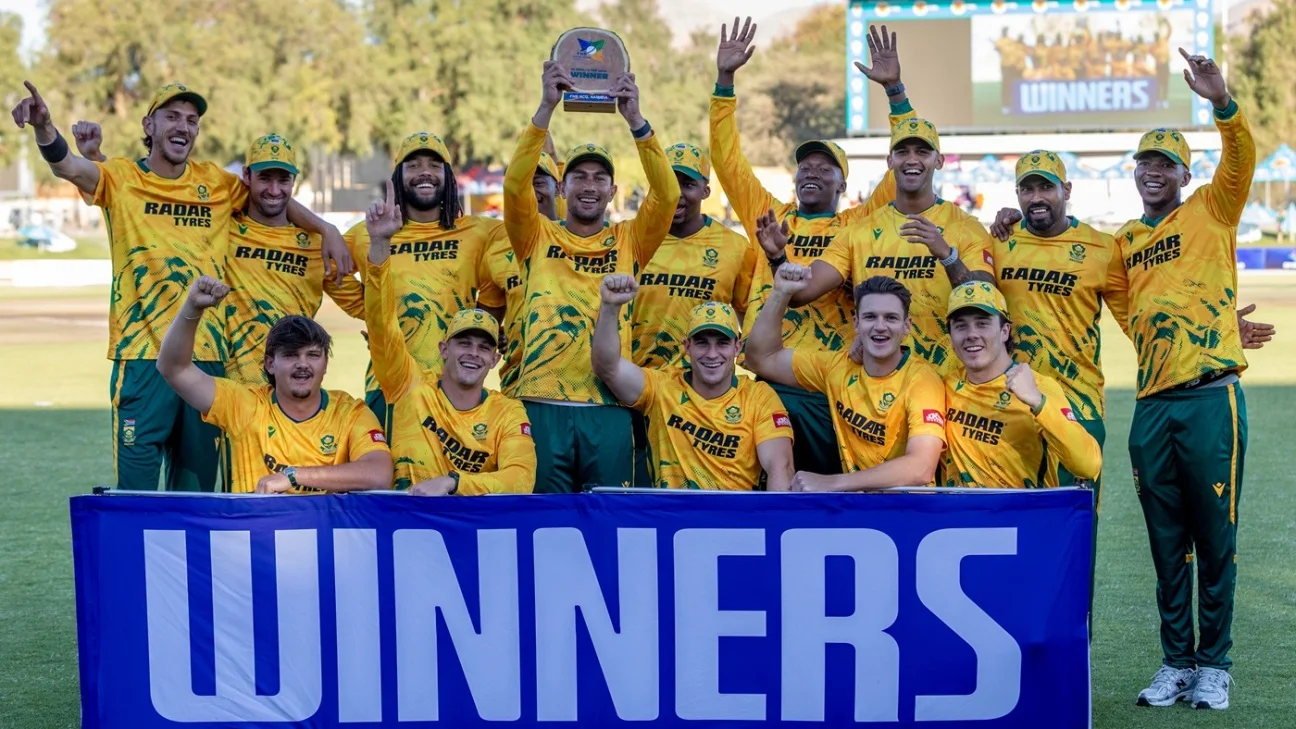
The first attempt at a tournament that could become the Africa T20 Cup resulted in an expected winner as South Africa – albeit not at full strength – claimed the tree-trunk trophy and had both the highest wicket-taker and run-scorer in the series in the camp. But the series also brought some surprises.
An upset in match one, when Namibia beat South Africa, two last-over thrillers in the group stage and surfaces that had good bounce and carry but were kind to set batters hold promise for future events which may expand to include other teams.
Cricket on the African continent remains a work in progress, and South Africa hope they have done their bit to aid its growth. “As South Africans, we are quite privileged to have a bigger audience than the other two countries so I do sort of feel like we do have some sort of responsibility to grow the game within areas of Africa,” Bjorn Fortuin, South Africa’s stand-in captain said at the post-final press conference. “We’ve seen the game expand massively over the past two to three years and we’ve seen multiple teams upset other teams at World Cups. Hopefully, we can see more African teams being competitive not only in Africa but on the world stage as well.”
By maintaining their status as the leaders on the continent, South Africa also stands as an example of what’s possible and have answered some questions about their depth.
South Africa’s bowling stands up
Dewald Brevis, Lhuan-dre Pretorius and Connor Esterhuizen showed that the future of South Africa’s white-ball batting is strong even before the final, when their young bowling crop stood out.
Eathan Bosch and Duan Jansen shared five wickets between them in the final and showed off excellent plans in a situation where they could have got carried away with the runs the batters had posted. Bosch, who had only one T20I wicket from three matches before the final, opened the bowling with perfect length: slightly short, but not too short. He created immediate doubt in Ben Curran’s mind and had him out for a first-ball duck. Jansen, who already had eight wickets coming in, showed his ability to adjust as he varied his lengths against an unsure line-up. His first wicket came off a slow, full ball before he went back to using the bounce he can generate to take the next two and finish as the series’ leading wicket-taker.
Fortuin expects to see plenty of the pair in future. “I’ll touch on the debutants Eathan and Duan. For them to come in, make their debuts, it’s a massive honour and then for them to perform the way that they did, showed massive guts and massive mental fortitude,” Fortuin said. “I was very pleased with the way that they dealt with the pressure of international cricket and I’ve got no doubt the series will be good for their development going forward.”
Spare a thought for Fortuin himself, whose career has run parallel to Keshav Maharaj’s, limiting his international opportunities. He is a wicket-taker in his own right.. Across all formats, no one has more wickets for Fortuin’s domestic side, Lions, than him; he finished as the joint second-highest wicket-taker in this series and bagged a career-best 4 for 24 in match four against Zimbabwe.
Fortuin doesn’t talk much about himself but the consistency of his performances and the way he stepped into leadership means South Africa have another senior they can call on when needed. He called captaining a “different challenge” because even though “I’m sort of used to the way guys operate domestically, seeing that we’ve played together for many years,” this was still “a fairly new group.” But he called the experience “something that I’ll relish and I’ll cherish for the rest of my life.”
With the amount of cricket being played and the rotation required to prevent injuries and manage workloads, there is every chance South Africa will need Fortuin in a role like this again. He proved he can do it: as a captain and a bowler who leads his own attack. That’s a layer of depth any team can do with so South Africa should be satisfied with this outing.
Zimbabwe: Down to Earth
For Zimbabwe, the reality check after a dream T20 World Cup – where they beat Australia and reached the Super 8 – has come. Since then, they lost a T20I series to Bangladesh 2-1, were blanked 3-nil by India, very nearly missed out on this final after their first match against Namibia was decided on the last ball and lost all three matches they played against South Africa. “Felt like we [Zimbabwe] took two steps forward and a step back,” Sikandar Raza said at the post-match press conference. “And that’s something that’s really hurtful.”
There are some plausible explanations for Zimbabwe failing to kick on after the T20 World Cup. Some of it is because Test and ODI captain Richard Ngarava has been unavailable due to injury, but most of it is inconsistency in their batting line-up. In every match in this series, they had a meltdown: losing 8 for 97 in game two against South Africa, 6 for 37 in game three, 8 for 66 in game four and 3 for 8 in game five. Asked to complete their highest successful T20I chase in the final, they were nowhere close to the required run-rate for most of their innings.
The ninth-wicket stand of 52 created a facade of respectability to their defeat but Raza can see straight through it. “Our tail has been scoring a lot of runs as well and we can take a lot of heart in that but that doesn’t mean the top order or the middle order don’t have to do their jobs,” he said. “Imagine if we can set the platform for these guys, then they can surely win us the game. Unfortunately, we haven’t given them the platform. They keep coming, scoring all those valuable runs that take us to a respectable total but still, I feel like that’s not good enough from all of us.”
This may mean Zimbabwe look at personnel and in particular the No. 3 spot which was shared between Dion Myers and Innocent Kaia in this series. Last season’s domestic statistics throw up names like Milton Shumba, Clive Madande and Johnathan Campbell and they’ve all been tried, with limited success before. Their attention must turn to developing the next set of batters but that is a long-term project.
For now, Zimbabwe have a quick turnaround and will host Australia for three ODIs from September 15 before a full tour against Afghanistan later in the year. Playing cricket against high-profile opposition can help a team raise their standards, and Zimbabwe will hope that is the case in the coming season.
Namibia: Dancing with the big dogs
Though the hosts did not make the final, there was plenty for them to be proud of after they beat South Africa in the opener and took both South Africa and Zimbabwe to last-over thrillers.
The most pleasing aspect of their performance was their batting, where Jan Frylinck and Louren Steenkamp formed a strong opening pair, and there was plenty of firepower in the middle. A place in the top six has to be found for 21-year-old Alexander Busing-Volschenk, whose 29-ball 56 in game three almost pulled off a win over Zimbabwe.
With the ball, the experience of Ruben Trumpelmann meant he finished as their leading wicket-taker, which may have been expected. But their younger crop did enough to get noticed. The pace of Jack Brassell, who was not afraid to use the short ball, and the game awareness of Max Heingo mean Namibia have the makings of their future attack. They will be tested over the next week when Namibia host South Africa for three ODIs, and they will need to sustain their skills for longer.
The Windhoek crowd, who packed the NCG out even though the home side were not in the final, is sure to be in attendance and the hope is that will build momentum ahead of the 2027 men’s ODI World Cup, of which Namibia is a co-host. Namibia’s chances of playing in the event hinge on where they finish in the Cricket World Cup League 2 (they are currently fifth on an eight-team points table) and whether they will advance directly to the qualifiers or need to compete in playoffs.
The road to the actual tournament is complicated but captain Gerhard Erasmus is just aiming to grow the fan base and keep cricket in the country thriving. “It’s been incredible to serve them (the crowds) with good cricket again,” he said after Namibia’s last match. “To everyone that’s been here, we want to thank them. Obviously, we want to see lots of people be here for our fifty-over games as well, either against the Proteas or in our other very important WCL games going forward.”
Firdose Moonda is Cricinfo’s senior correspondent for Africa and women’s cricket







Leave a Reply