
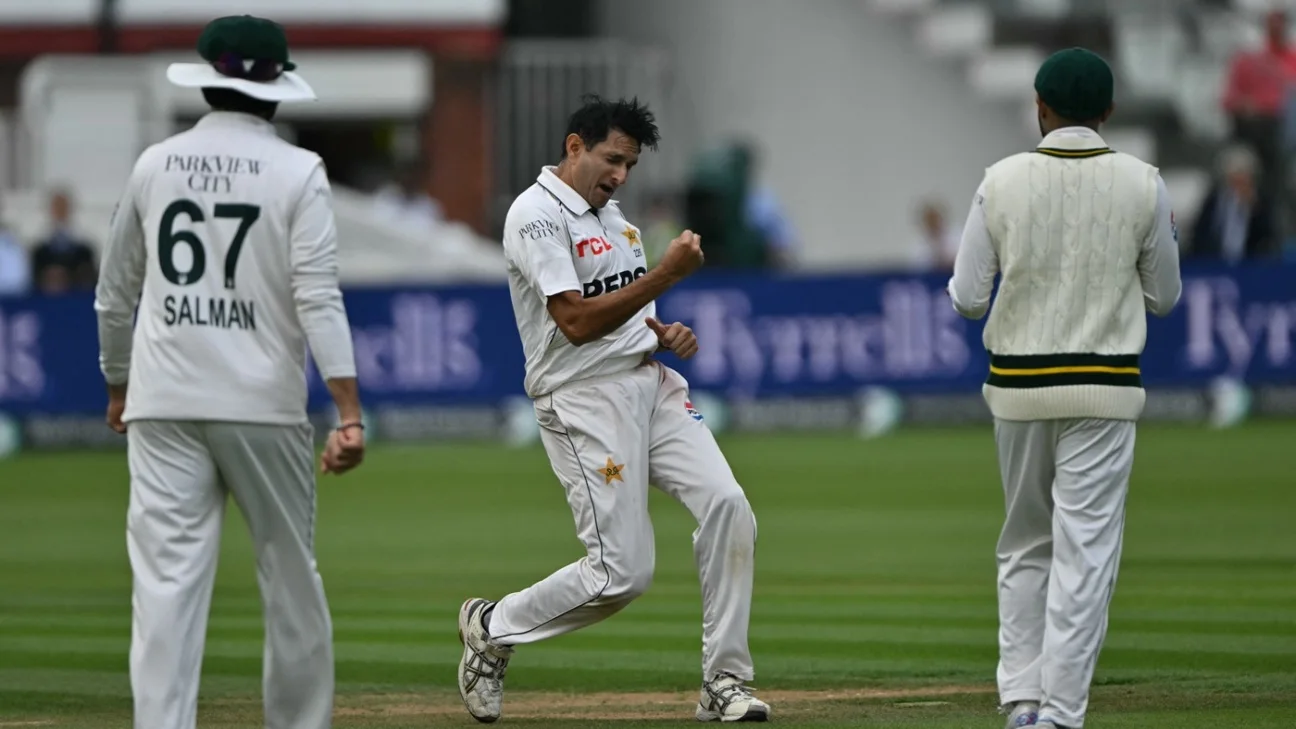
“It doesn’t happen very often and from Mike and my perspective, all we can do is come and add positivity,” Noffke said at a press conference after putting Pakistan’s quick bowlers through their paces at a practice session.
“There’s obviously a feeling of uncertainty [in the players] but also they’ve just got back on the job. I’ve been really impressed with the level of calmness that they’ve taken over the couple of days once we’ve given them time to talk. We’ve done that in one-on-one scenarios where they can talk to the head coach, the bowlers can talk with me, and they can get things off their chest and then move forward.”
Among the greatest points of uncertainty concerns Pakistan’s pace bowling attack. After two Tests where they operated with a battery of medium-quick right-arm bowlers, Pakistan have completely overhauled their strategy, bringing in variety and pace without worrying too much about experience. Twenty-one-year-old quick Razaullah was among them, as was left-arm pacer Mohammad Imran. Noffke had one-on-one sessions with both, as well as with Ubaid Shah, who has been on this tour from the beginning, but not played a Test yet.
“They [the new bowlers] have pace, which is a value-add. Mike said in previous interviews it’s about providing some balance to our attack. We’ve got a left-armer there available for selection in Imran Jnr. And Razaullah is a right-arm bowler with a slightly different action and good pace so it’s about providing some stability around those guys that have been doing the heavy lifting for us. Abbas is obviously amazing through this series and we need to support him as best we can.
“Razaullah and Ubaid bowled really nicely. The wickets are helping though, so it’s all about finding balance between when the wicket isn’t helping and when it is, so the lengths that we bowl, being able to pitch the ball a little bit fuller without floating up a half volley. They’re going really well and they’re keen, they’re smiling.”
Noffke engaged with Ubaid in detail, talking to him about his bowling action and arm position as he sent down deliveries in the nets. “It’s about us getting in the present now. And like anything, the uncertainty can make you feel, you know, you take a step back and you’re not sure,” he said. “We’ve really been encouraging these guys to show their skills, whatever that may be. If it’s Abbas that can nibble it on a spot or if the spinner plays the revs that he shows and the skills that he shows, Arafat [Minhas] on the inside, I think that’s what we want them to do.
“There’s always something going on in the background, and whether or not it’s in or out of our control, and I think most of the time it’s out of the player’s control, they need to focus on the cricket that they have in front of them.”
Ashley Noffke
“But any young fast bowler needs time and attention and help. That session was just more about answering his questions. He had lots of questions, so to be fair we worked on positions of the seam with wobble seam and swing. He’s highly skilled. With a lot of skill, it’s hard to control at times for a young fast bowler. But he’s getting better and better in that phase. Like a batter goes in and has half-volleys and hits cut shots, I really like when bowlers have their own space to be able to work on how their wrist feels, where it is without the pressure of a net session.”
It remains unclear what sort of combination Pakistan would opt for at this time of great upheaval. While Pakistan sent back left-arm spinner Ali Usman, they retained Sajid Khan, and called in Minhas. But with the Test still two days away, and the weather taking a cooler turn as the week progresses, those decisions have not yet been finalised.
“We don’t have to rush into that decision. There’s still a whole rest of the day today,” Noffke said. “And then, obviously, we want to see what it looks like tomorrow and where that weather forecast heads. We’ve watched [the pitch] over the last couple of days. We’re also watching above as well. England can be looking up instead of down but it looks a good surface. Plenty of grass on it though. The groundsman’s been working really hard to get it up to speed quickly.”
Noffke is keen to focus on the skillsets of the players he has available to them. He emphasised repeatedly that the circumstances which brought him here sit outside his control, and he considered it unproductive to try and engage with them at this stage. That is not unusual within the current selectorial structure at the PCB. Hesson said he had no input into team changes because he wasn’t part of Pakistan’s Test structure at that time, with Noffke similarly uninvolved with the red-ball setup.
Noffke did not deny that events of the week had had an unsettling effect on the group and that he had little involvement with the incomings and departures, but believed the group that Pakistan has ended up with was exciting. “[I know] as much as you do, and I can be really honest in that. I don’t know too much; I sit outside of that decision-making model and as coaches, we try and keep the players focused on what they need to worry about.
“One thing that I’ve learnt about being in Pakistan and coaching for a period of time, nearly 15 months now with the white-ball team. There’s always something going on in the background, and whether or not it’s in or out of our control, and I think most of the time it’s out of the player’s control, they need to focus on the cricket that they have in front of them. There’s some really great opportunities here for young cricketers that are highly skilled.”
“You only instil pride with really good cricket, don’t you? So, like we said before, the selection becomes out of our hands a little bit, and the players are completely out of their hands. All they can do is focus on putting good performances forward, so the comments based around how we’re perceived will be determined by how well we play cricket and how quickly we develop. There’s no question that we need to develop our game. Our Test game needs to improve.
“The strategy is good Test cricket. It’s about focusing on where we want to take our cricket, what we want to improve, and what we can control with the skills that we have. Discipline, good areas when we’re bowling, and long partnerships when we’re batting. They’re simple game plans.”
For Noffke, the task is now finding out why such simple game plans appear to have proved so difficult for Pakistan’s Test side.
Danyal Rasool is Cricinfo’s Pakistan correspondent. @Danny61000






Leave a Reply