
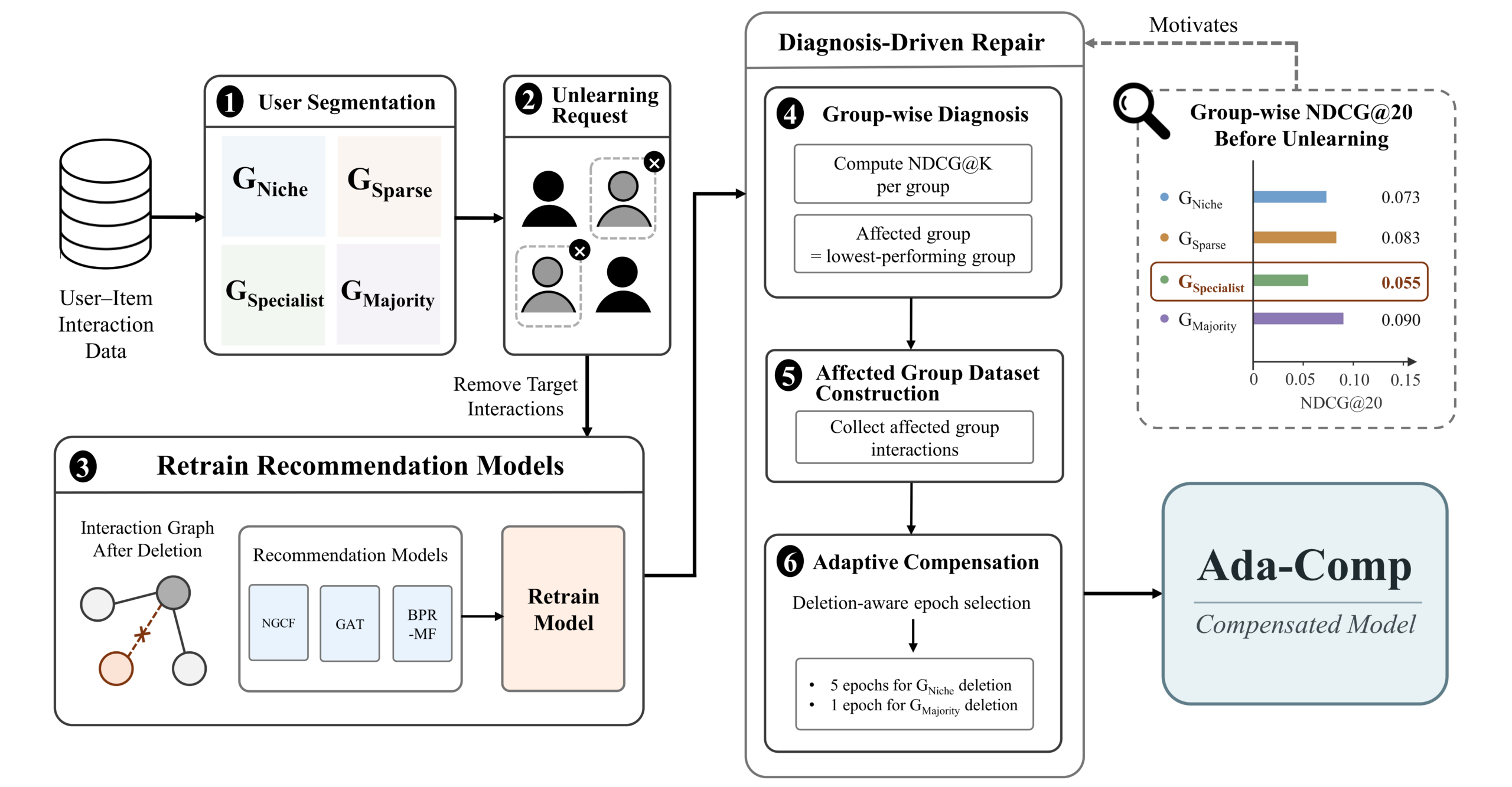
□ A research team led by Principal Researcher Sang-Chul Lee of the Division of Nanotechnology at DGIST (President Kunwoo Lee), who also holds a concurrent position in the Artificial Intelligence major of the Department of Interdisciplinary Studies, has developed an AI technology that automatically identifies and compensates for user groups whose recommendation performance deteriorates significantly after user data is deleted. Undergraduate researcher Eugene Jeong participated as the first author in the study, one of the only 28 papers selected for the ACM KDD Undergraduate Consortium (KDD-UC ’26) and was presented in Jeju this August.
□ With the recent increase in personal data protection demands, “machine unlearning,” a technology that removes the influence of a user’s data from an already trained AI model when the user requests its deletion, has been receiving attention. Although this is a crucial technology for implementing the “right to be forgotten” in AI systems, it has a limitation: deleting a particular user’s data can degrade the quality of recommendations for other users.
□ The research team focused on the fact that, in graph neural network (GNN)-based recommender systems, some users play a structural role in connecting different user groups, and that deleting their data can also affect the recommendation performance of surrounding users. Based on this observation, the team proposed “Ada-Comp (Adaptive Compensation),” a compensation technique that automatically identifies the user group most affected after data deletion and selectively provides additional training for that group.
□ This study is significant in that it expanded the perspective of machine unlearning from the conventional focus on “how effectively the information of users targeted for deletion has been removed” to consider “how the process affects other users.” The team proposed a new approach that faithfully reflects the deletion of personal data while preventing unexpected performance degradation from being concentrated among specific user groups.
□ In particular, this achievement is significant in that undergraduate-led research was developed into an international-level research outcome through interdisciplinary research between DGIST’s undergraduate and research divisions. Undergraduate researcher Eugene Jeong served as the first author, while Principal Researcher Sang-Chul Lee participated as the corresponding author, linking undergraduate research with the research experience of professional researchers.
□ In 2025, Sang-Chul Lee’s research team presented at the KDD Research Track research conducted during undergraduate study by Seungeon Lee, who was then a DGIST undergraduate student and has since graduated. With undergraduate researcher Eugene Jeong’s research selected for KDD-UC ’26 this year, research conducted by DGIST undergraduate students has now been selected and presented at KDD for two consecutive years.
□ “For trustworthy AI, it is important not only to delete personal data safely, but also to ensure that the quality of service for other users does not deteriorate in the process,” stated Principal Researcher Sang-Chul Lee. “We expect this study to present a new direction for reducing performance disparities among user groups that may arise after machine unlearning.”













Leave a Reply