
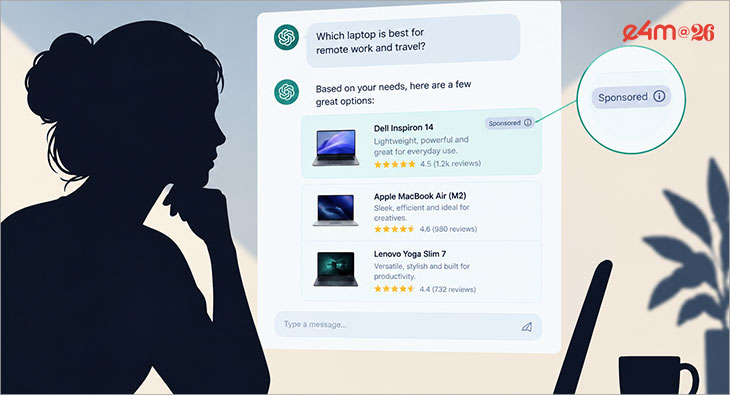
Open ChatGPT this festive season and, somewhere below the answer to a perfectly ordinary question about the best air fryer or the right home loan, a small labelled card may now appear: a sponsored product, placed there by a brand that paid for it. OpenAI began rolling out ChatGPT Ads in India on August 27, its second-largest market by weekly users, with more than 50 brands going live through agency partners WPP and Omnicom. From September 4, a self-serve Ads Manager has let any business run campaigns with daily budgets starting at a modest ₹725.
It is, on paper, a straightforward story, another platform monetising attention the way search and social did before it. But it has quietly forced India’s marketers to confront a murkier question sitting just beneath the paid placement: the one about everything ChatGPT recommends without being paid to. That distinction matters more than it might seem, because AI is no longer a side channel for discovery.
WPP Media’s This Year Next Year forecast pegs India’s advertising market at ₹2.01 lakh crore in 2026, with digital already commanding 68.1% of spend and commerce-led formats the fastest-growing slice, up 24.2%. Globally, the shift is even starker in the numbers that actually measure outcomes. Adobe Analytics, tracking over a trillion visits to US retail sites, found that by July 2026 shoppers arriving from AI referrals were converting at a 60% higher rate than everyone else and generating 53% more revenue per visit. A recommendation, in other words, is starting to close the sale before a brand has spent a rupee chasing the customer through a funnel.
Read On: India gave ChatGPT users. Can it now give OpenAI ad revenue?
The line between paid and earned
For Rushabh Shah, Chief Marketing Officer at Rustomjee Group, the first order of business is separating two things that keep getting collapsed into one conversation. “I would separate advertising on AI from being recommended by AI. One is paid for. The other is earned,” he says. It sounds like a technicality until you sit with it: an AI recommending a brand because it genuinely fits a user’s need is a very different achievement from an AI recommending a brand because someone wrote a cheque.
Saheb Singh, Director – Strategy at AGENCY09, a Mumbai-based digital marketing and brand strategy agency, draws the same line but locates it in the mechanics of the platform itself. “An AI recommendation is already a marketing outcome. It becomes advertising when payment or a commercial arrangement influences the placement,” he says. That is precisely what OpenAI’s own product design is trying to formalise: sponsored placements in ChatGPT are labelled, appear separately from the model’s answer and, per the company, cannot influence what the model actually recommends. Organic visibility, by contrast, still has to be earned through relevance and trust.
What makes this earned layer commercially significant is the point in the journey at which it arrives. Users typically hand an AI assistant their budget, their constraints, and their exact need before asking for a recommendation, which places a brand extremely close to a decision that is already forming. That is why Singh argues the category deserves the same seriousness as any established media line. “AI now deserves dedicated strategy, governance, and measurement alongside search, social, and commerce media,” he says, pointing to that same conversion premium Adobe has been tracking through 2026. No brand, he is careful to add, can guarantee it will show up organically across every model out there; the most any of them can do is stack the odds in its favour.
Read On: ChatGPT Ads just hit $1bn run rate. Now comes the price test in India
What makes a brand recommendable
Stacking those odds, it turns out, looks less like a media plan and more like an information audit. An AI system can only recommend what it can read, verify, and confidently match to a stated need, which means the unglamorous plumbing of a brand’s digital footprint (its product feeds, pricing pages, FAQs, and structured content) now carries as much weight as its campaigns.
Reshu Saraf, Head of Integrated Marketing & Communications at Interio by Godrej, has been rebuilding exactly that plumbing over the past several months. “Product information needs to be accurate and comprehensive, while content, customer experiences, and digital engagement need to provide enough context for AI to understand where a product fits into a consumer’s requirements,” she says. For a category like furniture, where shoppers research design, material, and fit for weeks before ever walking into a store, that context can shape a decision long before a salesperson enters the picture. Her team, she says, is developing blogs around the exact questions consumers are typing into search bars and AI chat windows alike, adding FAQs, and pulling insights from performance marketing to keep that content aligned with how people are actually asking.
Real estate offers an even sharper version of the same problem, because the stakes of getting it wrong are so much higher. Ankur Parmar, Chief Marketing Officer at Mahindra Lifespace Developers Ltd., frames it as a shift in what counts as evidence. “AI recommendations are emerging as a new form of marketing – but unlike advertising, they cannot simply be bought. They are earned through the quality, credibility and consistency of a brand’s digital footprint,” he says. In his category, that footprint is built from project delivery track record, customer experiences and third-party validation, the same signals an AI system pulls together from reviews, forums and news coverage before deciding what it is willing to vouch for.
Read On: ChatGPT ads: 3 takeaways on pricing of attention
“The principle is similar to search, but the bar is higher: brands must build not just visibility, but a credible body of evidence that AI can trust,” Parmar adds. Shah puts the same idea more bluntly: you can buy visibility, but you cannot buy credibility, and in a category like housing, where a family is committing years of savings on the strength of a name, that difference decides everything.
Beyond search and social
This is also where AI-led discovery genuinely breaks from the two channels marketers have spent two decades optimising for. Search rewards a page for matching a query; social rewards content for holding attention and generating engagement. An AI assistant does neither. “Traditional search generally ranks pages for queries, while social platforms distribute content through attention and engagement signals. An AI assistant interprets a fuller brief and often compresses the market into a short, reasoned recommendation,” Singh explains.
That compression is the uncomfortable part for marketers used to buying their way to the top of a results page: an AI is not listing ten options for a user to scroll through; it is picking two or three and explaining why. Saraf frames the shift from the brand’s side of the same table. “Traditional search is largely about being discovered against a specific query, while AI-led discovery is about being understood in the context of a consumer’s need and being considered relevant enough to be recommended,” she says.
Read On: Search had keywords. Social had audiences. Can ChatGPT sell context?
None of this makes search, social or earned media redundant. If anything, Singh notes, they remain part of the evidence an AI draws on when it decides who to trust. What changes is the job description. Brands will now need to track not just whether they rank or trend, but whether an AI mentions them at all, how accurately it represents them, which sources it is citing to make that call, and why a competitor got picked instead.
As ChatGPT’s sponsored cards start showing up in Indian users’ answers this festive season, the paid lane will be easy enough to measure. The much bigger prize, the one every marketer quoted here is chasing, is the recommendation nobody paid for.











Leave a Reply