
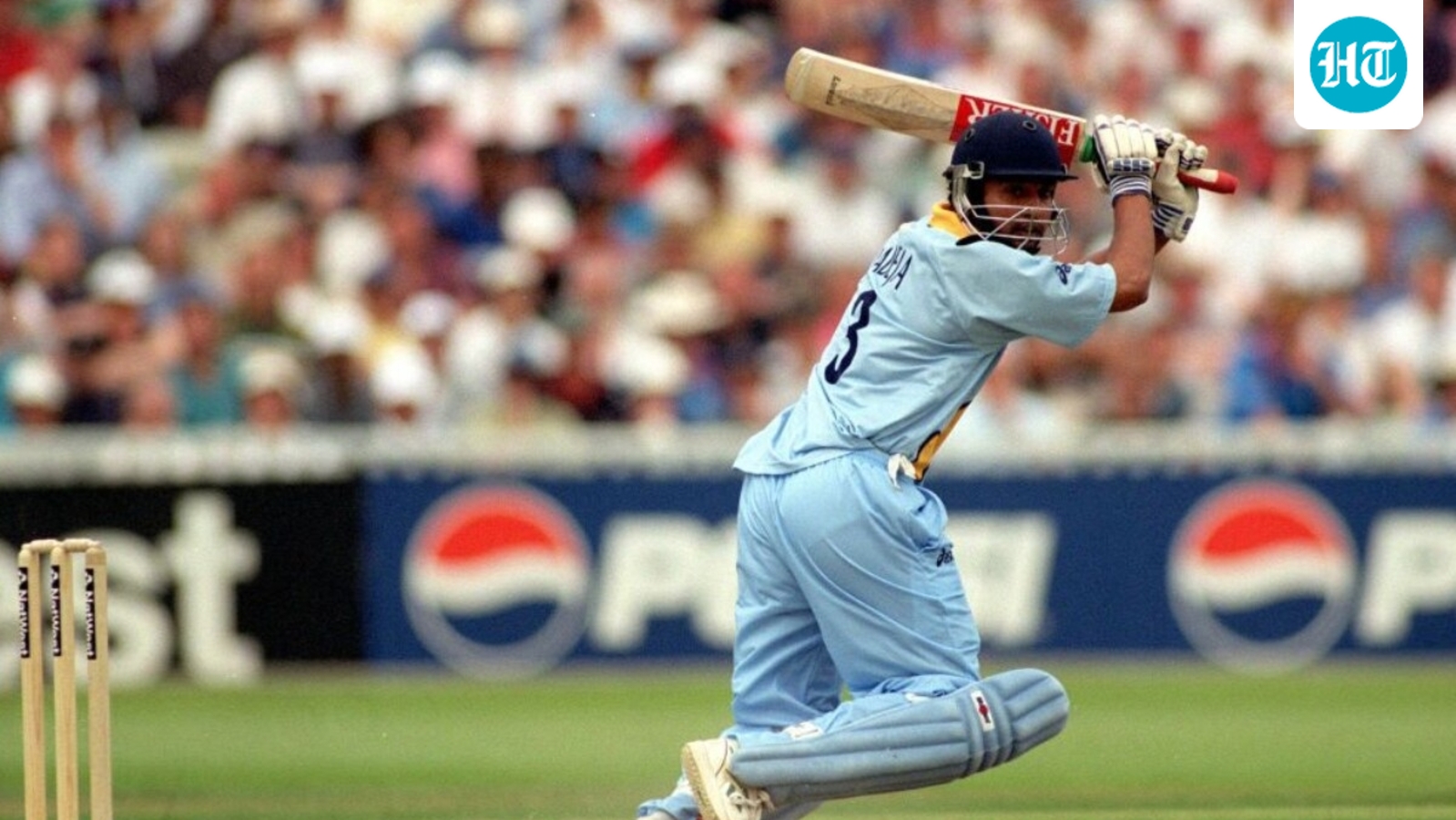
He was India’s OG 3D cricketer, long before the term “three-dimensional” became a thing. He was the personification of chutzpah at a time when almost every other Indian player remained reserved. He retained that swagger through the highs and lows of his and India’s cricket journey. He was India’s Australia slayer alongside Sachin Tendulkar, long before VVS Laxman made the Australians his favourite team to bat against. He is one of only 11 Indian players to score 5,000 runs and effect 50 dismissals in ODIs. He is India’s 16th-most-capped ODI cricketer; his bowling figures of 3/3 remain one of the country’s most economical spells of all time.
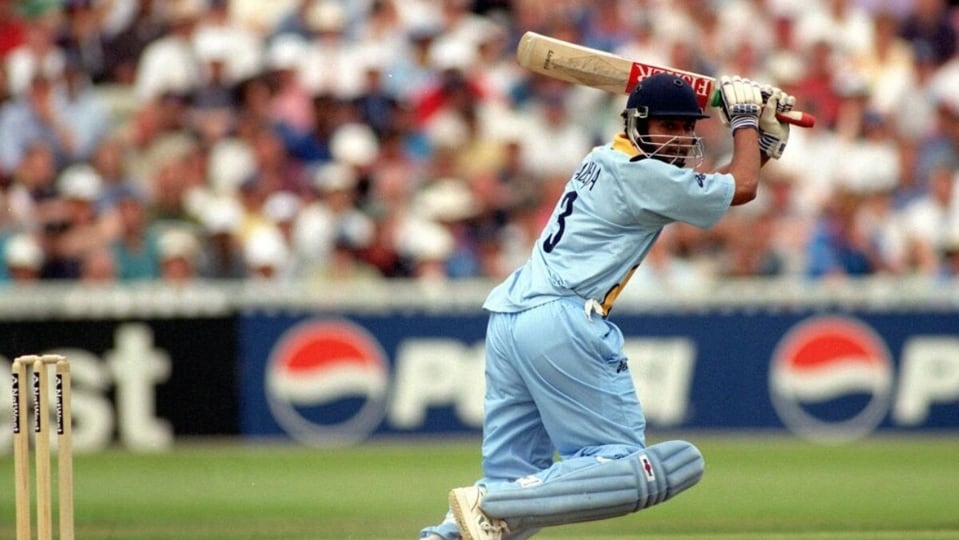
All these are exceptional pieces of trivia, but sadly, his career was brought to a premature end when one of Indian cricket’s darkest scandals broke out. He was a damn good batter who made fielding look cool, setting an example for the likes of Mohammad Kaif, Yuvraj Singh and Suresh Raina. With his collar up and cameras catching him chewing gum on the field, he never lost that smugness about himself. He was Tendulkar’s opening partner when Sachin opened for the first time in ODIs, and later became his opposition captain during the Master Blaster’s farewell Ranji Trophy match, giving the maestro a guard of honour.
Idolising the legendary Kapil Dev, Ajay Jadeja made his First-Class debut in 1988 for Haryana, but it wasn’t until the 1992 Ranji Trophy season that selectors took notice. Jadeja finished the season with 1,036 runs at an average of 94, including knocks of 256 against Services, 228 against Punjab and 199 against Himachal. Once he broke into the Indian team, it took Jadeja four years to notch up his maiden international hundred, when he struck 104 against the West Indies, and another four for his second.
Very few batters have tasted equal success as openers and middle-order batters. Jadeja was one of those rare breeds. Opening the batting, Jadeja scored 1384 runs at an average of 33. At No. 5, he scored 1496 runs at 35.6; at No. 6, 1324 runs at 37.83; and at No. 4, 1008 runs at 53.05. The reason he succeeded lower down the order was his tremendous ability to swat yorkers to the fence. Ask Pakistan.
The captain whom India lost
Jadeja could sneak in those quick singles, his street-smartness capturing plenty of attention during his playing days. It was perhaps this trait that made him captain material, although its true potential could never be realised. With the leadership of the team switching between Mohammad Azharuddin and Tendulkar, Jadeja, who served as India’s vice-captain, was more of a stand-in than a permanent option. He could never challenge his peers for the position since his Test career couldn’t quite flourish as it did in ODIs – he played just 15 Tests, with his frailty against quality pace and swing acting as a hindrance. Yet, with eight wins in 13 ODIs, Jadeja had a win percentage of 61 as captain.
Despite finishing with 8100 first-class runs at an average of 54, Jadeja’s domestic brilliance often went under the radar. Who can forget the 94 he made in Haryana’s famous two-run win over Bombay in the 1991 Ranji Trophy final? In 1997, Jadeja scored a career-best 119 against Sri Lanka for India and added a then-world-record stand of 223 for the fifth wicket with Azharuddin. A year later, the pair stitched together an unbeaten 275 against Zimbabwe, then the highest partnership for any wicket in ODI history.
Besides showing a penchant for playing yorkers well, Jadeja could hit them big. A huge part of India’s win over Pakistan in the 1996 World Cup is owed to Jadeja’s assault on Waqar Younis, when he bludgeoned the Pakistan pacer for 22 and 18 in his last two overs. In those days, such unprecedented hitting against a bowler of Waqar’s calibre was unheard of. Jadeja also boasted a stellar record against Australia, scoring 533 runs in 16 ODIs at an average of 48.45, even though he scored a lot more against New Zealand, Pakistan, Zimbabwe, Sri Lanka and South Africa.
Match-fixing and BCCI’s ban
While Azharuddin felt the most wrath with the BCCI handing him a life ban, Jadeja, too, was barred from playing any form of competitive cricket for five years. With time away from the cricket field, Jadeja started another entertaining chapter in his life, making a foray into Bollywood and debuting alongside Sunny Deol and Suniel Shetty in the crime-thriller title Khel. Although the movie did disastrously at the box office, Jadeja 2.0 had arrived. He went on to act in a 2009 film Pal Pal Dil Ke Ssaat (2009), in addition to a cameo appearance in Kai Po Che.
He also entered the world of reality television, participating in the celebrity dance show Jhalak Dikhhla Jaa and making appearances on Comedy Circus. However, once the Delhi High Court lifted the ban after failing to find evidence, Jadeja returned to play, this time for Delhi. At 35, Jadeja topped the run charts in the 2005-06 Ranji Trophy, scoring 684 runs at an average of 97.7. Despite his brilliance, Jadeja was never recalled to the Indian team. He continued to play domestic cricket, took up a mentorship role and later went on to coach Afghanistan as the team produced a memorable 2023 World Cup campaign.
In many ways, Jadeja’s time away from the cricket field brought him a whole lot more recognition than his stint on it. Currently working as a broadcaster, Jadeja is still remembered as one of the most charismatic Indian cricketers of the 1990s. He had a bit of everything, along with certain limitations. But it was his aura and panache that made onlookers turn their heads and catch a glimpse.




Leave a Reply