
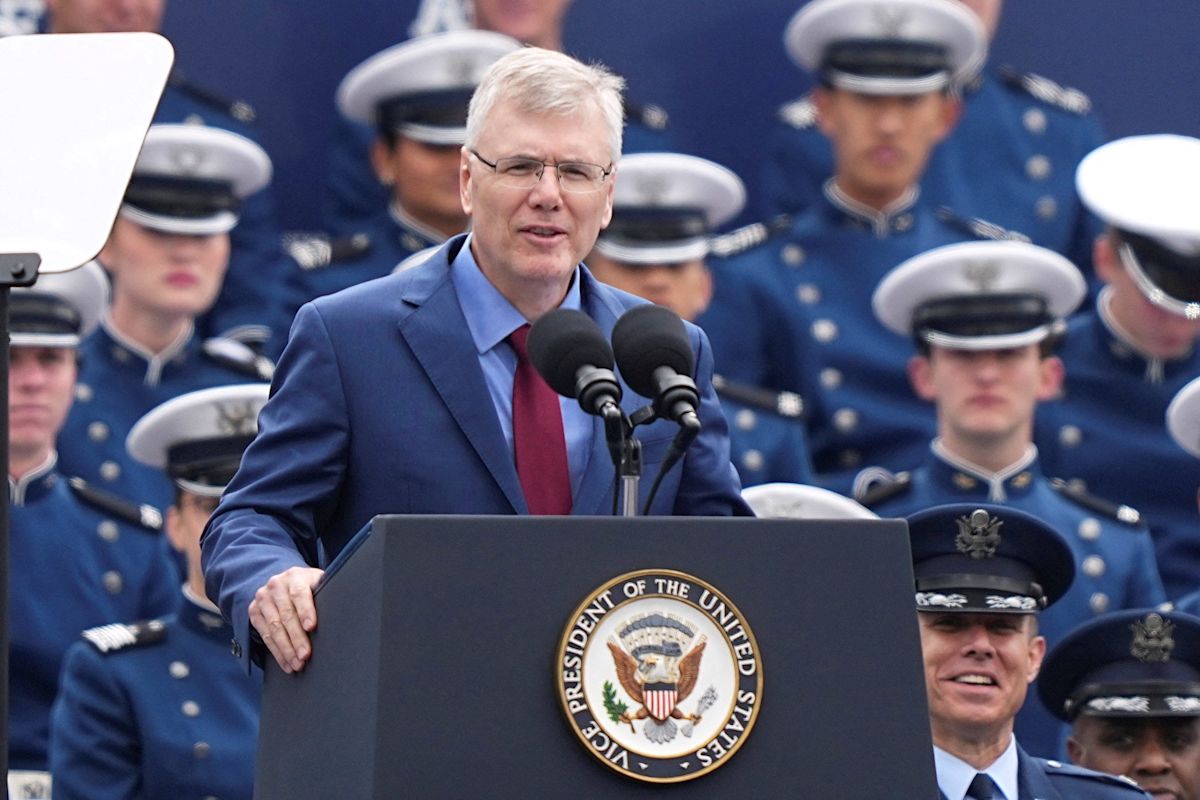
The U.S. has confirmed in a landmark revelation that the nation has deployed operational weapons in space.
Air Force Secretary Troy Meink became the first U.S. official to publicly acknowledge the orbital defense capability in what is widely being interpreted as a clear message of deterrence to both China and Russia.
“Today, we continue to ensure we remain ready to meet the challenges of evolving threats wherever they exist,” Meink said Monday, Sept. 14, in prepared remarks at the annual Air, Space and Cyber Conference. “This is why the United States now has on-orbit space control weapons capable of defending the joint force against hostile adversary action.”
The comments come as President Donald Trump has made clear that U.S. superiority in space is one of his top priorities for the United States.
Here’s what we know so far about the weapons the U.S. has in orbit.
Rocket launches: US space boom is outgrowing rocket launch sites
Air Force official confirms US has weapons in space in major 1st
Meink’s announcement came during an annual gathering hosted by the Air & Space Forces Association in National Harbor, Maryland, according to a press release from the Air Force.
While Meink did not provide specifics on the weapons or when they were deployed to orbit, the news alone marked a significant moment amid a time of global conflict. China and Russia, furthermore, have continued to remain powerful adversaries seemingly racing with the U.S. to expand military might to space.
“It is critically important that we maintain our dominance not only in the air but in space, and so we’ve had to take steps to make sure that when we’re threatened, we can take care of that,” Meink said at the conference.
Trump administration highlights space superiority as priority for US
Trump has made it a priority of his second administration to bolster U.S. superiority in space.
For example, a new policy Trump signed Aug. 20 calls for the U.S. to support more than 1,000 launches and reentries per year by 2030. Meeting the ambitious benchmark would mean that launches – many of which are to deploy military payload to orbit – would more than quadruple from today, when about 200 rockets get off the ground per year.
To accomplish the lofty objective, the Trump administration calls for the development of more launch sites across the U.S., as well as upgrades to existing spaceports where rockets already lift off.
Also recently, the Department of Transportation proposed at the end of July to exempt commercial space launch licensing from many environmental regulations. The proposal, officials said, builds on the groundwork Trump laid in August 2025 when he signed an executive order meant to make it easier and quicker for commercial providers like SpaceX to obtain licenses to launch rockets.
Trump signed an executive order in December emphasizing the importance of developing “next-generation missile defense technologies.” Such capabilities would appear to go hand in hand with the Trump administration’s planned “Golden Dome” missile defense system.
Trump establishes Space Force, Space Command
Trump has also repeatedly touted the establishment of the the U.S. Space Force in 2019 during his first term as a significant step in strengthening the nation’s military dominance in orbit.
That’s the same year Trump also moved to reestablish the U.S. Space Command, which is responsible for military operations beyond Earth’s atmosphere – including defending U.S. satellites from potential threats. Space Command, which is responsible for conducting military operations, is separate from the U.S. Space Force – a service branch of the military, like the Army or Navy, according to the Department of Defense.
Eric Lagatta is the Space Connect reporter for the USA TODAY Network. Reach him at elagatta@usatodayco.com
This article originally appeared on USA TODAY: US says for 1st time it now has weapons in space. What we know (so far)








Leave a Reply