
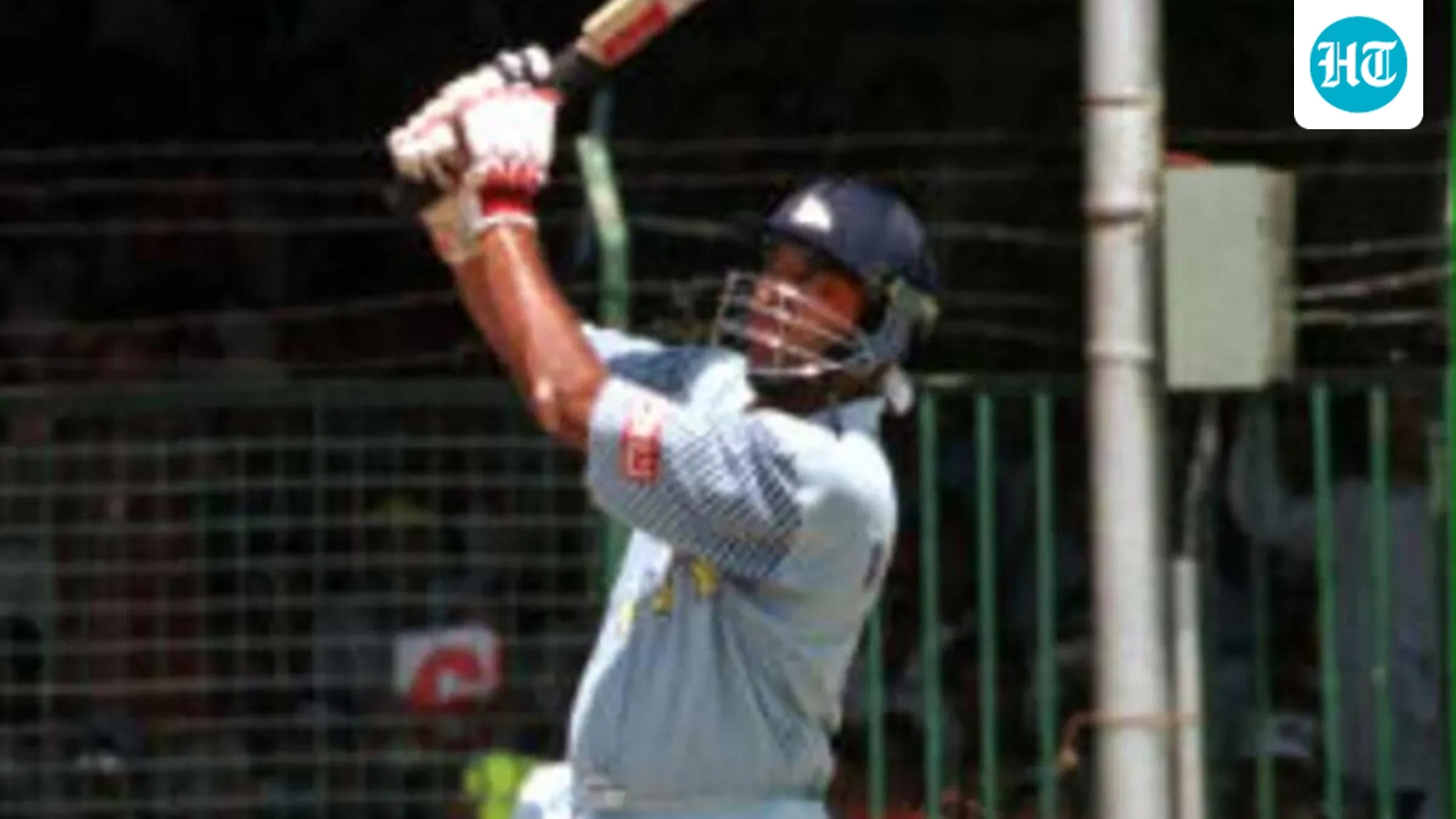
Long before an India cap arrived, the weight of runs had become impossible to ignore. There had been seasons of sustained accumulation, the extraordinary symmetry of 99 and 99 not out in the same Ranji Trophy match, a double-century, India A recognition and, eventually, a hundred against a touring Australian side. By the late 1990s, this was no precocious talent being advanced on promise. He had spent the better part of a decade building a case for international cricket, one innings at a time.
Then came something even more unusual. India included the left-hander in their preliminary plans for the 1999 World Cup before he had played a single ODI. His reputation had travelled ahead of him. When the international debut finally came, against Sri Lanka in Pune, he seemed intent on vindicating that faith at once, hammering 57 from 45 balls and adding impetus to an innings that Ajay Jadeja would eventually carry to 286.
For a brief moment, the trajectory appeared almost too neat. Years of domestic labour had yielded an India opportunity; the opportunity had produced an immediate half-century; and beyond it stood a World Cup in England. Yet what looked like the beginning of a substantial international career would instead become its defining afternoon. He travelled to the World Cup without appearing in a match and would finish his entire India career with only 12 ODIs.
That player was Amay Khurasiya, the flamboyant Madhya Pradesh left-handed batter whose 149 international runs tell very little of the cricketer he had been. Across 119 first-class matches, Khurasiya amassed 7,304 runs at 40.80, including 21 centuries and 31 fifties. His 112 List A appearances brought another 3,768 runs, while his domestic career repeatedly demonstrated that he could combine volume with aggression in a manner that made him especially attractive in limited-overs cricket.
The runs that forced India to look
Khuraisya had entered first-class cricket as a teenager in 1989-90 and quickly began producing seasons of genuine substance. He scored 584 runs from 11 innings in 1990-91, followed by 548 from 10 innings the next season. During the 1991-92 campaign came one of the strangest entries on his scorecard: 99 in the first innings and 99 not out in the second against Vidarbha. He also won the BCCI’s LP Jai Trophy for the fastest hundred in that season’s Ranji Trophy.
The following year brought the highest score of his first-class career, 358 against Vidarbha at Korba. Khurasiya was therefore never merely a dasher reliant upon attractive cameos. He had shown both the appetite and concentration required for substantial innings, even if aggression remained central to his identity. In an era when India were increasingly looking for greater intent in one-day cricket, that combination made him difficult to overlook.
By 1998, Khurasiya had pushed himself firmly into the national conversation. Playing for India A against the touring Australians, he struck an unbeaten 117 from 106 balls. Later that year, representing India at the Commonwealth Games in Kuala Lumpur before earning an ODI cap, he made 83 against Canada. His tournament ended dramatically against Australia when he collapsed from dehydration while fielding in the oppressive Malaysian heat and had to be stretchered away.
The following domestic season strengthened his claim further. Khurasiya scored 593 runs in the Ranji Trophy at an average of 59.30 in 1998-99 and made 57 as Madhya Pradesh defeated Bengal in the Wills Trophy final at Eden Gardens. By then, the selectors had seen enough. He entered India’s 19-man preliminary World Cup squad while still uncapped, an unusual vote of confidence that spoke to the strength of his domestic body of work.
His ODI debut on March 30, 1999 appeared to justify it immediately. Khurasiya’s 57 against Sri Lanka came with four fours and two sixes, and for a time, he looked entirely at ease with the set-up. Yet scores of 6,3, and 5 followed before the World Cup. He survived the cut to India’s final 15 but spent the tournament on the sidelines, and the momentum generated by that debut innings had already begun to dissipate.
Further opportunities arrived later in 1999, but the defining score remained elusive. Across three matches in the Aiwa Cup in Sri Lanka and two in the Coca-Cola Challenger in Singapore, he managed only 66 runs. Contemporary assessments increasingly pointed towards vulnerabilities that domestic attacks had not punished with the same precision. His shuffles across the crease and willingness to reach for deliveries outside off stump left him exposed against higher-quality bowling.
There was an irony in that weakness. The freedom that made Khurasiya such an appealing domestic batter was also what international attacks learned to exploit. His instinct was to impose himself on the bowling, but at the highest level, bowlers denied him the lengths and the room from which that aggression had flourished.
Still, the story did not end there. Khurasiya returned to domestic cricket and responded with another prolific campaign, scoring 711 first-class runs in 2000-01. When Sachin Tendulkar suffered a foot injury before India’s triangular series in Sri Lanka, the selectors recalled Khurasiya as a standby opener. Nearly two years after his previous ODI, he had unexpectedly forced open another door. It proved to be his final one. He scored 12 on his return and, in his next appearance, was bowled for a two-ball duck by Chaminda Vaas in Colombo. He never played international cricket again. The 57 he had made on debut remained the solitary fifty of his ODI career. Across his other ten innings, he managed only 92 runs.
Khurasiya continued to serve Madhya Pradesh, later captained the state and retired from first-class cricket in April 2007 before moving into commentary and coaching. His second life in the game ultimately became far longer than his first at international level, including a coaching career that later took Kerala to their maiden Ranji Trophy final.
The temptation is to reduce Khurasiya to modest dimensions of his India record. The more revealing numbers lie in three early seasons in which he crossed 500 runs, and another 711-run campaign that earned him an unlikely recall, 21 first-class centuries and more than 7,000 runs. He reached the threshold of a World Cup before he had even played an ODI, and announced himself with a half-century when the cap finally came, and then discovered just how unforgivingly narrow the distance can be between arriving for India and remaining there.




Leave a Reply