
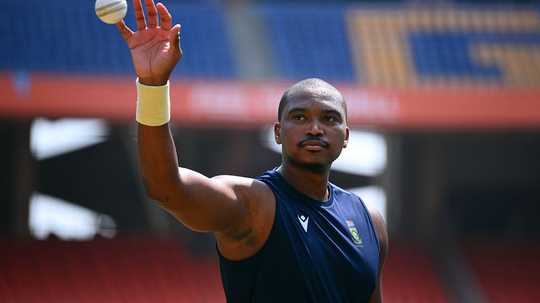
Lungi Ngidi has hobbled into a club he would rather not be part of, its exclusive but growing membership restricted to injured South Africa fast bowlers. Ngidi is the fifth inductee, all except one of them admitted into the club because of the same issue.
CSA said on Friday that Ngidi had been ruled out of the ODI series against Australia that starts at Kingsmead on Thursday. Like Kagiso Rabada, Ottneil Baartman and Lutho Sipamla, Ngidi was removed from the equation by a hamstring injury. The odd man out is Nandré Burger, who has aggravated a lingering back issue.
What is it with all the hamstrung hamstrings? Timing, it seems.
“It’s not surprising, because if you look at any sport there are two peaks in hamstring injuries — the beginning of the season and the end of the season,” Shuaib Manjra, CSA’s former chief medical officer and national men’s team doctor, told Cricbuzz.
“At the beginning of the season they happen because you’re getting a sudden increase in load. Players who have been taking breaks and suddenly there’s a ramp upward in activity. They go into the season and it’s high impact stuff, and they get injured because they’re not accustomed to it. Towards the end of the season it happens because there’s muscle fatigue and that causes it. So it’s not surprising.”
Ngidi was hurt in Centurion last Friday playing in the season’s opening round of first-class matches for the Titans against the Dolphins. As with Rabada, CSA didn’t hazard a prediction about whether Ngidi would be fit in time for the Test series against the Australians, which starts in Durban on October 9.
The Tests loom exponentially larger than a relatively random ODI rubber for a team defending the WTC title — their only senior global success — by beating Australia in the final at Lord’s in June last year.
Consequently a five-second video posted on Rabada’s social media accounts on Wednesday showing him bowling — gently, off a run-up of a few paces — has been heralded by cricketminded South Africans as a glimmer of hope.
And it isn’t only about being able to bowl again. Rabada hasn’t played a match of any sort since May. Burger was last in action in June. Sipamla turned his arm over last month for the first time since July. Before last week, Baartman also hadn’t been on the field since July. For those players, returning to play will take a careful building of bowling loads. Getting the overs in the legs, it used to be called. And if your hamstring has given you trouble …
“The other risk for a hamstring injury is a previous injury,” Manjra said. “You’re more likely to pick up another injury if you go back too early.
“Doctors have a saying that the highest risk of an injury is a previous unrehabilitated injury. So we have to ensure that the player is fully rehabilitated, otherwise they are vulnerable.
Ngidi’s case would seem to be different. He played six ETPL games for Glasgow Cosmic in the ETPL from August 27 to September 6, bowling 120 of a possible 144 deliveries. That’s a decent workload without being too heavy. Yet injury struck despite his healthy amount of gametime.
There is of course a converse argument: that Ngidi might have been hurt precisely because he was playing franchise cricket at a time when he should have been judiciously preparing himself for the coming season, which is packed with eight Tests. Those of that view could rightly be asked if they would pay Ngidi the money he would have lost by not going to the ETPL. He is, after all, a professional.
Nqobani Mokoena swiftly replaced Ngidi in the ODI squad. Gerald Coetzee stepped in for Rabada, and Duan Jansen for Baartman. Sipamla and Burger were not in the original selection, but the injuries suffered by those preferred to them would have yanked them closer had they been fit. South Africa’s ODI attack will be led by Marco Jansen, with Corbin Bosch and Kwena Maphaka also in the mix.
All of the uninjured players above could more than do a job, including at the highest level. That’s if they stay in one piece.



Leave a Reply