
关键信息:
- Huawei has officially launched the AI Practice LAB (AIPL) Solution globally. Centered around real-world scenarios, real data, and real algorithms, the solution utilizes the Project-Based Learning (PBL) teaching mode to span three major scenarios: AI fundamentals, AI-related disciplines, and “Discipline + AI”.
- Huawei also released the “AI+ Practical Teaching White Paper“, which systematically describes the profound transformation and strategic opportunities that higher education faces in the AI era. The paper proposes a systematic approach to shift higher education from the conventional knowledge-based teaching paradigm to the practical teaching paradigm, with AI practical teaching as the core driver.
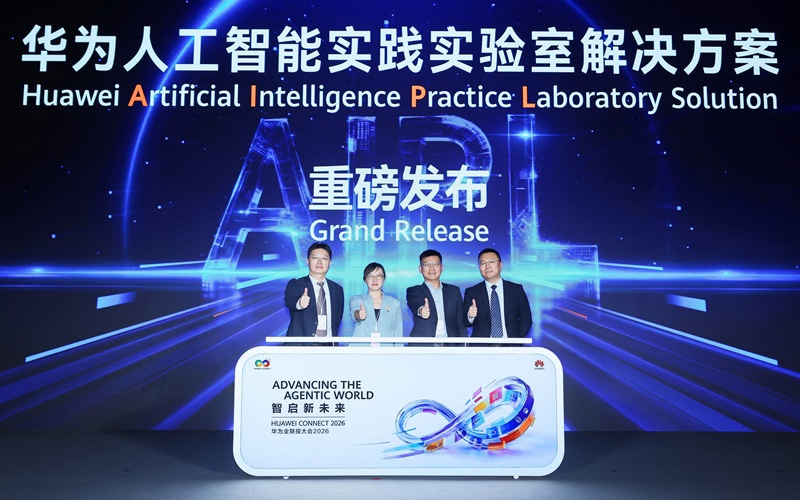
[Shanghai, China, September 19, 2026] During HUAWEI CONNECT 2026, the Global Education Summit themed “AI × Education: Building the Talent Foundation for the Digital & Intelligent Era” was successfully held in Shanghai. At the summit, Huawei officially launched the AI Practice LAB (AIPL) Solution globally, and simultaneously released the “AI+ Practical Teaching White Paper” (referred to as the “White Paper”).
As AI-driven education transformation gains momentum, the conventional theoretical teaching model can no longer meet the industry’s demand for practical capabilities, making AI talent cultivation a top priority for higher education. Drawing on its extensive experience across various industries, Huawei has introduced the AIPL Solution, which is centered around real-world scenarios, real data, and real algorithms. This solution aims to bridge the gap between conventional theoretical teaching and industry needs by introducing real-world industry cases, anonymized data, and engineering tools into teaching practices,help universities cultivate AI professionals who are truly aligned with industry needs.

Tao Jingwen, Deputy Chairman of the Supervisory Board, Huawei, shared at the Education Summit
Tao Jingwen, Deputy Chairman of the Supervisory Board, Huawei, noted that together with the education sector and industry enterprises, huawei have integrated AI technology to jointly deepen our exploration of practical education models. We have built “roads” and “bridges” in theoretical learning, practice, and scientific research innovation. Huawei will continue to remain deeply rooted in the education sector, adopting an open approach to collaborate with global universities, research institutions, and industry partners, empowering the digital and intelligent transformation of the education sector through technological innovation.

Launch of the AIPL Solution
At the summit, Li Junfeng, Vice President of Huawei and CEO of Global Public Sector BU; Pang Chuanchun, Director of Huawei’s Learning & Certification Services Dept; He Lian, Vice President of Wuhan University; Xue Guangtao, Director of Network & Information Center of Shanghai Jiao Tong University jointly launched the Huawei AIPL Solution to the world.
Currently, in collaboration with 12 baseline partners, the solution has been used to build AI practical teaching solutions and has been deployed at multiple universities, including Beijing Institute of Technology and Shanghai Jiao Tong University. This global launch aims to promote the concept and solution of AI practice worldwide, fostering the cultivation of AI innovation talents globally.

Release of “AI+ Practical Teaching White Paper“
At the summit, Huawei, together with multiple universities and partners, released the “AI+ Practical Teaching White Paper“. Du Min, President of Huawei Higher Education BU; Sun Gang, Director of Huawei’s ICT Talent Partner Development Dept; Zhang Jianjun, Vice President of Huawei; Bi Xiaohan, Deputy Director of UNESCO International Centre for Higher Education Innovation; Xia Zhengwei, Vice Director of Information Center of Wuhan University; Li Kangju, President of the Shenyang Institute of Technology and Lu Jie, Deputy Director of BGI College witnessed the release.
The white paper systematically elaborates the theoretical logic and practical pathways for restructuring higher education talent cultivation paradigms in the AI era. Focusing on the core topic of “AI + practical teaching”, it proposes a transformation reference framework featuring “one foundation, two types of elements, three levels of courses, four-dimensional evaluation, and a five-party ecosystem.” This framework aims to provide a systematic, pragmatic, and actionable guide for university administrators, frontline teachers, education researchers, and industry professionals.

Guests delivering speeches and sharing insights
At the summit, multiple guests shared their insights on how AI empowers educational transformation. Du Min, President of Huawei Higher Education BU, pointed out that AI practical teaching is a key pathway for talent cultivation. Huawei is promoting the intelligent upgrade of education across all educational stages through the AIEC and AIPL solutions and is willing to collaborate with global universities to explore new paths for educational reform. Bi Xiaohan, Deputy Director of UNESCO International Centre for Higher Education Innovation, stated that AI is driving higher education from knowledge transmission to human-machine collaboration. However, current challenges such as insufficient teacher capabilities and uneven infrastructure still exist, and there is an urgent need to address these issues through a systematic approach combining regular training and industry-academia cooperation. In terms of university practices, He Lian, Vice President of Wuhan University, introduced how the university is exploring new educational models through the “Digital Intelligence Luojia Experimental Class” while strengthening the security and ethical defenses of AI applications. Xue Guangtao, Director of Network & Information Center of Shanghai Jiao Tong University, mentioned that the university will continue to improve its AI Capability Center and work with Huawei to build an open and collaborative AI computing ecosystem. In the context of international and regional practices, Daniele Cesarini, Head of AI-HPC Architecture, CINECA in Italy, emphasized the core role of intelligent & digital infrastructure in transforming global research paradigms. Yang Biyu, Deputy Director of the Dongguan Education Bureau, shared the practice of leveraging Huawei’s computing power to build the “Guanjiaotong” agent platform, promoting the coverage of AI general education and the construction of a building a smart educational ecosystem across all scenarios.
Looking ahead, Huawei will continue to work closely with universities and partners to strengthen the digital and intelligent foundation of the education industry and promote the replication of the AIPL model across multiple disciplines. By empowering education with technology and cultivating talent through hands-on practice, Huawei will transform cutting-edge industry technologies and real-world business scenarios into educational resources for practical training, smart teaching, smart campus, and research innovation. In this way, high-quality educational resources will be more widely shared.
Themed “Advancing the Agentic World”, HUAWEI CONNECT 2026 will delve into AI across three dimensions: strategy, technology, and ecosystems. You can expect an in-depth look at our latest strategic initiatives, and we’ll also be unveiling our all-new digital and intelligent infrastructure products, scenario-specific solutions for industries, and development tools. The event will run from September 17 to 19 at the Shanghai World Expo Exhibition & Convention Center and Shanghai Expo Center. For more information, please visit HUAWEI CONNECT 2026 online at www.huawei.com/en/events/huaweiconnect
FAQs
Q1: What is the AIPL Solution?
Based on Huawei’s Ascend AI computing backbone and the AIPL enablement platform, the AIPL Solution aggregates AI practice courses from industry partners, and supplements the “Discipline + AI” professional practice components in universities. It helps universities cultivate versatile talents who are both proficient in their disciplines and AI in the era of AI. Driven by real industry needs, the solution upgrades teaching and connects theories with practice through AIPL, ensuring that AI talent cultivation in universities is truly aligned with industry realities and that industry demands and university AI talent cultivation resonate in sync.
Q2: What is the core value of the AIPL Solution?
Real-world scenarios, real data, and real algorithms from the industry empowering AI practical teaching: Covering over 1,000 AI fundamentals, AI-related disciplines, and “Discipline + AI” practice courses, with extensive scenario-based cases, the solution enhances students’ hands-on practice skills, improving their mastery of AI knowledge points by 30%.
A unified AI practice platform: The AIPL enablement platform opens up practice capabilities through standard APIs, and provides standard tool chains such as AI training and inference and agent development platforms. This lowers the barrier to practical teaching and improves experiment development efficiency by 50%.
A high-performance AI computing backbone: Software and hardware are collaboratively accelerated, with unified management of computing/networking/storage cross-domain collaboration. The backbone is compatible with over 60 mainstream models in the industry.
Q3: What is the core content of the “AI+ Practical Teaching White Paper“?
The white paper systematically elaborates on the profound transformation facing higher education in the AI era, proposing that “AI practical teaching” should serve as the core driver to help universities transition from the conventional knowledge-based teaching paradigm to the practical teaching paradigm. Focusing on three key propositions—disruptive teaching models, reconstruction of curriculum systems, and transformation of educational paradigms—the white paper provides methodological guidance and implementation paths for universities to carry out AI practical teaching.








Leave a Reply