
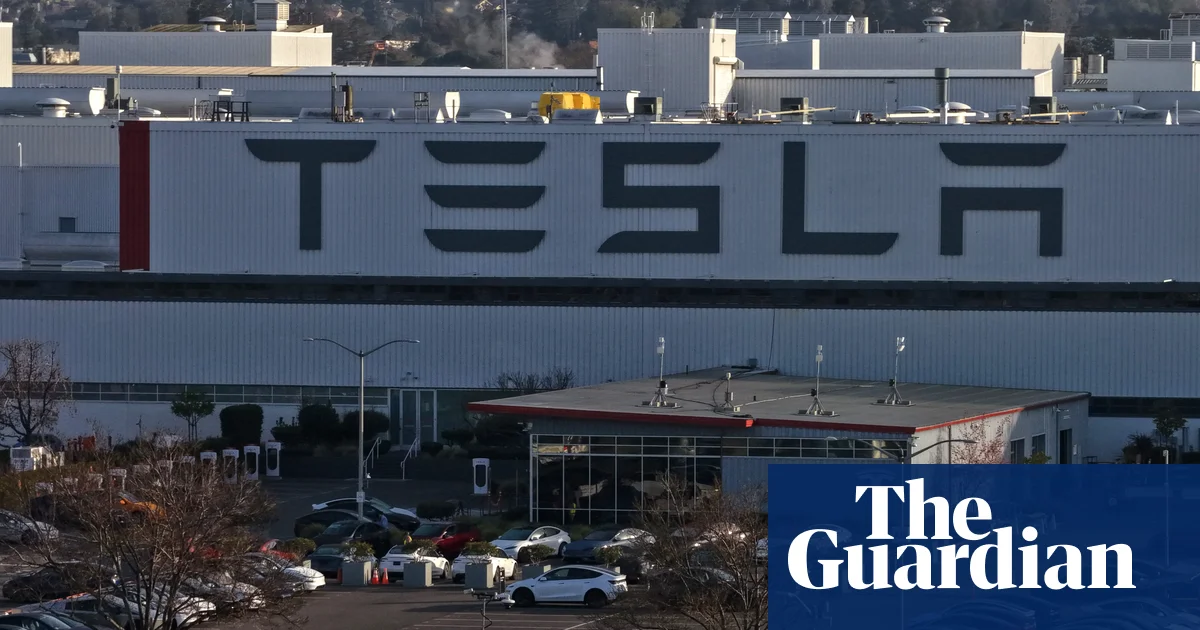
Dozens of Black employees at Tesla’s flagship plant in California said they were subject to racist slurs, unequal pay and promotions, and bullying by supervisors on a daily basis, a situation management did little to nothing to fix.
Their complaints form the basis of a lawsuit brought against the Elon Musk-owned electric car company by the state of California, which began trial with opening statements on Monday.
Brett Watson, a lawyer for the California Civil Rights Department, started by showing the court a series of photographs taken throughout Tesla’s Fremont factory. There was the N-word scratched on to a grey-blue metal surface and written in black marker on a wall. “KKK”, swastikas, the Confederate flag, a white supremacist logo and “go back to Africa” had also been found scrawled in bathrooms, lockers, workplace benches and lunch tables, according to court documents.
Watson listed a long string of racial epithets workers said were directed personally at them, including one incident where a Black worker said he was asked: “You want to hang from a tree?”
“Despite what Tesla might argue, you will hear Black workers were deeply offended,” Watson said. “These experiences cannot be dismissed as a few bad apples … hundreds of complaints to Tesla and [the Civil Rights Department] will show these experiences were not isolated.”
Watson said Black employees at Tesla experienced “rampant racism” that was left unchecked for years, and that workers referred to the factory as a “slaveship”, “the plantation” and “The Elon Slave Labor Association” – spelling out TESLA. One Black worker told state lawyers that he heard racial slurs as often as 50-100 times a day.
The lawsuit was filed against Tesla in February 2022 and alleges that the company did not comply with the law, violating California’s Fair Employment and Housing Act. It alleges that the factory was racially segregated and Black workers were paid less, promoted less and terminated more frequently than their white counterparts.
The state is seeking financial damages and injunctive relief, which could force Tesla to change its labor practices and internal policies. Judge Peter Borkon will make the final ruling in the bench trial, which proceeds without a jury.
It’s the first such lawsuit brought against Tesla by a government agency on behalf of dozens of workers to go to trial. Legal experts say the outcome of the trial could have sweeping consequences for the company since the state is not bound by the same arbitration agreements as employees. The trial is expected to continue through the end of October.
The car manufacturer has denied any wrongdoing and called the lawsuit “misguided”, saying it has “always disciplined and terminated employees who engage in misconduct, including those who use racial slurs or harass others in different ways”. Tesla said its Fremont factory has a majority-minority workforce and provides “the best paying jobs in the automotive industry” to tens of thousands of Californians.
Tyree Jones, the lead lawyer for Tesla, began his opening statements repeatedly saying the N-word in a familiar tone. “What’s up my [N-word], my [N-word] …,” Jones said, adding that “none of which is used as a racial slur.”
“By this action, the state of California attacks the way many Black people greet each other,” Jones said. “It’s offensive.”
Jones touted Tesla’s accomplishments as an innovative electric car manufacturer and reiterated that the company provides thousands of jobs in the state. “The most prolific employer of California is on trial and under attack by the state,” Jones said. Referring to the racist graffiti around the factory, Jones said: “The state is blaming the employer, when it’s the victim.”
After both sides presented opening arguments, the state called three witnesses. All were former Black employees at Tesla who said they either witnessed or were subject to racism at the company. The first witness worked at Tesla from 2021 to 2024 and said he was repeatedly bullied for being Black. In one incident, he alleged he was called the N-word by another employee, and the company gave him a write-up on the situation instead of the instigator.
The second witness was a senior security manager who worked at Tesla for six years. He said he habitually worked with human resources when complaints of discrimination came in, and that he witnessed Black employees treated differently than workers of other races. In one incident, he alleged Musk got involved when white employees were caught drinking alcohol on site and the CEO directed management to override company policy and not terminate the workers.
after newsletter promotion
Nadia Clark, who previously worked as a police officer and an army officer for decades, was employed as a security manager at Tesla’s Fremont facility from 2020 to 2022. She testified about an incident where a white employee called her the N-word more than ten times in a row in front of other workers.
“I likened Tesla to some experiences I had on the street and in the military. It was like a pressure cooker,” Clark said. “These words have a violent landing.”
She said the incident shook her and she immediately reported it to human resources, but never got a response. Clark decided to leave Tesla that day. “There were these continuous patterns that were never addressed,” Clark said. “The work environment was unsafe, hostile, and I never returned.”
This lawsuit is one of dozens of discrimination suits brought against Tesla, including a case brought by the Equal Employment Opportunity Commission, a federal agency. The suits allege the company has routinely ignored complaints of repeated racial harassment. In 2022, a federal jury awarded Owen Diaz, a former Tesla employee, $137m for these claims – one of the largest awards given in a discrimination lawsuit brought by a single worker, although a judge later reduced that sum.
Similar suits have been filed by female employees, who allege they experienced physical assaults, harassment and catcalling at Tesla facilities across the country.
Tesla has denied wrongdoing in all cases, and has said it implemented various policies in recent years to prevent racist and sexist conduct and punish it when it does occur.
Musk, who joined Tesla in 2004 and became the CEO in 2008, has also been accused of racist behavior, including promoting white supremacist conspiracy theories like “white genocide”. The CEO also tends to broadcast his thoughts on X, a social media platform he owns, fixating on anti-immigrant content and theories that the white race is under threat.
Musk is not expected to be called as a witness in the trial. He hasn’t publicly addressed the legal proceedings under way and did not return a request for comment.


Leave a Reply