
The first wave of generative AI transformed content creation almost overnight. Marketers can now draft blogs, spin up social posts, write ad copy and even put together full campaigns in minutes. That kind of productivity has genuinely reshaped how businesses think about digital communication.
Yet rapid adoption brought a deeper structural question to the forefront: if anyone can create content with AI, what actually separates the brands that win from the rest? Turns out it has nothing to do with churning out more content.
The differentiator is rarely volume. Rather, it lies in understanding why certain communication deeply resonates while equally polished content falls flat.
That’s really the question that kicks off what I think of as AI’s second act, the point where it stops being a glorified content machine and starts acting more like a marketing strategist. One that can read audience behaviour, forecast engagement and push communication that’s grounded in real data rather than guesswork. Thereby ushering in an era of strategic content intelligence.
AI’s real frontier is content intelligence
Most of the chatter around generative AI is still stuck on automation, writing faster, working cheaper, and producing more. While it is useful, it barely scratches the surface of what modern AI architecture enables.
The bigger deal is AI’s ability to make sense of human communication at a scale that was simply out of reach before. When we look at the sheer volume of social media, every single day millions of videos go live, billions of comments get typed out and endless customer conversations play out across every platform imaginable.
Buried somewhere in that mountain of noise are real signals about what people trust, how they feel and what actually pulls them in. Leading brands attempt to catch on to subtle signals regarding engagement, trust and sentiments.
Traditional analytics cannot effectively evaluate unstructured text at this scale. Large Language Models, though, can process millions of reviews, read customer conversations, pick up on language patterns, gauge sentiment, check how readable something is and spot behavioural trends, all in a matter of minutes.
That’s the real shift here. AI stops being just a creative helper and starts becoming something closer to an intelligence engine for marketing.
Why does some content just work?
For years marketers leaned on the same old scoreboard: views, impressions, click-through rates, and watch time. Fine metrics, sure, but they only tell you what happened. They don’t tell you why.
To actually get inside audience psychology, you’ve got to dig into something far messier, the language creators use, the stories woven into their videos and the conversations that spark up around all of it. The narrative framing, choice of words, tone and organic discussions around the content all provide the clues to uncovering psychological drivers of engagement.
That’s exactly what we went after in our recent research. We looked at over 1,055 YouTube videos and more than 633,000 viewer comments, running it all through machine learning and generative AI.
Instead of just glancing at surface-level numbers such as views or video length, we dug into the actual transcripts and the back and forth in the comments to understand what really moves the needle on engagement.
And what we found backs up something worth remembering. Real engagement has just as much to do with how something’s said and how people talk back to it as it does with slick production or how often you hit publish.
AI as your new research partner
If you ask me, one of AI’s biggest wins so far is making marketing research faster, more scalable and genuinely more useful. Stuff that used to eat up weeks – manual coding, sentiment analysis, all of it – can now happen in a sliver of the time thanks to AI-powered semantic analysis.
In our study we used generative AI to pull transcripts, sum up the narratives, gauge sentiment, measure how subjective the content felt and even score readability. Then we stacked those results against the usual text analytics tools. GPT-4, for what it’s worth, came out ahead of several benchmark methods when it came to picking up on the subtler semantic layers of digital content.
And this doesn’t stop at YouTube. Financial institutions could use the same lens to figure out what’s actually worrying investors on forums. Schools could work out which content genuinely holds a student’s attention versus what just looks good on paper.
Hospitals and health bodies could gauge how the public is really reacting to an awareness push. Even consumer brands could finally understand why one product demo builds trust instantly while a nearly identical one just doesn’t click.
Basically, AI is turning into a research analyst that never clocks out.
Marketing is getting more human, not less
Here’s the twist nobody saw coming. The more AI gets used, the more human psychology actually matters. People are drowning in AI-generated content these days, and instead of rewarding sheer volume, they’re gravitating toward things that feel real: authentic, clear, and relevant. Our research made this pretty obvious.
Content that felt grounded and relatable consistently beat out stuff that came across as vague or distant. The same goes for conversations tied to real present-moment experiences; they consistently drove stronger engagement than anything abstract.
The point was never to make AI sound smarter or more polished. It’s to help us actually understand how people talk in the real world, what they genuinely care about and how trust gets built through honest conversation.
Looked at that way, AI isn’t taking the human out of human-centric marketing. If anything, it’s sharpening it.
Moving past vanity metrics toward something predictive
Digital marketing has always been a bit backward-looking; teams pour money into a campaign and then sit around afterward figuring out what worked and what flopped. Generative AI flips that. It opens the door to something far more useful: predictive intelligence.
By reading narrative structure, sentiment, readability and emotional tone all at once, AI can give marketers a real sense of how audiences might respond before they go all in on a campaign. That means sharper planning, smarter spending and decisions based on more than a hunch.
Instead of asking how many people watched this, the far more useful question becomes what actually makes people want to engage with this in the first place.
The future belongs to whoever learns the fastest
As generative AI keeps evolving, simply having access to the tools won’t set anyone apart for much longer since everyone’s going to have that. What will matter the most is how well organisations turn AI generated insight into decisions that move the business forward.
The brands that come out on top won’t necessarily be the loudest or the most prolific. They’ll be the ones who genuinely understand their audience, adapt faster when preferences shift and keep refining how they communicate based on evidence not just gut feeling.
This next chapter of AI isn’t really about replacing marketers at all. It’s about handing them sharper intelligence, deeper customer understanding and the ability to make faster, better calls.
AI has already proven it can create content; that part is settled. Its bigger contribution might end up being something else entirely: helping us actually understand the people we’re creating all that content for. In a digital world this crowded, it’s understanding, not automation alone, that’s going to define where marketing goes next.
The true value of AI lies not in replacing human judgement, but in providing the strategic clarity needed to communicate effectively in an increasingly crowded media landscape.
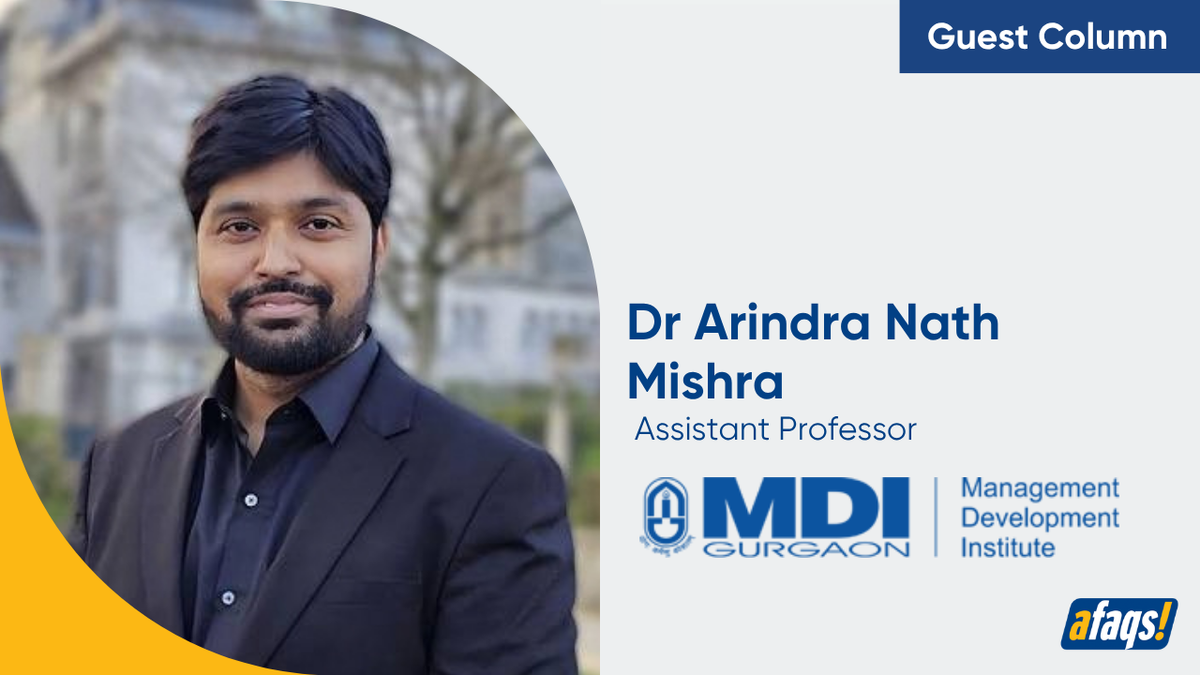
(Dr Arindra Nath Mishra is an award-winning researcher in the field of AI. He primarily works on issues and challenges related to NLP and LLMs. Prior to his academic career, he worked in business analyst roles at IBM and Cartesian Consulting.)







Leave a Reply