
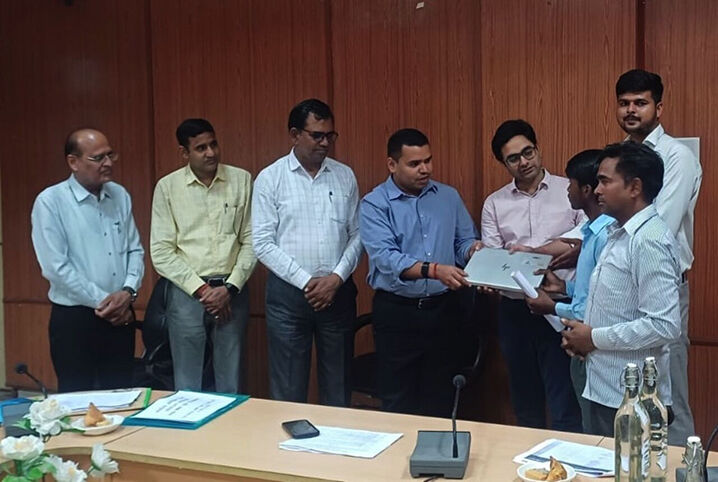
Technology can be a game-changer, be it in administration or education. This is amply being demonstrated in Saharanpur, Uttar Pradesh, under the able guidance of a young District Magistrate.
Mission Prabal is a district-level initiative by the Saharanpur District Administration, in partnership with CodeYogi Foundation (technical implementation) and Safex Group (CSR funding), to equip government school students with practical AI, software development, and professional technology skills. Launched in May 2024, Saharanpur became the first district in Uttar Pradesh to implement a structured, district-wide technology skilling programme for government school students. The programme delivered a 150-hour curriculum entirely through students’ own smartphones, in Hindi, at zero cost to the government, covering Classes 9–12 across all streams.
The District Administration’s Role: Government as Convener
The Saharanpur District Administration approached Mission Prabal not as a sponsorship but as an implementation challenge — using the district’s convening power to bring together technical expertise, CSR funding, and the existing school network around a common objective.
The administration conducted large-scale orientations reaching 146 school leaders and nodal teachers, and worked with school leadership, parents, and students to drive enrolment across all blocks of the district. School heads and teachers were positioned as the first point of contact between the programme and students — ensuring that the initiative was understood, trusted, and adopted at the school level.
A real-time data dashboard was established for school-wise and student-wise progress monitoring — a shift from monitoring inputs (enrolments, coverage) to monitoring outcomes (progression, completion, skill acquisition). The administration also introduced a system of district-level felicitations and recognition events for high-performing students, reinforcing the message that achievement in technology is valued and that government school students can aspire to opportunities traditionally associated with elite institutions.
CodeYogi Foundation provided the curriculum, learning platform, live doubt support, and mentorship. Safex Group provided CSR funding, enabling the programme to operate at zero cost to the district government. InMobi provided laptops for the top-performing students, recognising the calibre of talent emerging from the programme.
Programme Structure
The curriculum spans 150+ hours, organised into modules of 1 to 3 hours each. It begins with the foundations of technology and AI — how software works, how applications are built, and how AI is applied across domains. Students then progress through hands-on exercises where they apply these concepts to build real software. Every assignment is evaluated automatically by the system — a student cannot move forward until they demonstrate competency at the current level. No physical teacher is required for doubt resolution or evaluation; the system handles both. By the end of the curriculum, a student has demonstrable, verifiable skill in creating functional software — including websites, web applications, and more — all learned through their smartphone, in Hindi.
Results (as of February 2026)
The programme has enrolled 18,500+ students across 127 government schools. Of these, 7,222 began writing software, 3,818 completed their first hour of structured learning, and 3,010 can now independently build functional applications. 59% of enrolled students are girls. 95% of all learning was done entirely on smartphones. 18 students have cleared technical interviews and obtained industry certification. Three students have secured software internships.
Students have independently built applications addressing real community problems — blood-donor discovery, women’s and children’s safety, local employment matching, scholarship information, affordable medicine access, and citizen grievance redressal. This shift from learning to problem-solving is among the programme’s most significant outcomes.
Ten of the top-performing students — recipients of InMobi laptops — went on to a clear trajectory shift:
Payal Bhardwaj, a humanities-stream student with no prior exposure to technology, discovered her aptitude through the programme and now works with CodeYogi’s core engineering team in Dehradun on AI engineering projects, while completing her graduation remotely.
Arjun Dhiman enrolled during his first year of BCA after learning about the programme through his school. He is now a full-time member of CodeYogi’s engineering team, working on professional software products.
Himanshu Kashyap, still a school student, has completed an internship, built digital solutions for multiple organisations, and earned revenue from client work. He developed and published an AI-powered app on the Google Play Store that helps students weak in English type confidently. The app has paying subscribers internationally.
Road Ahead
The programme is building structured pathways from foundational digital literacy through advanced AI skills, certification, higher education (including the IIT Madras BS Degree programme for high performers), internships, and employment. The district administration is exploring replication of the PPP model in other districts of Uttar Pradesh, with Mission Prabal as the proof of concept. The long-term objective is to create a pipeline of AI-ready, digitally skilled young people who can contribute to Uttar Pradesh’s goal of becoming a trillion-dollar economy by 2030 — not as job seekers, but as builders.
What has been accomplished in Saharanpur is a wonderful example of Nexus of Good. The model can be replicated and scaled through public-private partnership.
Views expressed are personal. The writer is an author and a former civil servant







Leave a Reply