
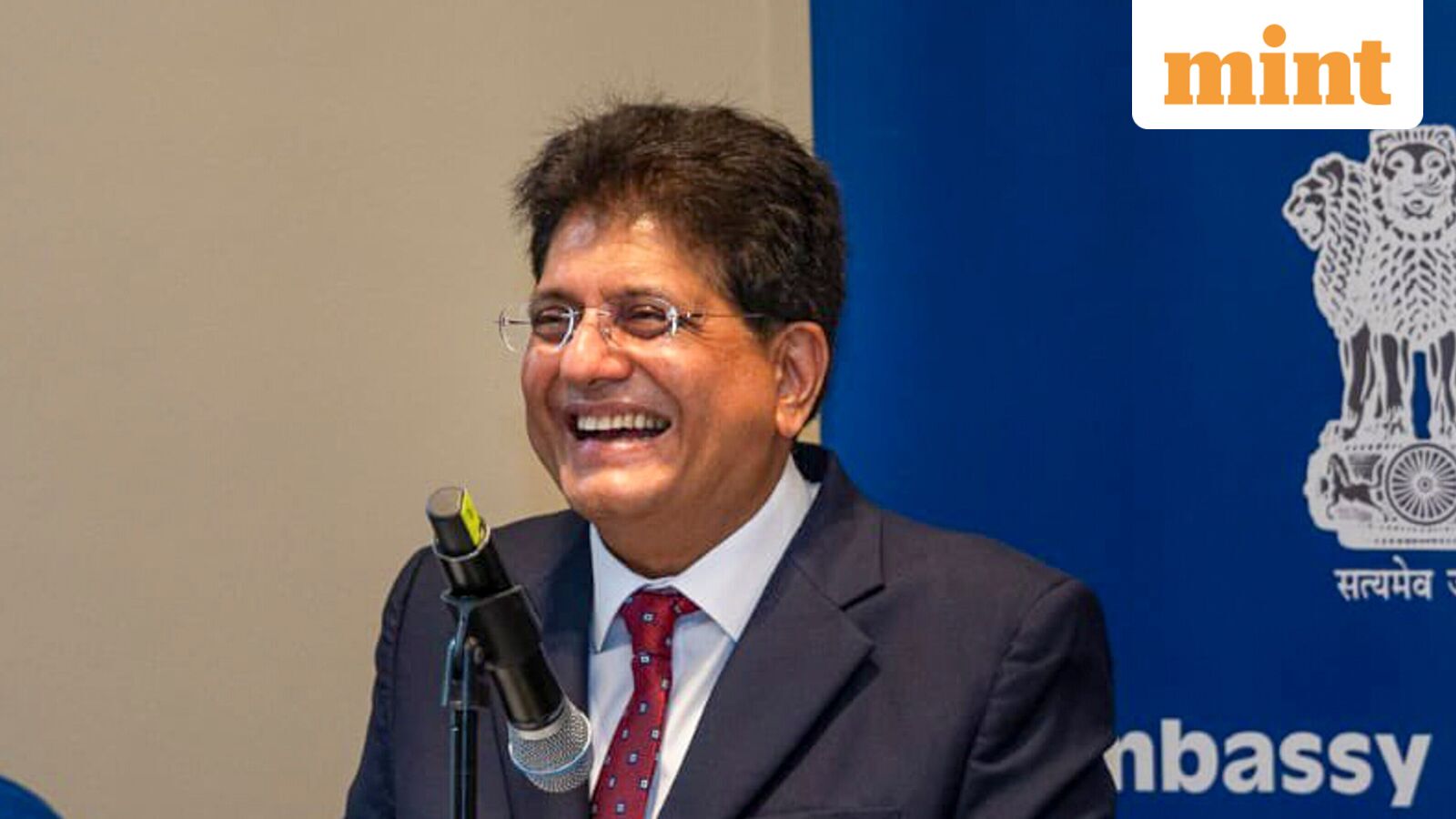
India’s commerce and industry minister Piyush Goyal said that under the proposed trade agreement with the United States, India will get a comparative advantage over other countries and preferential access to the US market.
The development assumes significance amid growing uncertainty in global trade following the ongoing wars in West Asia and Ukraine.
Goyal said in a late Monday night (India time) press briefing, “And in the US also, we will get a comparative advantage from other countries. We will get preferential access. So, now the story has started.”
Goyal had earlier on Monday said India and the United States had concluded most of the discussions and were fine-tuning the proposed trade agreement.
Efforts towards a limited India-US trade deal first began in 2018, during President Donald Trump’s first term, but were put on hold under the Biden administration. Talks were revived last year after Trump returned to office.
Goyal added that concluded trade agreements and those under negotiation would give India preferential access to $85 trillion of the $115 trillion global GDP.
Other trade deals
In response to a Mint query, Goyal said the proposed free trade agreement (FTA) with Chile was at an advanced stage of conclusion, while Mexico was keen to secure an early harvest deal.
He added that good progress was being made on the proposed Comprehensive Economic Partnership Agreement (CEPA) with Canada. Discussions with Mercosur (Mercado Común del Sur, or Southern Common Market) could also be accelerated now that elections in Brazil were over.
Goyal said countries including Ecuador and several in Africa wanted to sign FTAs with India. India has eight trade negotiations underway.
“Egypt has invited us to discuss potentially how we can work more,” Goyal said, adding, “We have just started SACU (Southern African Customs Union) negotiations. So, it may take some time.”
He said negotiations with the Gulf Cooperation Council (GCC), which would add the four other Gulf countries and Israel, could take longer because of the West Asia crisis.
“The GCC (Gulf Cooperation Council), which would add those four other countries of the Gulf and Israel. These negotiations for obvious reasons because of the West Asia crisis may take some time. Though we are ready to speed up negotiations.
These proposed trade deals come in the backdrop of global supply chains getting affected and a global slowdown.
“The Eurasia FTA is only about goods. It doesn’t include services. Hence, we are still assessing the benefits of entering into that agreement,” Goyal said, adding that while many other countries were talking to India and wanted an FTA, “But we also don’t have more bandwidth at the moment.”
Building expertise
In response to a Mint query about building institutional capacity and sectoral expertise for trade negotiations, Goyal said the government had been working to ensure that experience gained in negotiations was retained and used in future agreements.
“Prime Minister Narendra Modi has been very focused on this aspect. That our negotiations and all the learnings and effort that’s going in should not become a one-time affair. And therefore, in the last three years or so, we’ve prepared proper manuals which are a guide like a standard operating practice, SOP, towards proper and organized FTA negotiations. Every FTA that we enter into, we prepare a lot of documentation for future reference and to help guide officers in the future because people keep changing. And lastly, I think Indians are basically smarter.”
“Indian negotiators, Indian officers and our missions all across the world are doing a smart and efficient job to be able to handle so many different engagements simultaneously,” Goyal said.
Trade with China
Goyal added that he hoped India would become a major exporter of goods and services to China and the ASEAN region.
“I have had meetings with my counterpart in Yaoundé (Cameroon), also in Delhi when he had come down for the BRICS summit. And we are open to working and encouraging free and fair trade with every country around the globe. We are looking to open markets in different countries on reciprocal basis for our goods and services also,” Goyal said.
He also pointed to the importance of intermediate goods and raw materials sourced from China.
“They (China) are also providing us important intermediate goods, important raw materials. If in any particular product we find that the fair play or pricing is not proper, then there is an established judicial process which is conducted. Other than that, we believe in the rules of fair play, we believe in the rules of open trade. And across the world, markets are open. Across the world, we welcome suppliers to meet the growing needs of India,” Goyal added.
India’s bilateral trade with China stood at $151.09 billion in 2025-26, comprising imports of $131.62 billion from China and a trade deficit of $112.14 billion, according to data from the ministry of commerce and industry.
Ramita Mishra contributed to the story.
The writer is in The Hague as the guest of the Confederation of Indian Industry.







Leave a Reply