
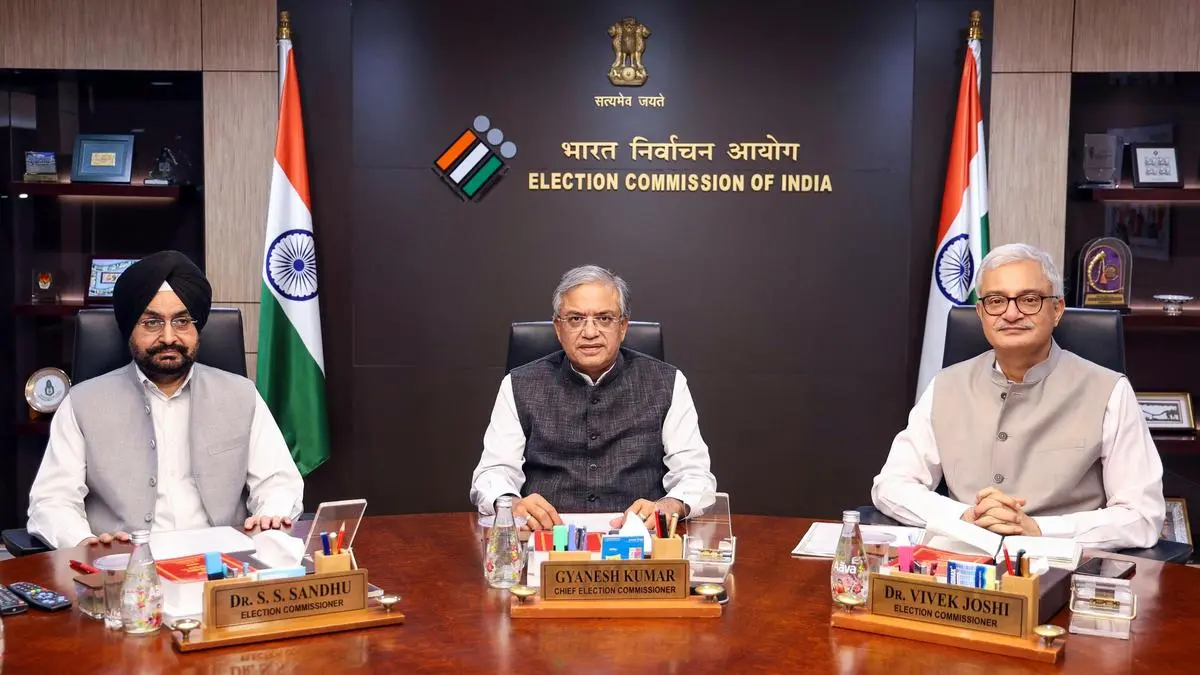
On September 26, the Election Commission of India (ECI) held a meeting of the full commission, following which it issued a detailed press note that listed a number of decisions and also carried a photograph from the meeting of Chief Election Commissioner (CEC) Gyanesh Kumar with Election Commissioners (ECs) Sukhbir Singh Sandhu and Vivek Joshi.
Many of the measures listed in the press note were evidently a course correction undertaken by the ECI in the wake of the political furore over the two ECs having reportedly objected in writing to some significant decisions taken by the poll body with regard to the contentious Special Intensive Revision (SIR) of the electoral rolls. The photograph, meanwhile, was an apparent effort to present a picture of unity in the wake of the reported differences between the CEC and the two ECs over certain SIR-related matters and the way the poll body was functioning.
The slew of measures announced by the ECI on September 26 was only the beginning of a hectic damage-control exercise, with more steps being announced in the days that followed against a backdrop of street protests in which the demands included the resignation of the CEC and a rollback of the SIR.
However, many of the measures announced by the ECI are being seen as an acceptance on its part of the divide within the commission and an affirmation of the issues the two ECs had reportedly raised about the SIR. Some of the decisions mark a curious U-turn for the commission, while others have given rise to more questions about the manner in which the SIR has been conducted.
It is being asked whether the steps rolled out by the ECI are adequate to undo the damage allegedly done by the SIR to the rolls and to the voting rights of the people and also whether they can help the poll body redeem its credibility.
The September 26 press note included several decisions that were seen as an acknowledgment and an attempted resolution of the issues raised by the two ECs. These included the decision that the declaration attached to Form 6 for the SIR would not be in use during the non-SIR period. The press note also said the declaration has been upheld by the Supreme Court. Whether the ECI can bring about changes in Form 6 under the existing laws and the way the changes were affecting young, first-time voters wishing to fill the form to enter the electoral rolls were amongst the issues reportedly raised by the two ECs.
Amongst the decisions announced that day was the setting up of a committee headed by a Senior Deputy Election Commissioner and including an independent expert from IIT/IIIT to review the ECINET, a centralised digital platform meant for use by both citizens and election officials, to double-check that it complies with the provisions of the Acts and Rules and submit its report to the commission. The ECI said that various upgradations of the portal have already been made based on the inputs from the State Chief Electoral Officers (CEOs) in the past few months, and in case any further flexibility is required by the field officers, that will be made operational. The two ECs are reported to have expressed their reservations about the centralisation of the ECINET and the restriction on access to it for the Electoral Registration Officers (EROs).
Also, acknowledging the issues reportedly raised by the two ECs with regard to the ECI’s functioning, the press note said that for all meetings of the commission, the agenda will be circulated in advance and minutes will be issued. It also said the annual performance appraisal reports of all the officers will be completed within the stipulated time frame, that is December 31 every year, approval of the commission will be taken for foreign trips of the officers, and all directions issued by the Commissioners to the officers of the poll body shall be meticulously complied with.
It was also clarified that the two ECs did write to the Cabinet Secretary, but the letter was not related to any policy matter of the commission or the IT division; it was about the working of an officer on deputation to the ECI.
The commission has tried to project a picture of normalcy within the institution and quell the talk about differences between the CEC and the ECs. However, it would not be easy for the ECI to silence its critics as its functioning and decision-making are under intense public scrutiny, with more information coming out about the alleged disagreements.
The RTI reply
For instance, information procured by the transparency campaigner Commodore Lokesh Batra (Retd) from an RTI query made to the Cabinet Secretariat seeking to know what steps it took to address the grievances raised by the two ECs brings out details about the nature of the complaint made by Sandhu and Joshi against the concerned officer and throws light on the commission’s functioning.
The Cabinet Secretariat stated in its response to the RTI query that both the ECs had, through letters dated July 29, 2026, informed the Cabinet Secretary that IAS officer Maneesh Garg, who has been posted as Senior Deputy Election Commissioner in the ECI since September 2, 2024, and was assigned additional charge of the Administration Division on July 28, 2026, had, after taking charge of administration, issued an order regarding work allocation of officers equivalent and senior to him without discussing the revised work allocation with the commission or the officers concerned.
Also Read | The Election Commission’s decade of declining credibility
The two ECs, according to the Cabinet Secretariat’s response, “…have stated that this happened despite repeated oral and written instructions to all concerned officers against taking such actions without prior discussion/approval of the Commission.”
The Cabinet Secretariat desisted from acting in the matter because the communication had been sent not on behalf of the commission but by the two ECs in their individual capacity. As per the RTI response, it did, however, decide to request the CEC for his opinion on this issue.
Before the Supreme Court
The Supreme Court will examine whether the decisions related to the SIR were taken unanimously, by majority view of the commission, or unilaterally by the CEC, because it has agreed to hear petitions on the functioning of the ECI. According to the Chief Election Commissioner and Other Election Commissioners (Appointment, Conditions of Service and Term of Office) Act, 2023, the commission must take decisions as far as possible by unanimity, and if there is a difference of opinion on any matter, it shall be decided according to the opinion of the majority.

Activists take part in a ‘Tiranga Yatra’ demanding the resignation of CEC Gyanesh Kumar over the SIR of electoral rolls in Bengaluru on October 23, 2026.
| Photo Credit:
Shailendra Bhojak/PTI
“The CEC and the ECs were on the same page with regard to the SIR, therefore, the SIR will remain. It is legally sustainable. But the other decisions are under the scrutiny of the hon’ble Supreme Court. And if it is proved that these decisions were taken without unanimity or without participation of all three of them, and the majority view was different, then I think those decisions and the things done after that would be questionable,” said former CEC O.P. Rawat.
The commission has taken some corrective measures with regard to the ECINET in the wake of the recent controversy to bring greater ease for the EROs and AEROs (Assistant EROs) in deciding the cases of voters who have been issued notices during the SIR. However, allegations continue to be made that the ECINET was designed to centralise additions and deletions of voters.
“There are concerns about the ECINET being allegedly used in a centralised manner to bring about changes in the electoral rolls. For example, there are media reports claiming appeals were generated centrally to seek removal of voters cleared by SIR tribunals in West Bengal. There is a need for a proper inquiry into the design and functioning of the ECINET,” said Maj Gen Anil Verma (Retd), head of the Association for Democratic Reforms.
Also, while the ECI said the old Form 6 would be in use in non-SIR states and during the non-SIR period, experts have asked how there can be two different forms for the same task.
While the ECI emphasised that the declaration attached to Form 6 during the SIR has the sanction of the Supreme Court, which upheld the SIR in Bihar through its judgment on May 27, 2026, that claim has been questioned by the ECI’s critics, who say the revised declaration issued for phase two of the SIR in October 2025 and changes made in Form 6 online in July 2026 were not brought before the court.
On October 12, 2026, the Supreme Court clarified that it had neither approved nor disapproved the changes made in Form 6 in its Bihar SIR judgment, which had dealt with the legality of the exercise in the eastern State.
“When the Bihar SIR issue was heard and decided, the new Form 6 was not there. The new Form 6 was neither approved nor disapproved by us. But we will examine it now,” Justice Joymalya Bagchi observed orally while hearing a petition challenging the changes made in Form 6 during the SIR. Justice Bagchi is part of the bench headed by Chief Justice of India (CJI) Surya Kant.
On October 5, the CJI had said in oral observations while hearing a petition challenging the allegedly unilateral decision-making by the CEC that “any modified Form 6 has not been approved by us. Let’s be clear.”
Notices, enrolment, and objections
In the wake of widespread criticism about notices being issued to a substantial percentage of the voters either over “logical discrepancies” or over inability to link themselves or their parents to the previous SIR, the ECI announced on September 26 that the Booth Level Officers (BLOs) would visit the homes of people who have received notices instead of these people having to come for hearings.
On September 29, apparently aiming to deal with the charge made by opposition parties as also civil society that the SIR had resulted in mass disenfranchisement, the ECI issued instructions to the CEOs of all the States and Union Territories (UTs) to carry out a special drive to enrol voters who were left out during the SIR as also first-time and young voters.
However, there continues to be immense criticism about making existing voters who were deleted from the rolls during the SIR fill up Form 6 as new voters during the enrolment campaign. Critics say these voters are making a false declaration in Form 6 about not having been in the list before, which is a punishable offence.
“There are penal consequences to making a false declaration in Form 6. The people should be allowed to tell the ECI that your BLO (Booth Level Officer) marked me wrongly because of which my name was removed from the list, and I should not be made to fill Form 6 and make a false declaration saying that I have never been on any electoral roll,” said Sagrika Rajora, lawyer-activist and co-founder of Voter Adhikar Manch.

A Booth Level Officer hands over an enumeration form to residents of RT Nagar during the Special Intensive Revision of electoral rolls in Bengaluru on July 3, 2026.
| Photo Credit:
Allen Egenuse J/ The Hindu
In the wake of reports about large-scale misuse of Form 7 to delete voters in a targeted manner during the claims and objections period of the SIR, the commission issued fresh guidelines on October 9, placing a limit on the number of Form 7 applications that can be submitted by an individual voter.
Earlier, there was no cap on the number of Form 7 applications an individual voter could file, while there was a limit on the number of Form 7s that Booth Level Agents of political parties could submit during a day as well as during the entire claims and objections period.
Verma said large-scale misuse of Form 7 during the SIR took advantage of the lack of a limit on the number of Form 7s a voter could submit. He also said that the commission needs to ensure that Form 7 applications go through proper verification. “The ECI failed to take adequate measures despite the early warnings,” he said.
Summary revision and rolls
Then, on October 15, the commission announced the much-delayed Special Summary Revision (SSR) of the electoral rolls in 14 States and 3 UTs where the SIR has been completed. And much in contrast to its firm stand in the past against providing machine-readable voter lists to the political parties, it said the draft and final lists during the SSR would be provided in PDF format to the parties at no cost.
The SSR, an annual exercise since 1958, had not been held since the Lok Sabha elections in 2024. It was on pause while the SIR was conducted across the country. The SSR involves updating the electoral rolls with the addition of newly eligible voters and deletion of those who have passed away or have shifted, with January 1 as the qualifying date. The ECI had come in for criticism for the delay in carrying out the SSR, with critics saying this was affecting the voting rights of the youngsters who had just turned 18 or were about to turn 18.
Also Read | Decoding the dissent inside ECI
On sharing machine-readable voter lists, a long-pending demand of opposition parties, the ECI had earlier said that it was prohibited by a judgment of the Supreme Court. The CEC had, while addressing a press conference on August 17, 2025, said, “We have to understand the difference between a machine-readable voter list and a searchable voter list. You can search the voter list available on the Election Commission website by entering the EPIC [Electors Photo Identity Card] number. You can also download it. This is not called machine-readable. Regarding machine-readable, in 2019, the Supreme Court also studied this subject in depth and found that giving a machine-readable electoral roll can violate the privacy of the voter.”
The decisions on the SSR and machine-readable lists are seen as an effort to address the grievances of the opposition parties. However, the parties in the anti-BJP bloc have said that the U-turn by the ECI on these issues would not be enough to absolve the CEC of alleged wrongdoing.
The ECI’s damage-control measures leave many issues unaddressed. They have also not silenced its critics who are demanding that accountability be fixed for the controversial SIR.






Leave a Reply