
If you’ve been in the digital marketing space for long enough, you’ve seen the rules rewrite themselves more than once. The shift from last-click attribution to multi-touch models. The rise of programmatic, agentic buying. The slow death of third-party cookies. Each wave reshaped what it means to spend a marketing dollar intelligently.
Well, we’re in the middle of another wave right now.
Performance marketing in 2026 looks meaningfully different from what it looked like even two years ago. For one thing, AI is no longer just a feature… it’s the infrastructure. And the definition of “performance” itself is expanding to include signals that previously weren’t even on the radar.
This article breaks down what performance marketing actually is, how to measure it properly, and the six trends that are defining marketing performance insights and analysis heading into the rest of the year.
What Is Performance Marketing?
Performance marketing is a results-first approach to digital advertising in which brands only pay (or measure success) based on specific, predefined outcomes. Clicks, leads, app installs, purchases, form completions: the defining characteristic is that spend is tied directly to some action a user takes.
Unlike brand advertising, which prioritizes awareness and reach over trackable conversions, performance marketing runs on accountability. Every campaign has a clear cost-per-acquisition (CPA) target, a return on ad spend (ROAS) goal, or a conversion rate (CVR) benchmark. Budgets only increase if performance is achieved.
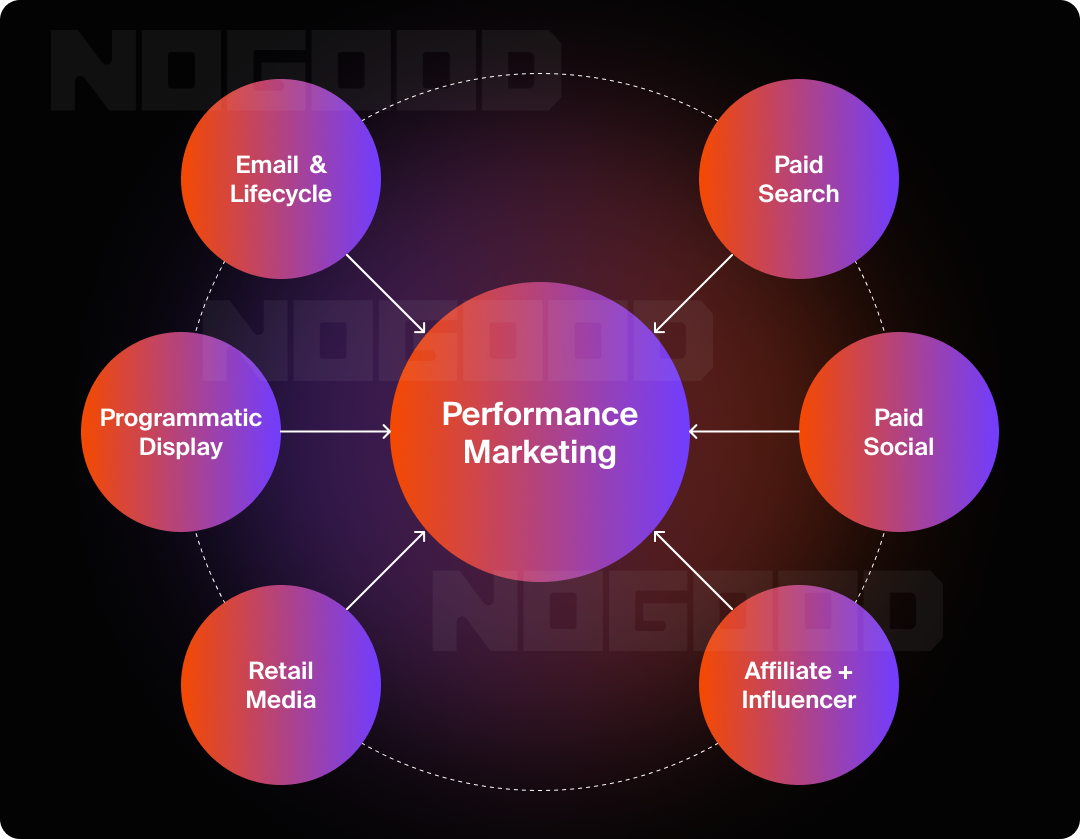
In practice, performance marketing typically spans the following digital channels:
The channel mix varies widely by brand and industry: a B2B SaaS company optimizing for demo requests runs very different campaigns than a DTC brand chasing ROAS on Meta. The underlying discipline, however, is the same: spend money on what works, cut what doesn’t, and let data drive decision-making.
What Role Does Analytics Play in Performance Marketing?
Analytics for performance marketing is the practice of collecting, interpreting, and acting on the data generated by your campaigns. It’s the connective tissue between what you’re spending and what you’re actually getting for it.
At its simplest, performance marketing analytics answers three questions: What happened? Why did it happen? What should we do differently?
That progression, from reporting to diagnosis to optimization, is what separates teams working off of real insights versus those who are just pulling numbers.
In practice, performance analytics is comprised of several layers:
- Channel-Level Reporting: Metrics by platform (clicks, impressions, CTR, spend, CPC, conversion rates, etc.)
- Attribution Modeling: Understanding which touchpoints in the customer journey deserve how much credit for a conversion (first click, last click, linear, data-driven, incrementality-based, etc.)
- Audience Analysis: Breaking down performance by segment (demographics, device type, geography, intent signal) to find where efficiency is greatest
- Incrementality Testing: Measuring the true lift of campaigns, beyond the conversions that would have happened anyway, marketing or not
- Predictive Analytics: Using historical performance data to forecast future outcomes and model budget scenarios
Most sophisticated teams today use a combination of native platform dashboards (Google Ads, Meta Ads Manager), business intelligence tools (Looker, Tableau, Google Looker Studio), and CDPs or data warehouses (Segment, BigQuery) to stitch together a complete picture of performance marketing insights and analysis.
How Do You Measure Marketing Performance?
Measuring performance in marketing requires more than installing a tracking pixel and watching conversions roll in. It requires a clear measurement framework that connects campaign activity to business outcomes, and the ability to distinguish signal from noise.
The foundation of any measurement approach is defining what success looks like before a campaign launches. That means establishing:
- Primary KPIs (the metrics that directly reflect your business goal)
- Secondary KPIs (diagnostic metrics that help explain why primary KPIs are moving)
- Guardrail metrics (indicators that tell you if something is going wrong: rising CPAs, declining quality scores, audience fatigue)
What Are Key Performance Indicators for Marketing?
The most commonly tracked KPIs in performance marketing fall into four categories:
- Efficiency Metrics: CPA (cost per acquisition), CPL (cost per lead), CPC (cost per click), ROAS (return on ad spend). These tell you how efficiently your budget is driving results.
- Volume Metrics: Total conversions, leads generated, revenue attributed. These track whether you’re hitting actual targets, not just efficiency benchmarks.
- Quality Metrics: Lead-to-opportunity rate, MQL-to-SQL conversion, customer lifetime value, churn rate (post-acquisition). These connect top-of-funnel activity to bottom-of-funnel outcomes and are especially important for B2B and subscription businesses where volume without quality is practically useless.
- Engagement Metrics: CTR, landing page conversion rate, time-on-site, scroll depth. These are diagnostic; they tell you where friction exists in the user experience and how to make the journey to conversion more seamless.
The mistake many teams make is treating efficiency metrics (or, more typically, a combination of efficiency and volume metrics) as the only ones that matter. A campaign that drives low CPAs but generates leads that never convert to closed deals isn’t actually performing, it’s optimizing for the wrong variable.
Marketing performance insights become genuinely useful when they connect the dots to show the full picture of paid media’s effect on overall business goals.
What Is the Relationship Between Performance Marketing & SEO/AEO?
The line between performance marketing and SEO (and now AEO) is getting less clear, and smart teams are treating them as complementary versus separate disciplines.
Performance marketing traditionally refers to paid channels where you can directly control spend and directly attribute outcomes to specific campaigns.
SEO, though, is an earned channel: you invest in content, technical infrastructure, and authority-building, and the returns compound over time but aren’t tied to a per-click spend. Its cooler, younger cousin, AEO (Answer Engine Optimization) takes the same approach, but optimizes for LLMs versus traditional search channels.
Despite this distinction, the goal is the same from a business outcome perspective: get the right person to the right page at the right moment, at an acceptable cost. Many of the best-performing marketing programs treat paid and organic as an integrated demand generation system (using paid search data to inform SEO keyword priorities, and organic content performance to improve paid landing page quality scores, for example).
The emergence of AEO (Answer Engine Optimization) is further blurring the line, creating a third channel that requires both content quality and technical precision.

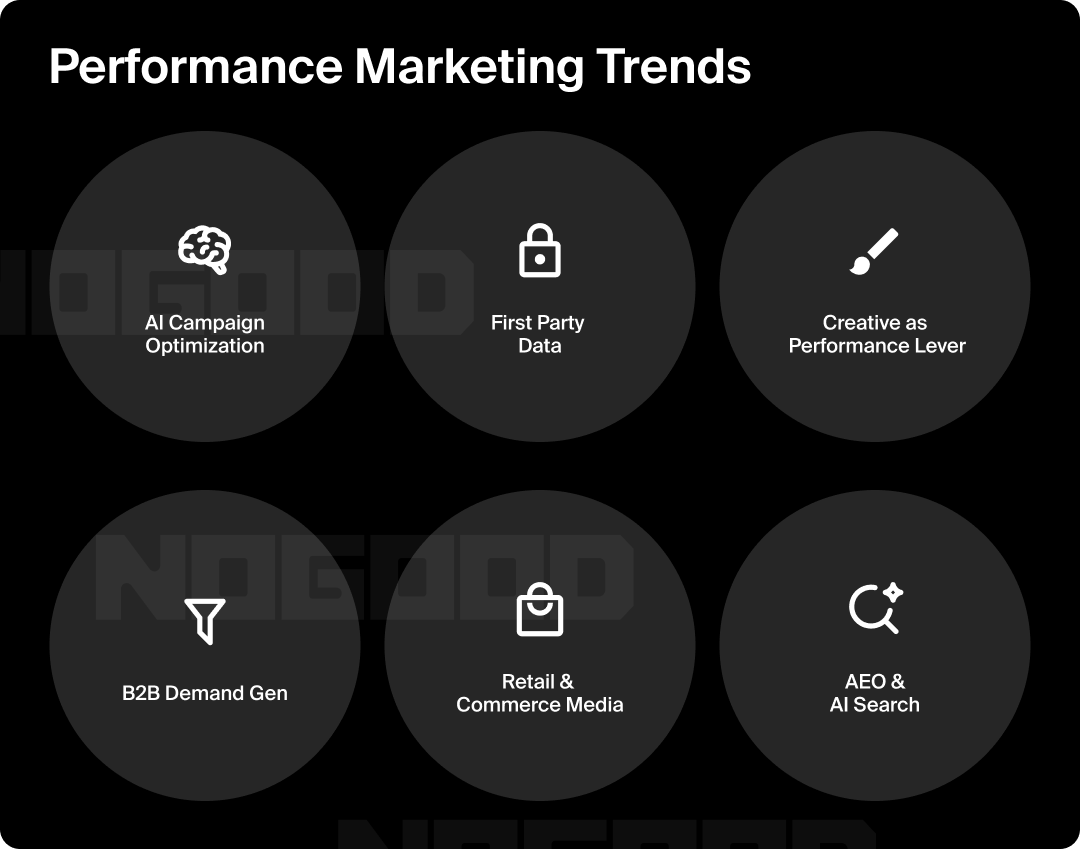
6 Performance Marketing Trends Defining 2026
With the foundations established, here’s where performance marketing is actually heading… and what the most forward-looking teams are already doing about it.
Trend 1: AI Campaign Optimization Is Table Stakes, but Human Judgment Is Increasingly Necessary
Every major ad platform has spent the last two years pushing automated bidding and AI campaign management. Google’s Performance Max. Meta’s Advantage+ campaigns. The pitch is compelling: let the algorithm handle targeting, bidding, and creative rotation, and it will outperform manual management at scale.
The reality is more nuanced. Marketers who handed everything to the algorithm in 2023 and 2024 often saw initial efficiency gains followed by plateau, because AI tools optimize ruthlessly for the signals you give them, and if those signals don’t fully reflect business value, the optimization runs in the wrong direction.
A common scenario: Performance Max campaigns that hit CPA targets but cannibalize branded search, inflate assisted conversions, or flood a CRM with low-quality leads.
The teams generating the best marketing performance insights right now are the ones who’ve figured out how to work with AI tools rather than simply deferring to them. That means:
- Feeding platforms richer conversion signals (offline conversion data, lead quality scores from CRM integration, LTV-weighted conversion values) so that automated systems optimize toward revenue, not just conversion volume.
- Maintaining human oversight on creative strategy, audience segmentation, and budget allocation decisions that require business context the algorithm doesn’t have.
The opportunity in 2026 isn’t a decision between all-AI or all-human judgment. It’s building workflows where each does what it’s actually good at, AI acting as a supplementary tool used strategically.
AI Campaign Management: Automation vs. Human Oversight
|
✅ Dynamic Bidding |
✅ Business Goal Alignment |
|
✅ Audience Targeting |
✅ Signal Quality |
|
✅ Creative Strategy |
|
|
✅ Budget Philosophy |
Trend 2: Signal Loss Is the Defining Constraint & First-Party Data Is the Only Real Answer
The third-party cookie deprecation that the industry spent years debating is now an operational reality in most browsers. Apple’s SKAdNetwork has been reshaping mobile attribution for several years. And while Google ultimately preserved cookies in Chrome after a prolonged back-and-forth, the broader trajectory toward privacy-first infrastructure is clear and irreversible.
For performance marketers, this means that the visibility you once had into the customer journey (aka, following a user from first ad exposure through several retargeting touchpoints to final purchase) is degraded at almost every stage. Retargeting pool sizes have shrunk. Cross-device attribution has more gaps. Platform-reported conversion data diverges increasingly from what analysts see in GA4 or backend systems.
The teams navigating this best have made first-party data infrastructure a strategic priority, not just a technical project. That includes:
- Implementing server-side tagging and Conversions API integrations (Meta CAPI, Google Enhanced Conversions) to recover signal loss at the browser level.
- Building email and SMS programs that provide durable first-party identifiers.
- Investing in CDPs like Segment or Klaviyo to unify customer data across touchpoints so that audience segmentation doesn’t depend on third-party behavioral data.
This shift also changes what great marketing data insights and performance analysis look like. Teams that were previously reading pixel-based attribution data need to become comfortable with modeled conversions, incrementality tests, and media mix modeling; probabilistic approaches that acknowledge realistic measurement uncertainty.
Trend 3: Creative Is the Primary Performance Lever on Paid Social
Ask any performance marketer where they’re spending the most time in 2026, and a significant portion will say creative. The shift is driven by platform changes that have narrowed the gap in targeting sophistication between advertisers. When everyone has access to Meta’s Advantage+ audiences or TikTok’s interest targeting, the differentiator becomes what you put in front of those audiences, not who you’re targeting.
AI is changing creative production meaningfully as well. AI image and video generation tools have dramatically lowered the cost of producing variations at scale, allowing for faster iteration cycles that surface winning concepts in days versus weeks. The constraint is shifting from production bandwidth to creative ideation and judgment: knowing which concepts are worth creating and testing in the first place.
For performance teams, this means building tighter integration between creative and analytics: tracking creative performance at the element level (hook, body, CTA), feeding platform signals back into creative briefs, and treating the creative testing backlog as a strategic asset.
Trend 4: The B2B Funnel Is Breaking; Demand Gen Replaces Lead Gen
For years, B2B performance marketing was organized around a single goal: generate leads. Fill the CRM with MQLs, hand them to sales, and let the pipeline work. Volume was the metric. The more contacts you could acquire at a tolerable CPL, the better.
That model is breaking down. Buyers increasingly research independently before ever engaging with sales; according to Gartner, B2B buyers spend only 17% of their total buying journey actually talking to potential suppliers. By the time a lead form gets filled, the decision has often already been shaped by content, community, word-of-mouth, and brand perception built over months.
The performance marketing response to this shift is the demand generation model: creating awareness, trust, and preference before the buyer is in active evaluation mode. In practice, this means:
- investing in content that reaches buyers earlier in the funnel (thought leadership, educational content, category-level problem framing).
- Building distribution through channels like LinkedIn and newsletters that create repeated exposure.
- Measuring success with pipeline metrics (opportunities created, pipeline influenced, revenue closed) rather than just raw lead volume.
This creates measurement challenges that teams are still working through. How do you attribute a closed deal to a LinkedIn post that a prospect read six months ago? The honest answer is: incompletely, and with models.
The better question is whether you’re seeing the downstream quality signals (demo-to-close rates, sales cycle length, average contract value) improve as your top-of-funnel content improves. That’s where the real marketing performance insights live.

Trend 5: Retail Media & Commerce Media Are Reshaping the Performance Landscape
Retail media networks (advertising ecosystems built by retailers on top of their own first-party shopper data) have grown from a niche tactic to a major performance channel in less than three years. Amazon Advertising is the obvious leader, but Walmart Connect, Target’s Roundel, Instacart Ads, and dozens of other retailer-owned networks are now key channels for consumer brands.
The appeal is straightforward: retail media allows brands to reach buyers at the bottom of the purchase funnel, with targeting based on actual purchase behavior. A snack brand can target people who recently bought competing products, and a skincare brand can reach shoppers who previously purchased in the category. The signal quality is high because it’s grounded in actual, first-party transaction data.
For performance marketers, retail media introduces new complexity:
- Different measurement frameworks (in-store sales lift vs. online conversion, closed-loop attribution through retailer data)
- Different creative specifications
- Different bidding mechanics than traditional Paid Search or Social
The teams doing this well are building dedicated retail media competencies, instead of treating it as an extension of existing Paid Search programs.
eCommerce and DTC brands should also be watching commerce media trends more broadly: the integration of shoppable content formats into platforms like TikTok Shop and Instagram Shopping creates new performance marketing surfaces where content and commerce intersect in ways that traditional channel taxonomies don’t capture as well.
Trend 6: AEO Is the Next Frontier of Performance Search
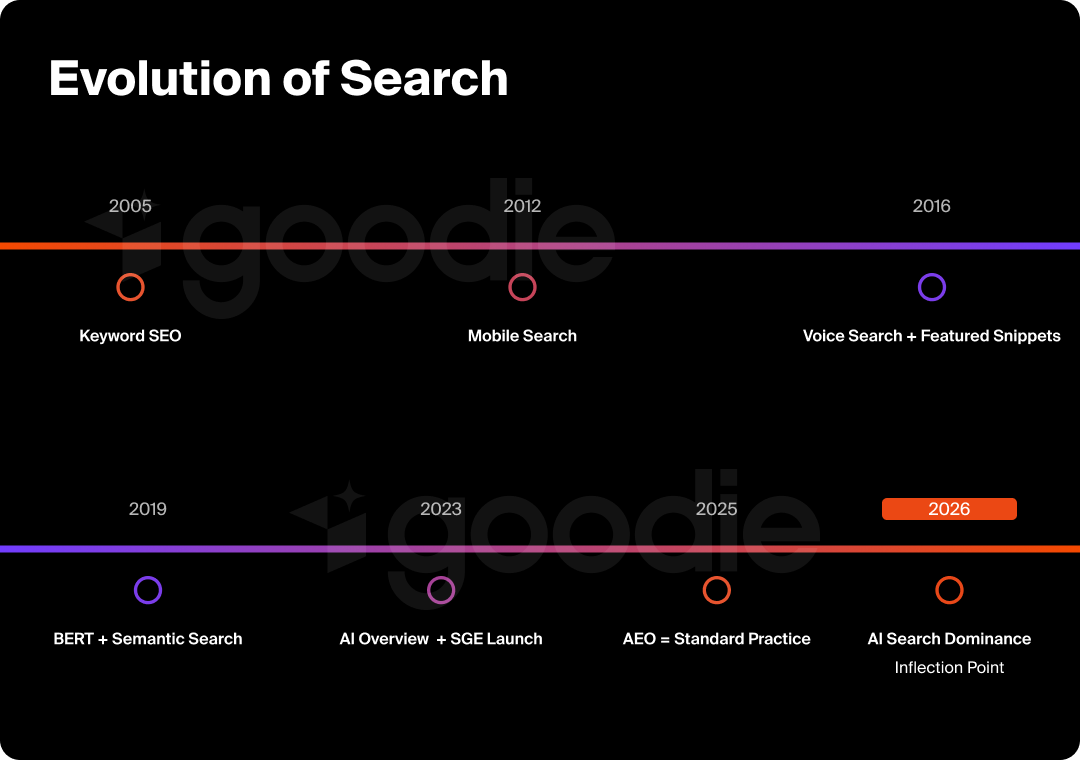
Answer Engine Optimization is no longer speculative (if you’ve been following this blog for a while, you should know that). With AI Overviews now appearing for 55% of Google searches, and tools like Perplexity and ChatGPT becoming primary research starting points for educated buyers, the organic search landscape is being restructured in real time.
For performance marketers, this matters for two reasons:
- First, AEO affects organic visibility and traffic quality in ways that influence paid media efficiency. If your brand is cited as a trusted source in AI answers, that influences purchase intent before a buyer ever clicks a paid ad.
- Second, AEO is creating new thinking about what SEO content should accomplish: not just ranking for a keyword, but being structured as a clear, authoritative answer to a specific question.
The content formats that perform well in AEO environments: well-structured definitional content (“What is X?”), comparison content (“X vs. Y”), step-by-step process explainers, and content with clear, citable data points. Notably, these formats also tend to perform well for voice search and featured snippet capture, so AEO frequently reinforces traditional SEO instead of competing with it.
Teams that are building AEO into their content strategy now are positioning themselves to capture early-funnel influence at the exact moment when buyers are formulating their understanding of a category (before they’ve decided what terms to search, what vendors to evaluate, or what questions to ask).
Putting It Together: What Good Performance Marketing Looks Like in 2026
The theme across all six trends is the same: the performance marketer’s job has gotten more complex. AI handles more of the execution, but requires better inputs. Privacy constraints demand stronger first-party data infrastructure. Creative has become a primary competitive lever. Attribution models require more sophistication. And new channels (retail media, AEO, AI Search) require teams to explore unfamiliar territory to remain competitive.
All of that to say, however, the marketers who produce the best marketing performance insights and analysis are the ones who’ve internalized a few principles that hold true regardless of which platforms or trends are dominant at any given moment:
- Connect spend to revenue, not just conversions. A low CPA that produces low-quality leads is not an effective growth engine.
- Treat measurement as a strategic capability. The team that understands what its data actually means (not just what the dashboard shows) has a durable competitive advantage.
- Build for signal quality, not volume. First-party data, enriched conversion signals, and incrementality testing are the infrastructure of sustainable performance programs.
- Test faster than the competition. In a landscape where AI is democratizing execution, learning velocity is the differentiator.
The Bottom Line
Performance marketing has always been about accountability: spend money where it delivers returns, and be honest about where it doesn’t. What’s changed is the complexity of the environment in which that discipline has to operate: more channels, more AI, less signal clarity, higher creative competition, and buyers who complete most of their journey before ever talking to your team.
The strongest performance marketing insights won’t necessarily come from the biggest budgets or the most advanced tech stacks. They’ll come from being relentlessly clear on what business outcomes are being optimized for, honest about the limitations of campaign measurement, and systematic about learning faster than the landscape changes.
That combination of strategic clarity, measurement rigor, and learning velocity is what performance marketing looks like in 2026.