

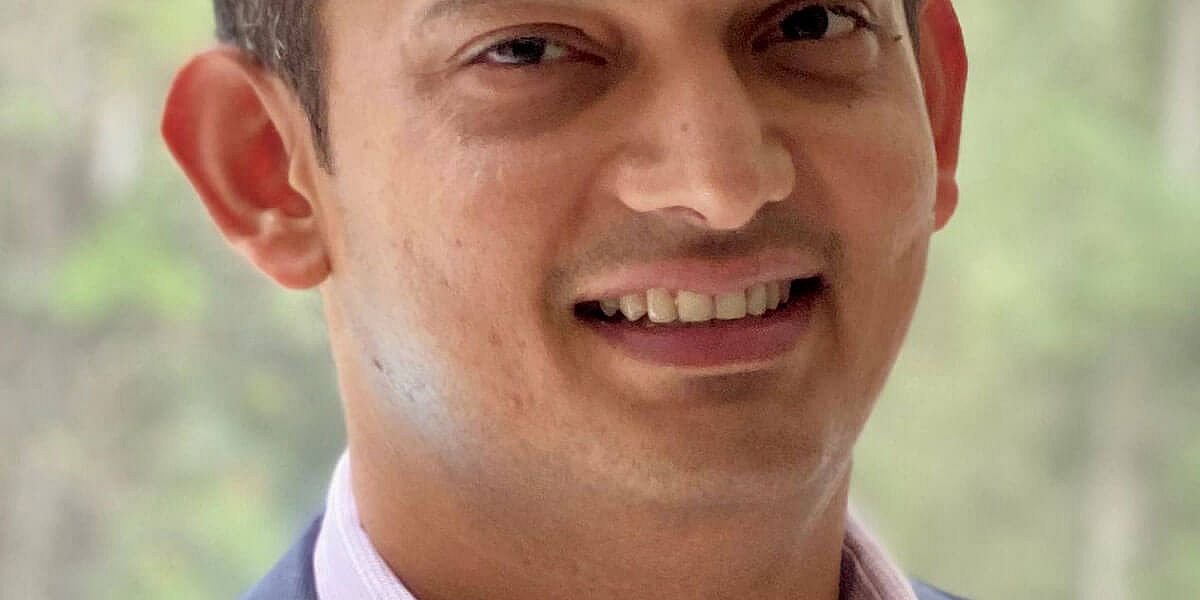
IU Bloomington’s Faculty 100 initiative has brought more than 70 new tenured or tenure-track faculty members to campus since it launched in fall 2022 and remains on track to reach 100 by 2027.
Their work spans strategic areas including microelectronics, artificial intelligence, quantum science and health sciences. To date, Faculty 100 scholars have collectively contributed to nearly 300 proposals seeking more than $230 million in new external funding, with nearly $40 million awarded.

Before joining IU, Shah directed the Artificial Intelligence Research Laboratory for Secure and Efficient Systems, and he previously conducted research at Lawrence Livermore National Laboratory and George Mason University’s Center for Secure Information Systems. He also has more than nine years of information technology and security industry experience, including roles in software engineering and executive leadership.
IU Today recently caught up with Shah to ask him about his research, working at IU Bloomington and being part of the Faculty 100 initiative.
Q: In two to three sentences, how would you describe your current research focus and its importance?
A: My research focuses on developing AI-enabled methods for cybersecurity and security and defense applications, with particular emphasis on autonomous and multi-agent AI systems, reinforcement learning and secure and trustworthy AI. My work seeks to improve how organizations and mission-critical systems identify, respond to and adapt to emerging threats while ensuring that increasingly autonomous AI systems themselves remain reliable and resilient. This research is increasingly important as AI becomes more deeply integrated into cybersecurity operations and high-consequence decision-making.
Q: Are there interdisciplinary research opportunities or collaborations you would like to pursue at IU Bloomington? Any specific departments, centers or fields you’re excited to partner with?
A: I am particularly interested in collaborations that bring together AI, cybersecurity, decision sciences, engineering, public policy and human-centered research. At IU, there are strong opportunities to work with colleagues in the Luddy School of Informatics, Computing and Engineering, the Center for Applied Cybersecurity Research, the Luddy Artificial Intelligence Center, and researchers across the Kelley School and other units working in security, policy, critical infrastructure and national security. These collaborations could help create shared research environments for studying secure AI and developing technologies for complex civilian and defense applications.
Q: What is a recent project, award or publication you’re proud of, or a current project you’re working on?
A: One current project I am particularly excited about involves developing multi-agent AI systems for tactical cyber defense, where autonomous agents must coordinate, reason and adapt to rapidly changing threats. The work builds on my broader research in reinforcement learning, generative AI and adversarial evaluation and is part of a research portfolio supported by multiple defense research organizations, including DARPA and the U.S. Army. Ultimately, the goal is to develop AI systems that can augment human decision-making while remaining robust under adversarial and uncertain conditions.
Q: How has being part of Faculty 100 impacted your view of IU and your work here?
Being part of Faculty 100 has reinforced my view of IU as a university where ambitious interdisciplinary research can grow across traditional academic boundaries. The initiative has created opportunities to connect with researchers working in AI, cybersecurity, engineering, policy and other fields, and has highlighted the breadth of expertise available across the Bloomington campus. I see particular potential for building research efforts that bring these strengths together around large, externally funded challenges in AI, security and defense.
Q: What is something people should know about you, either in terms of inspiration for your research or personal interests?
A: Much of my research perspective comes from having worked across industry, a national laboratory and academia. With more than nine years of industry experience as well as research experience at Lawrence Livermore National Laboratory, I am especially motivated by problems where advances in AI can move beyond theoretical performance and help people make better decisions in real operational environments. This combination of practical and academic experience continues to shape my interest in developing AI systems that are capable, as well as secure, resilient and useful.
This is part of a series of Q&As highlighting Faculty 100 scholars and the research, creative activity and collaborations they are advancing at IU Bloomington.















Leave a Reply